


TL;DR
- AI in test automation is real in a few places and oversold in most. It earns its keep on test design, maintenance, and flaky-failure reduction.
- The honest wins are maintenance and stability, because that is where QA teams lose the most time. Around 40 percent of QA capacity goes to maintaining existing tests.
- The theater is “AI writes and runs all your tests on its own.” Fully autonomous testing is a demo, not a release process you can sign off on.
- Nondeterministic AI output is a trap in testing, because a test that changes its own behavior is a flaky test by design.
- The useful pattern is deterministic. Generate a verified specification of how the app behaves, then produce a stable test suite from it.
- Honest caveat: AI lowers the cost of building and maintaining tests. It does not replace the judgment about what to test and what “correct” means.
Every QA team is being told that AI will write its tests, fix its tests, and run its tests while everyone sleeps. Meanwhile the real problem on the ground has not changed. Tests break when the UI changes, maintenance eats the week, and coverage never catches up to the release schedule. Around 40 percent of QA capacity goes into keeping existing tests alive, before anyone writes a new one.
AI can help with that. It is already doing so in production QA teams. The trick is knowing which claims are backed by a working mechanism and which are a slide in a pitch deck. This page is the honest map. It covers where AI genuinely moves the needle in test automation, where it does not, and how to tell the difference when a vendor shows you a demo.
What is AI in test automation?
AI in test automation is the use of machine learning and generative models to help create, maintain, or run automated tests, rather than relying only on hand-written scripts. In practice it shows up in four places: generating tests from an application or a spec, repairing broken element references, prioritizing which tests to run, and flagging likely-flaky or redundant tests. Each of those is a specific, checkable capability, so treat “AI-powered” as a question, not an answer.
Where does AI genuinely help?
AI helps most where the work is repetitive, pattern-heavy, and expensive to do by hand. That is test maintenance, element identification, and triage, not the judgment calls about what a feature should do. These are the capabilities with a real mechanism behind them, and they are the ones worth paying for.
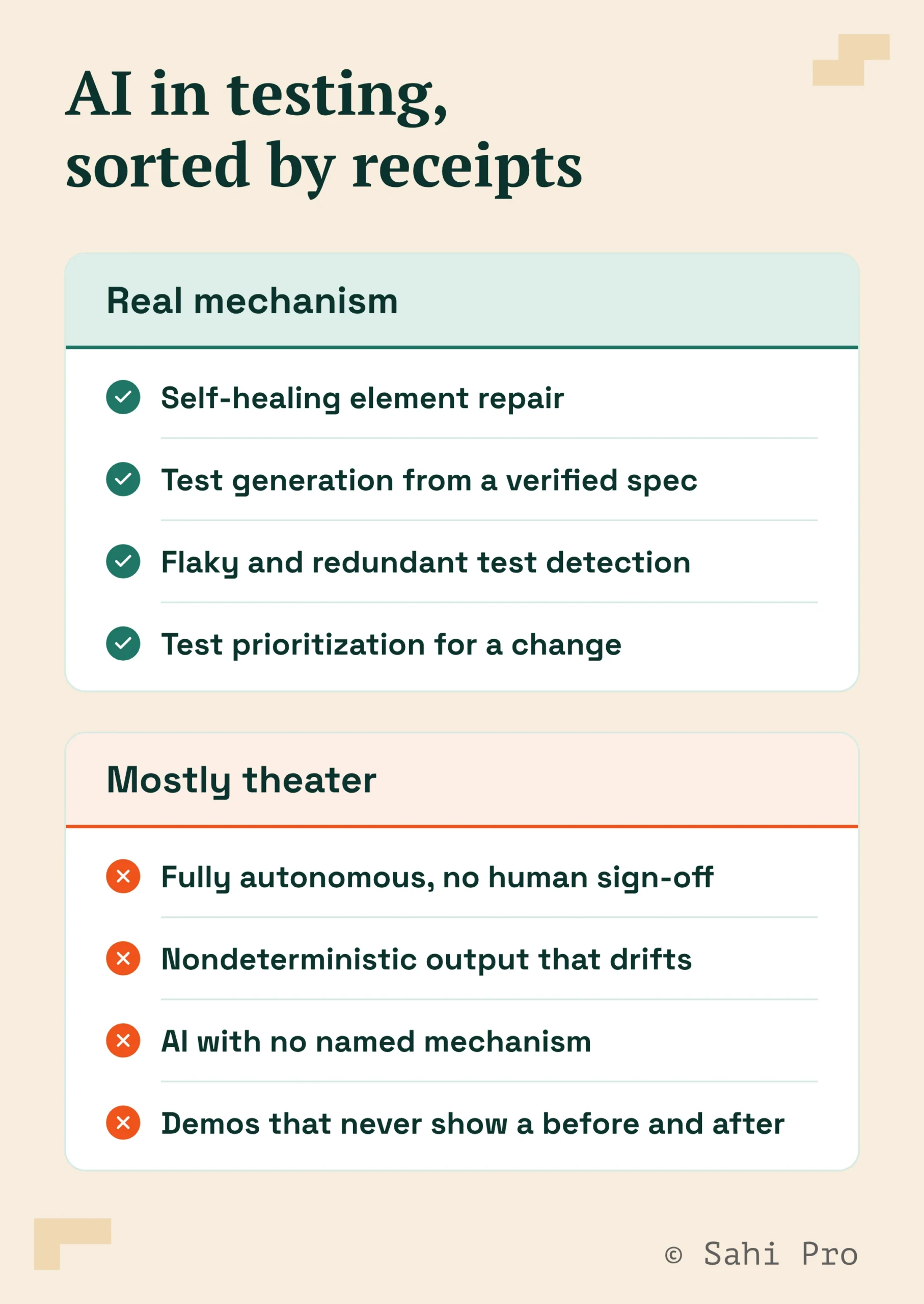
The capabilities that hold up:
- Maintenance and self-healing. When a locator breaks on a UI change, the tool relocates the element from its stable attributes and relationships instead of failing. This is the single biggest time sink AI can remove.
- Test generation from behavior. AI can read an application or a verified specification and produce a test suite, which cuts the hours spent authoring scripts by hand.
- Flaky and redundant test detection. Models can spot tests that fail intermittently or duplicate coverage, so teams fix or retire them instead of rerunning them.
- Test prioritization. AI can rank which tests to run for a given change, which shortens feedback in large suites.
Where is AI mostly theater?
The oversold claim is full autonomy, that AI will explore your app, decide what matters, write the tests, and own the release gate without a human in the loop. That is a compelling demo and a poor release process, because someone still has to define what “correct” means and stand behind the sign-off. Treat any pitch that removes the human from that decision as marketing.
The second trap is nondeterminism. A generative model that produces a slightly different test or a different result each run has built flakiness into the tool itself. In testing, the same input must give the same result every time, or the suite cannot be trusted. An AI feature that cannot guarantee that is adding noise, not removing it. Everyone claims AI. The question to ask is whether they can show the same test passing the same way a hundred times.
The maintenance problem AI should solve
The clearest, most honest use of AI in testing is killing maintenance, because maintenance is where the hours go. Sahi Pro identifies elements by relationship and context, by the label beside a field or the text on a button, so a test survives a UI change instead of breaking. That is the mechanism behind self-healing, and it is engineering rather than a buzzword.
The result is a maintenance reduction of 80 percent against conventional tools. In a benchmark that rebuilt a brittle Selenium suite across equivalent scenarios, maintenance effort dropped from a score of 89 to 27, and coverage rose from 23 scenarios to 144 with the same team. Sahi Pro’s engine is proprietary and not built on Selenium or Appium, which is why it can read the page relationally and wait for the application on its own.
Deterministic AI: how Atlas generates tests
The useful way to apply generative AI to testing is to make it deterministic, and that is what Atlas does. Atlas builds a verified specification of how the application actually behaves, then generates a test suite from that specification. The AI is used to understand the application and draft the spec. The suite that runs is deterministic, so it behaves the same way every time.
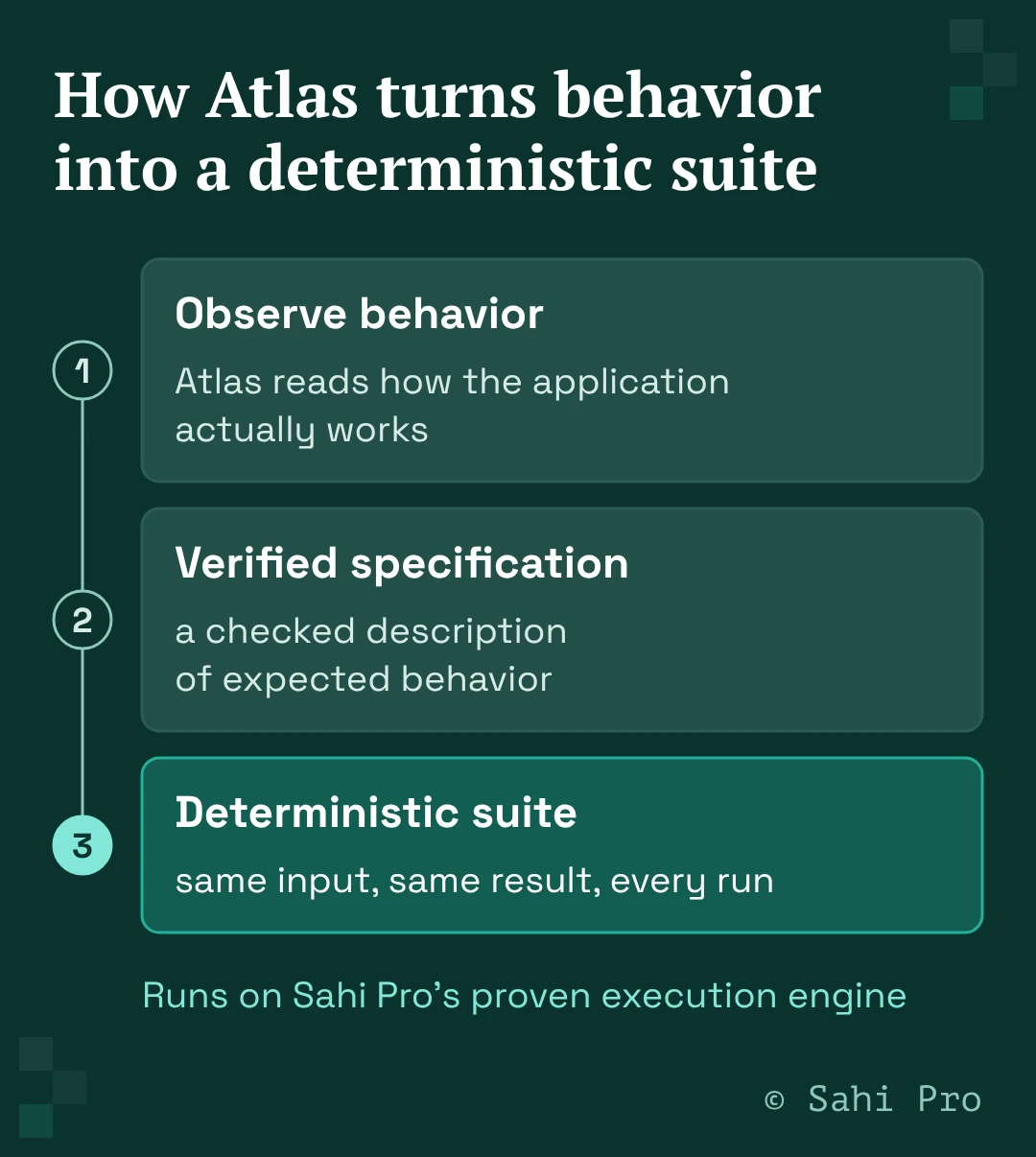
This matters because it inverts the usual genAI problem. Instead of a model improvising test code that drifts, the model produces a checked description of behavior, and a stable engine executes against it. Teams reach productivity in about two weeks with no certification required, because the authoring burden moves from writing scripts to confirming a specification. Atlas sits upstream of Sahi Pro’s execution engine, so the design studio and the proven runtime are one pipeline.
How to evaluate an AI testing claim
Judge an AI testing tool by receipts, not adjectives. Ask three questions. What exactly does the AI do, generate, heal, prioritize, or detect, and can they name the mechanism. Can they run the same AI-produced test a hundred times and get the same result. And can they show a real team’s maintenance hours before and after, not a staged demo. A vendor who answers those plainly is selling a capability. A vendor who answers with a slogan is selling a feeling.
Start where AI pays back fastest
AI in test automation is worth adopting where it has a real mechanism, maintenance, element stability, and deterministic test generation, and worth ignoring where it promises to remove the human from the release decision. Start with the category that costs you the most hours today, which for most teams is maintenance. See how Sahi Pro and Atlas handle it on your own application in a working session.
Sources
- Flaky Tests: An Engineering Guide, Minitap, 2025. https://www.minitap.ai/magazine/flaky-tests-engineering-guide