


















No-Code Automation Every Role Owns.

Business analysts and manual testers contribute directly alongside engineers, the same product.

This Is For Two Kinds of Teams

The Manual Tester or Business Analyst

You know the workflows, edge cases, and defect patterns that matter, and Sahi Pro lets you turn that knowledge into automated coverage through a no-code interface and BDTA without writing code.

The QA Manager or Test Lead

Sahi Pro lets manual testers and business analysts contribute directly to automation, so engineers can focus on higher-complexity work while coverage expands without matching headcount growth.

Three Capabilities That Make Regression Automation Work

Flowcharts turns every major automation pattern into a drag-and-drop interface. Conditional logic, data-driven testing, and suite dependencies without writing a single line of code.

Sahi Pro – Final Responsive Stacking
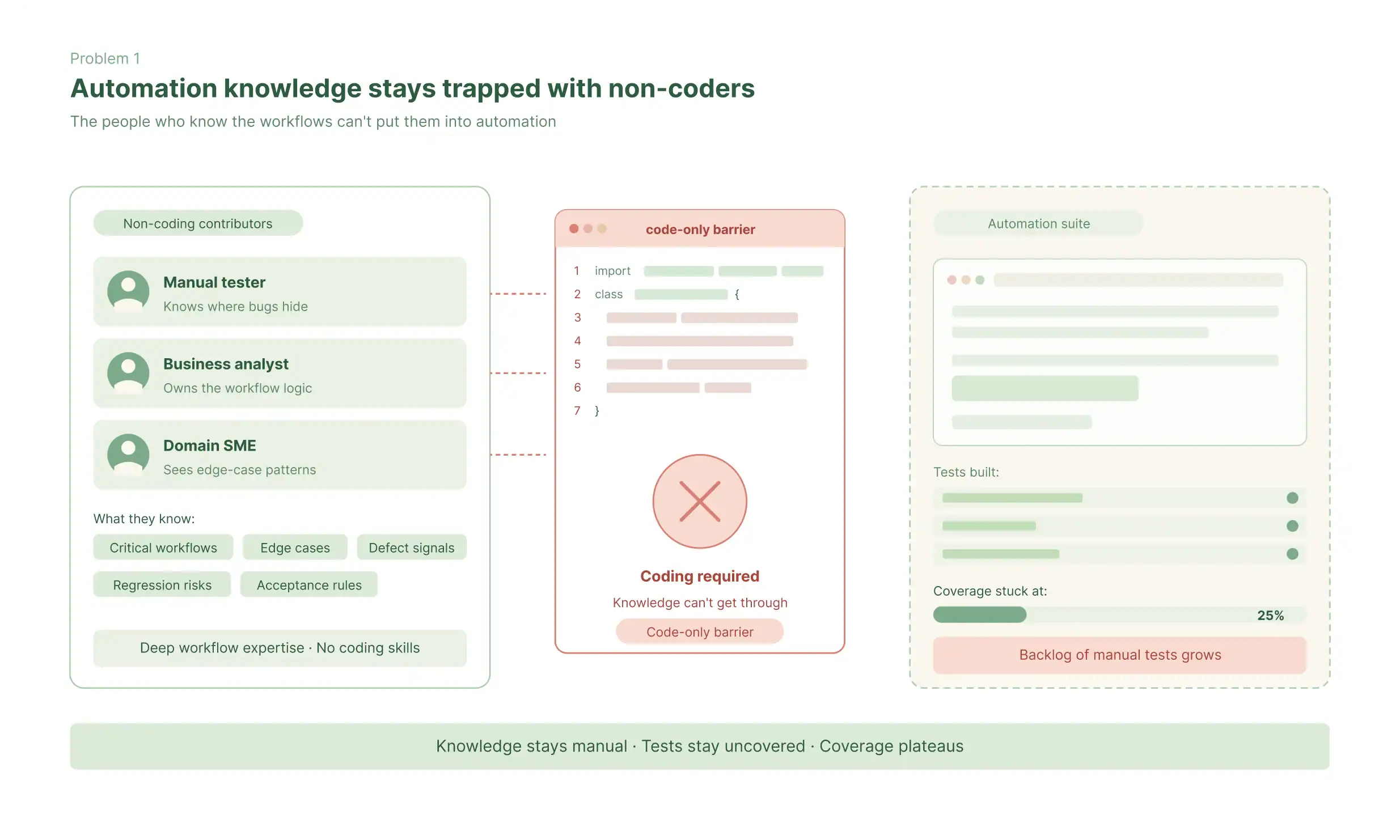
Problem 1

Automation Knowledge Stays Trapped With Non-Coders

Manual testers and business analysts often know the most critical workflows, edge cases, and defect patterns, but cannot contribute directly when automation depends on coding.
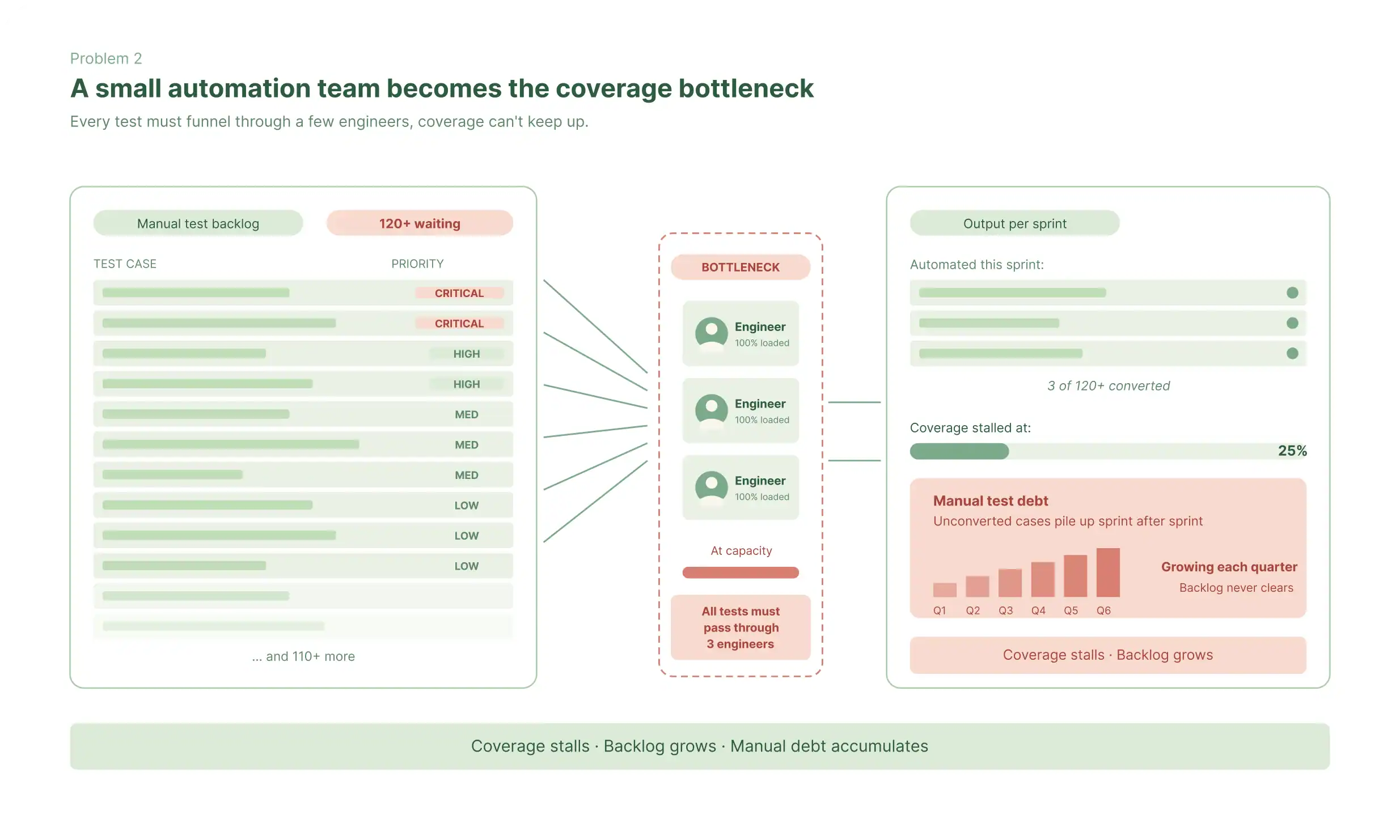
Problem 2

A Small Automation Team Becomes the Coverage Bottleneck

When every test must pass through a limited group of automation engineers, coverage stalls and manual test cases pile up as unconverted automation debt.
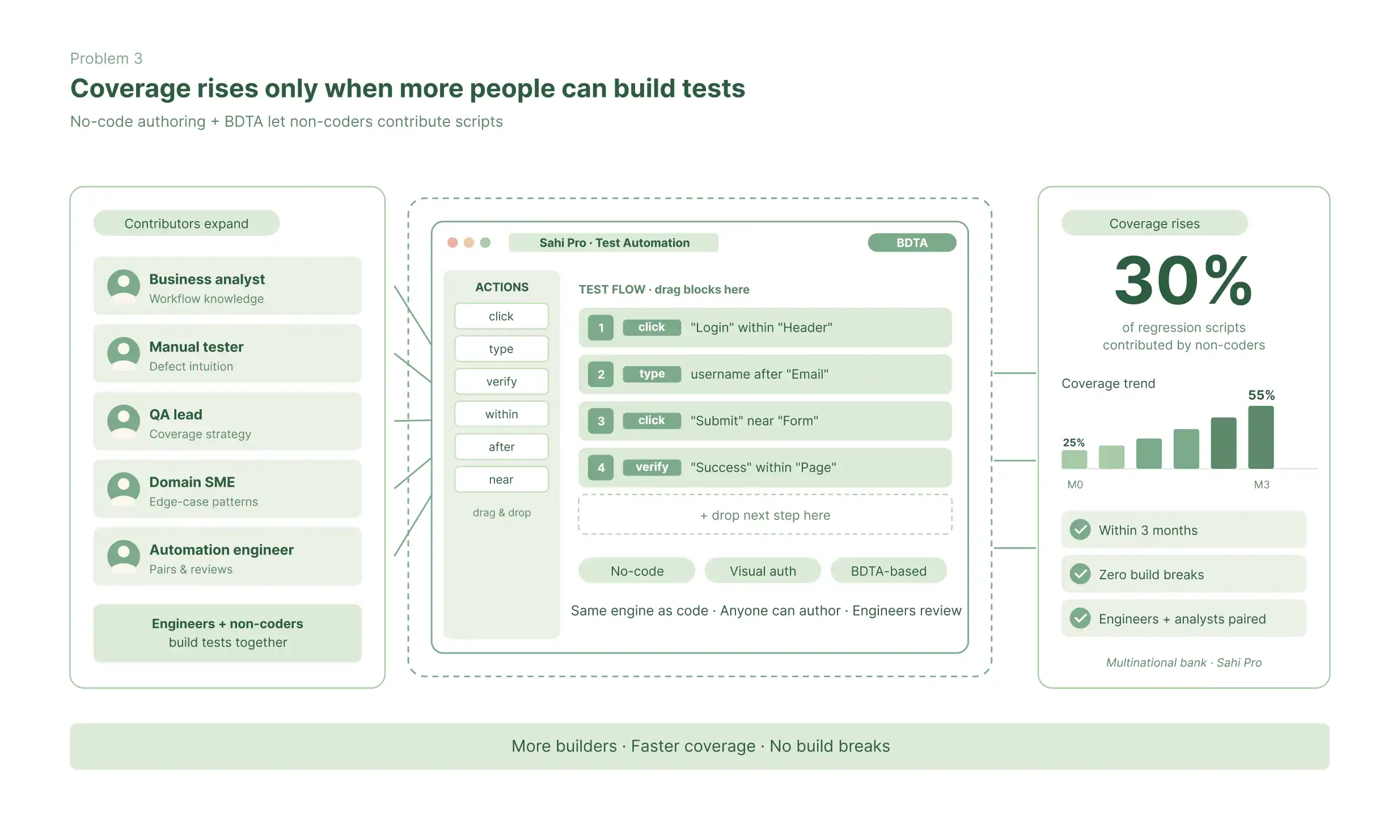
Problem 3

Coverage Rises Only When More People Can Build Tests

Sahi Pro expands automation coverage by letting non-technical contributors build tests through its no-code interface and BDTA.

Two No-Code Authoring Paths

Path 1

No-Code Interface

What non-technical users can build in the no-code interface:

Path 2

BDTA (Business Driven Test Automation)

How BDTA works in practice:

Both Paths, Same Product

No-code and engineer-written tests run in the same engine, same suites, and same tools.

Can Non-Technical Testers Build Tests That Actually Mean Something?

No-Code Does Not Mean No Depth - Engineers Keep Full Control

No-code does not reduce technical control: QA engineers still have full JavaScript access to Sahi Pro’s complete API for complex web, desktop, API, database, and mobile automation in the same product.

The product architecture means:

The limit is not what the no-code interface can express. The limit is the tester’s knowledge of the application.

Named Results From Teams Running No-Code Automation in Production

No-Code Does Not Mean Limited Coverage

Functional
testing

Verification that features behave as specified, authored by business testers

Regression
testing

Full suite re-execution before every release, run without engineering support

Data-driven
testing

The same test flow executed against multiple data inputs automatically

Cross-browser
testing

No-code tests execute across Chrome, Firefox, Safari, and Edge

User acceptance
testing

Business-scenario test execution by the people who understand the business

Positive and negative
validation

Tests that verify both that valid inputs are accepted and invalid inputs are rejected

Integration
testing

Multi-system workflows where the business logic spans multiple application layers

API
testing

REST API calls and validations included in no-code test flows

Smoke
testing

Fast verification of core functionality before full regression runs

From Manual Testing to No-Code Automation: A Practical Path

1. Pilot on high-value, repetitive tests (Weeks 1-4)

Start with frequently repeated, well-defined business workflows and run Sahi Pro alongside existing tools to prove fit and generate early wins.

Train selected team members on the no-code interface and BDTA so they can build tests, execute suites, review results, and support peer onboarding.

After the pilot and training, extend automation into more priority scenarios and increase contribution from non-technical team members.

Run no-code and scripted tests in the same CI/CD pipeline and add parallel execution as the suite grows to match release cadence.

Questions Teams Ask Before Deploying No-Code Automation

What is no-code test automation?

No-code test automation is the practice of building and running automated tests using visual interfaces – spreadsheet-style frameworks or recorded interactions – without writing programming code. It allows non-programmers to create and maintain automated tests using their knowledge of application behaviour and business processes. Sahi Pro provides two no-code interfaces: a visual no-code editor and the BDTA (Business Driven Test Automation) spreadsheet framework.

Yes, with the right tool. The limitation of most early no-code tools was that they produced tests that were shallow, brittle, or unable to handle real application complexity. Sahi Pro’s no-code interfaces are built on the same automation engine as its scripted tests, which means non-technical users can create reliable tests for real business workflows, while engineers retain full code-level control for technically complex scenarios.

Sahi Pro’s no-code model is not limited to replaying clicks, because the no-code layer lets teams define business steps and outcomes first, then implement and validate them with recorded interactions and assertions. The product also supports conditional logic, preconditions, and structured handling of test data, which makes the approach more durable than simple recorder-only automation.

Yes. Sahi Pro is designed so manual testers, business analysts, and QA engineers can all contribute in the same product rather than splitting work across separate tools. Engineers retain full JavaScript access for technically complex scenarios, while non-technical users contribute through the no-code interface and BDTA framework.

Sahi Pro can extract entered values into reusable entities and attributes, so test data is separated from individual recorded steps instead of being hard-coded into every action. That structure makes data-driven execution easier to manage and reduces the manual effort required to update or reuse business scenarios across multiple runs.

Yes. Tests authored by technical and non-technical contributors run together in the same CI/CD pipeline. Sahi Pro supports common CI/CD environments including Jenkins, GitLab CI, and Azure DevOps. The same command-line trigger works for no-code tests and scripted tests – the pipeline does not distinguish between them.

Teams using Sahi Pro’s no-code recorder and interface are typically productive within the first pilot phase – building and running test cases against high-value, repetitive workflows. The product and support materials consistently describe rapid onboarding and a low learning curve for non-technical contributors compared with engineer-centric automation tools.

Try It Against Your Regression Suite, or Talk Through Your Requirements

Try It Yourself

Full product access across all modules and capabilities. Run Sahi Pro against your actual application - the one whose regression suite is currently giving you problems - before any conversation about purchasing.

Talk to Our Team

Tell us about your current regression suite - test case count, application technologies, release frequency, and current maintenance overhead. We will come back with a specific assessment of where Sahi Pro addresses your problems and what deployment looks like in your environment.