


TL;DR
- “SAP application testing” gets used loosely across the industry, usually as a stand-in for SAP testing in general. Most sources that use the term don’t actually define it as anything distinct.
- There’s a real, useful distinction underneath it, though: SAP itself separates the Basis layer (infrastructure, system administration, database, installation) from the application layer (business processes, transactions, custom code, Fiori apps). Application testing is testing that layer specifically.
- Basis-layer validation, system health checks, installation verification, server configuration, is an IT operations concern, not a QA one. It’s worth knowing the line exists, even if you’re not the one testing across it.
- Everything that actually falls under application testing, regression, Fiori, migration validation, transaction-level testing, we’ve already covered in depth elsewhere. This piece exists to draw the map, not repeat those guides.
Search for “SAP application testing” and you’ll find the term used constantly and defined rarely. Most articles that use it mean SAP testing in general, the same regression, integration, and functional testing covered everywhere else. That’s not wrong, exactly, but it’s not precise either. There’s a real distinction worth naming, and it comes from how SAP itself is structured, not from marketing language.
The line that actually defines application testing
SAP systems split into two layers. The Basis layer is the infrastructure underneath everything: system installation, database administration, server configuration, and the technical plumbing that keeps the system running. The application layer sits on top of it: business processes, transactions, custom ABAP code, Fiori apps, the things a business user or a tester actually interacts with.
Basis work is typically owned by Basis administrators, a distinct role from developers or functional consultants. Application testing is testing that second layer, the one your business processes actually run on, not the infrastructure holding it up.
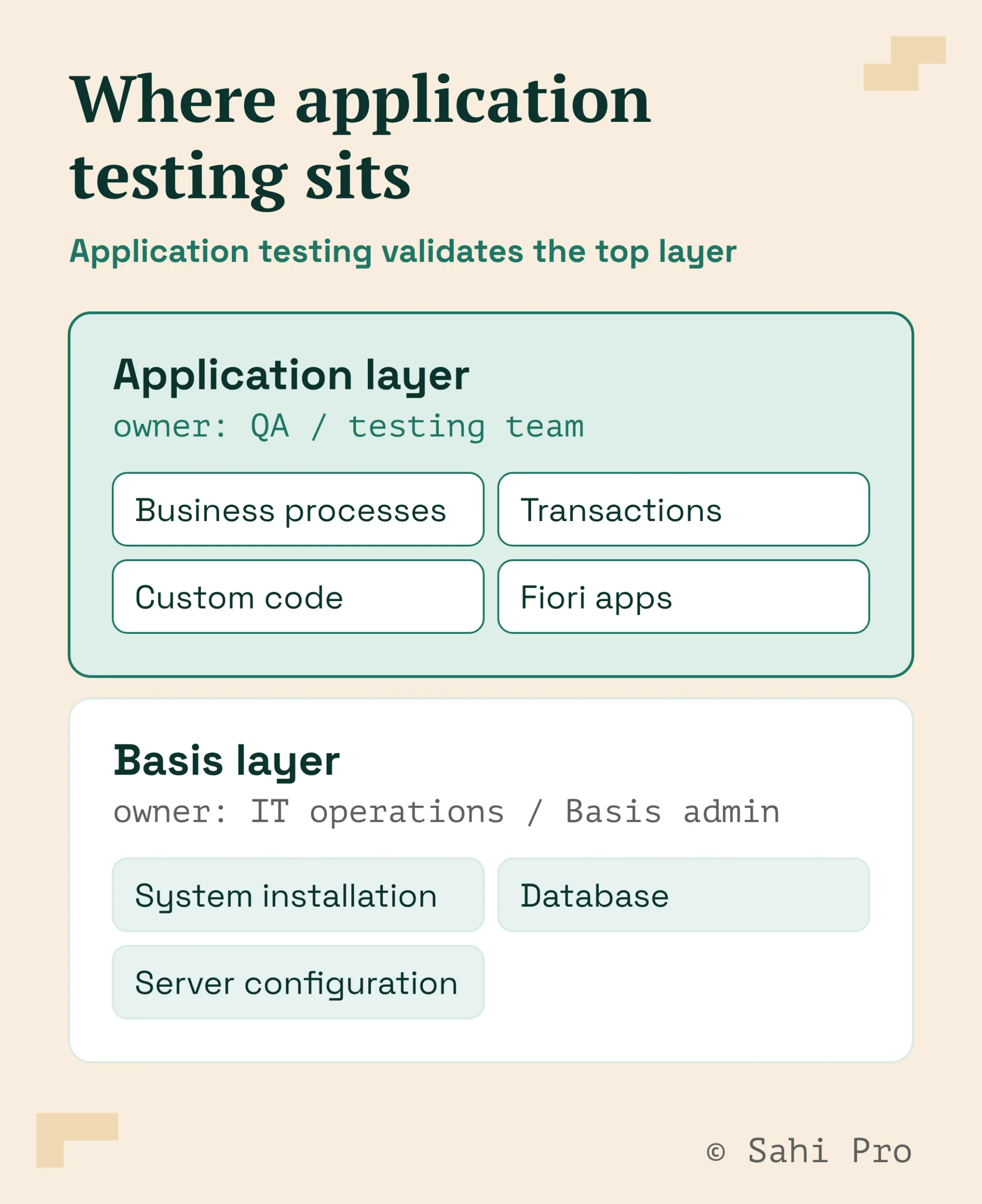
That gives “SAP application testing” a precise meaning: validating business processes, transactions, custom code, and the interfaces built on top of SAP, not validating whether the system itself is correctly installed and configured. The second kind of validation matters too, it’s just a different job, usually done by Basis teams as part of system administration rather than by a QA function.
What falls inside that scope, and where we’ve already covered it
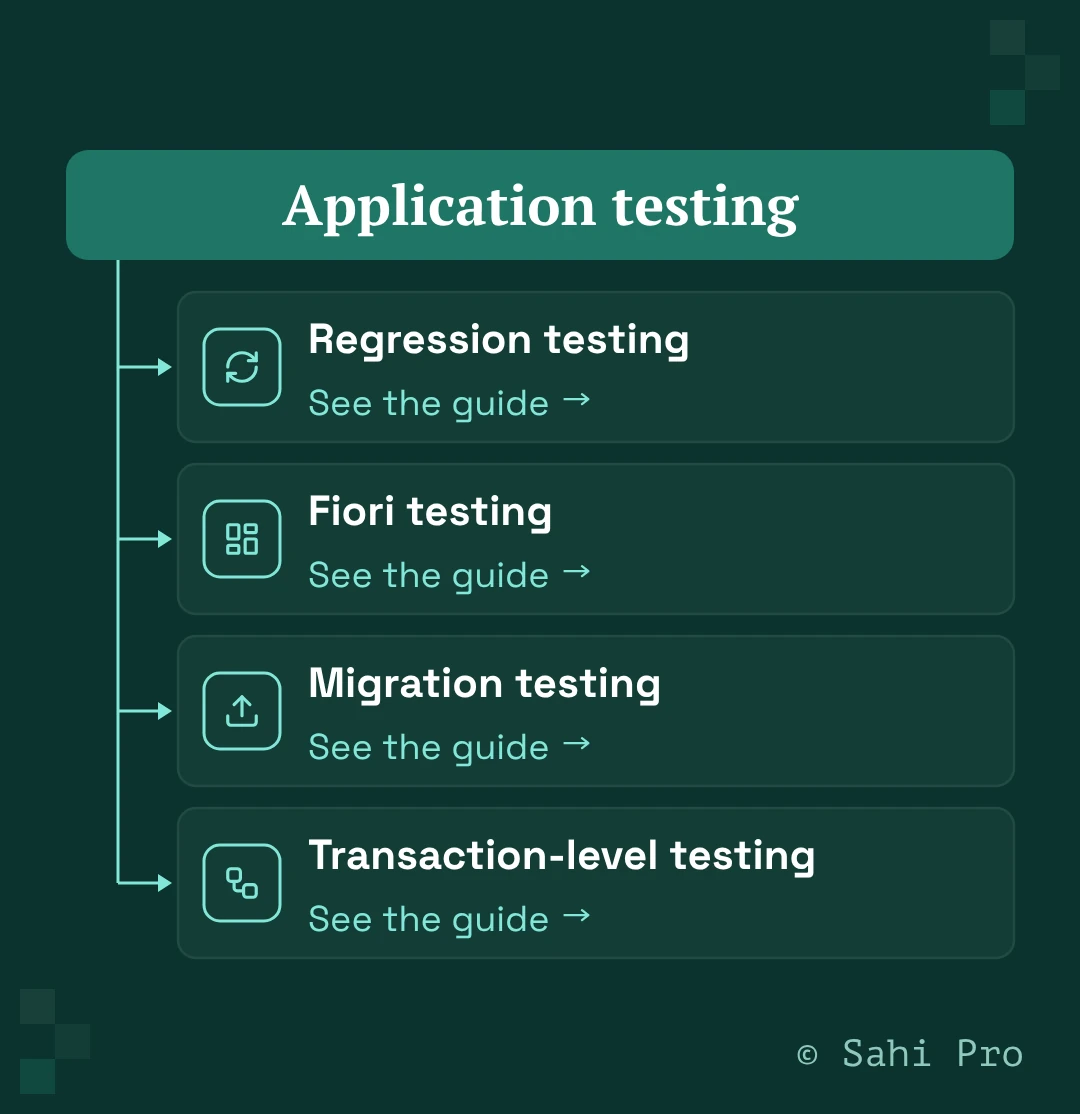
Once you draw that line, application testing turns out to be an umbrella over testing work most teams already recognize by other names.
- Regression testing confirms that changes, upgrades, and support packs haven’t broken existing business processes. We’ve covered this in full in our regression testing guide.
- Fiori and UI testing validates the application layer’s modern interface specifically, which behaves differently enough from classic SAP GUI screens to need its own approach. Covered in our Fiori testing guide.
- Migration validation confirms business processes still work correctly after a move to S/4HANA or a similar platform shift. Covered in our migration testing checklist.
- Transaction-level testing validates the specific codes and screens testers actually work with day to day. Covered in our T-code reference.
If you’re looking for the broader picture of what SAP testing involves before narrowing into any one of these, our complete guide to SAP testing is the right starting point.
Where Sahi Pro fits into this
Sahi Pro is built to test the application layer specifically, the business processes, transactions, and interfaces described above, across SAP GUI, Fiori, web, desktop, mobile, and API in one continuous flow. Elements are identified by relationship and context rather than fixed screen position, so tests stay stable through the application-layer changes, a Fiori update, a custom code change, a process redesign, that break position-based automation.
This runs on a proprietary execution engine, not a Selenium or Appium wrapper. Sahi Pro customers report a 90 percent reduction in regression man-hours and an 80 percent reduction in test maintenance compared to conventional tools, figures from Sahi Pro’s 1,000-plus enterprise customer base as a whole.
Want to see how Sahi Pro tests the application layer across your specific SAP landscape? Book a demo and bring a business process that spans more than one interface.
Sources
- Gambit, “What is SAP Basis?” (gambit-group.com/en/wiki/sap-basis) — cited for the real, verifiable distinction between the Basis layer (infrastructure, database, server configuration, system administration) and the application layer (business processes, custom ABAP code, developer- and functional-team-owned). This is the factual basis for this piece’s central definitional claim, not a Sahi Pro-invented distinction.
- QASource, “A Complete Guide to SAP Testing” (qasource.com/blog) and GeeksforGeeks’s SAP testing coverage — competitor content check, confirmed that “SAP application testing” is not used as a distinct, defined term in either source, supporting the piece’s opening claim that the term is used loosely industry-wide. Cited only to support that observation, not for any technical claim about SAP testing itself.
- Sahi Pro proof points (90% regression man-hours reduction, 80% maintenance reduction, 1,000+ enterprise customers) are Sahi Pro’s own company-wide, previously established figures.
- https://www.sahipro.com/request-demo confirmed live in prior research this session.