


India runs an enormous amount of SAP. Manufacturing, pharma, energy, and financial services enterprises here have some of the largest SAP install bases in the world, and most of them are mid-migration to S/4HANA right now. That combination, scale plus active transformation, makes SAP testing in India a genuinely different problem than SAP testing anywhere else.
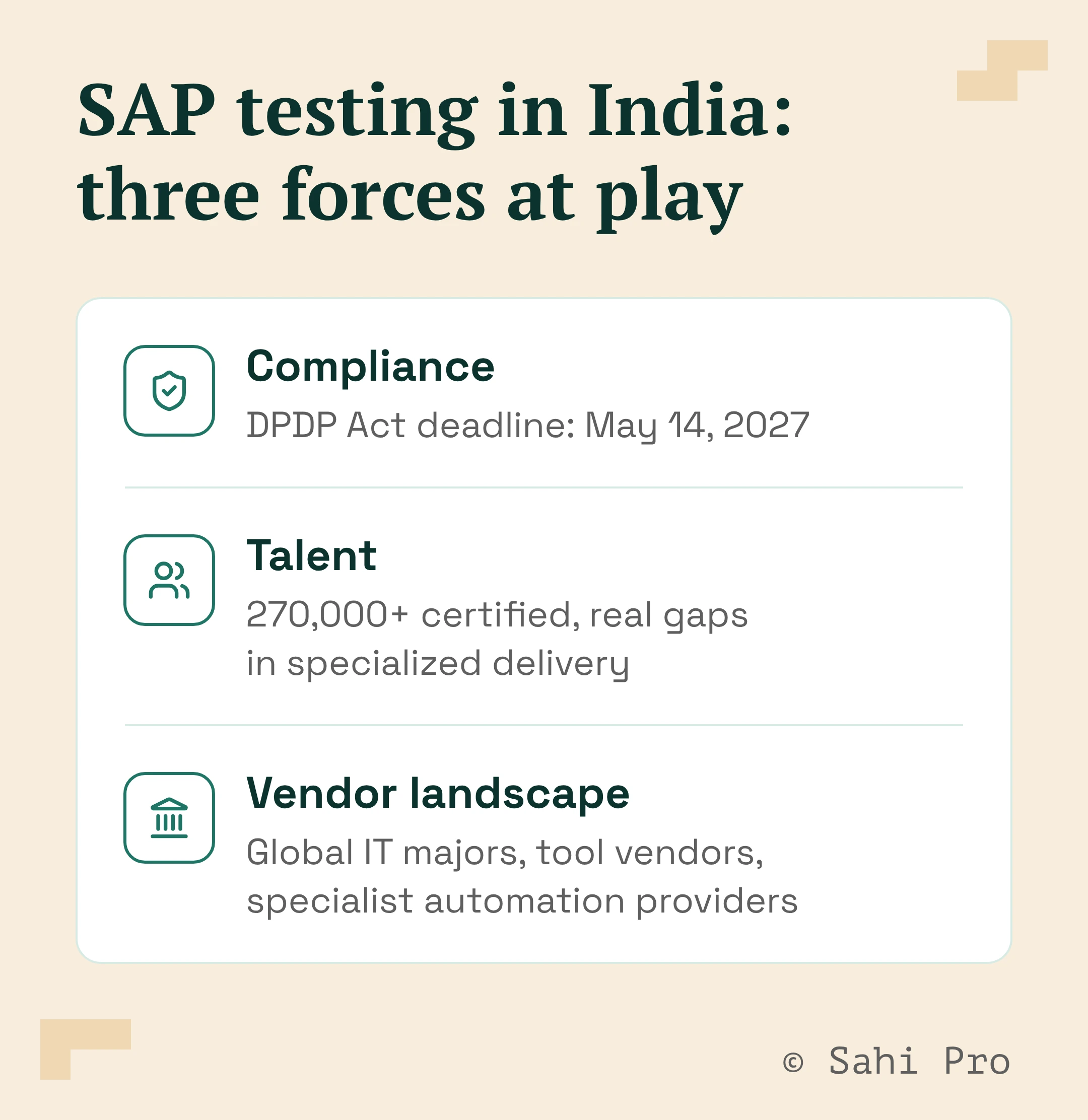
Three forces shape it specifically: a new data protection law with a hard compliance deadline, a talent market that looks abundant on paper but has real gaps underneath, and a vendor landscape that most buyers navigate without a clear map. This piece covers all three.
Compliance: the DPDP Act changes how test data gets handled
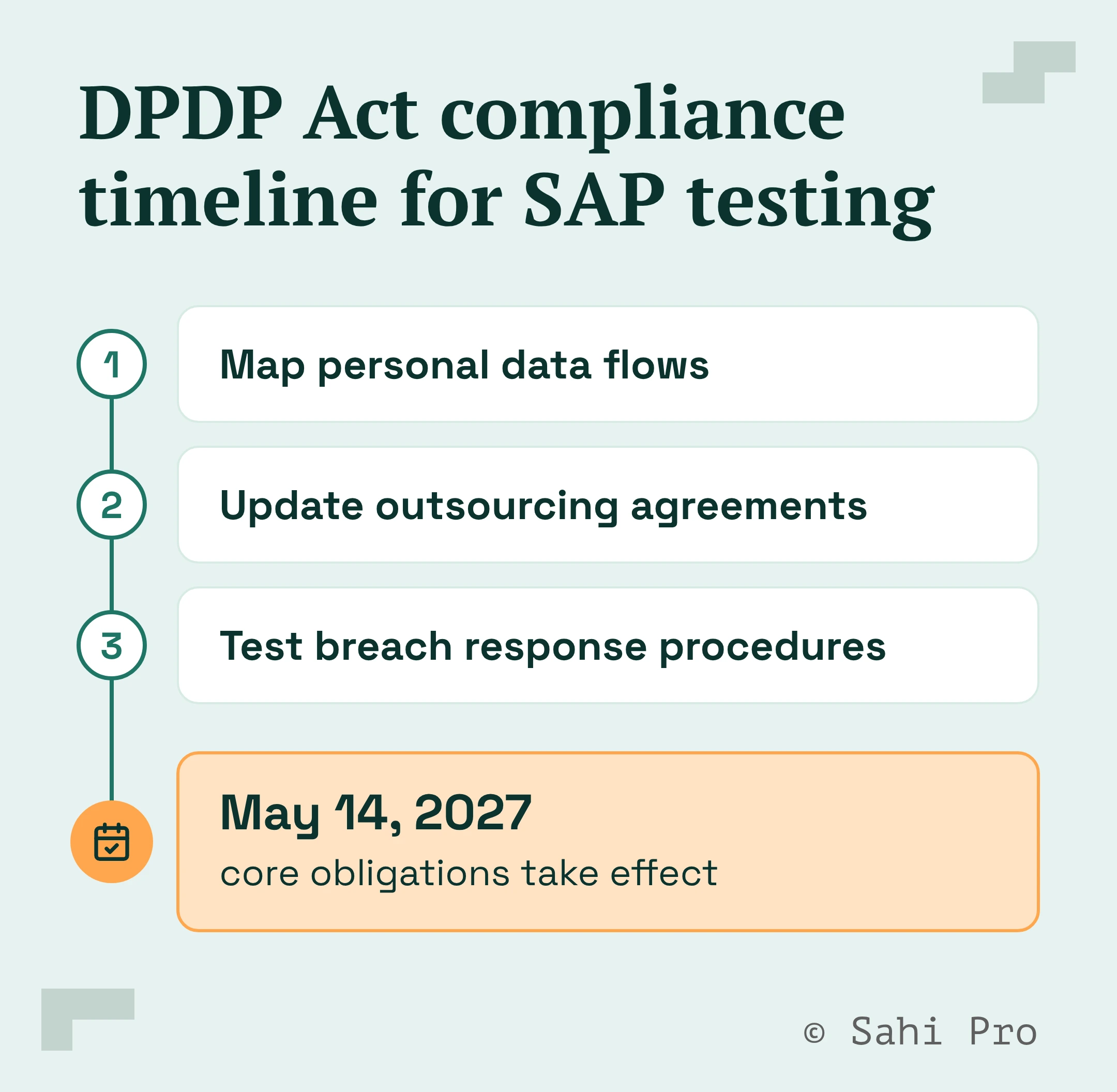
India’s Digital Personal Data Protection Act (DPDP Act) has a confirmed compliance deadline. Core operational obligations, breach requirements, and the penalty framework become effective on May 14, 2027, according to India Briefing’s compliance guidance.
That deadline matters directly for SAP testing, for a few reasons.
- Test data handling comes under scrutiny. Regulatory guidance under the Act calls for organizations to map personal data flows across customer, employee, supplier, and other systems, and SAP test environments are exactly the kind of place where production-like personal data tends to live in copies nobody has fully inventoried.
- Outsourcing and vendor agreements need updating. The same guidance explicitly calls for updating processor, cloud, and outsourcing agreements before the deadline. Any enterprise running SAP testing through a third party in India needs those contracts to reflect the new obligations.
- Breach response has to be tested, not just documented. The Act’s guidance calls for testing breach detection, notification, and escalation procedures directly, which puts an operational requirement on top of what used to be a paperwork exercise.
None of this is unique to SAP. But SAP systems, being the system of record for financial, HR, and supply chain data at most large Indian enterprises, sit closer to the center of DPDP Act exposure than almost anything else in the stack.
Talent: a large certified base with real gaps underneath
India has the third-highest number of SAP-certified professionals globally, more than 270,000 certifications, and over 20,000 of those are specifically in SAP S/4HANA, according to workforce data compiled by 2COMS. On paper, that looks like more than enough supply.
The same data points to a gap underneath that headline number. Certification volume is high, but organizations still report shortages of professionals with hands-on experience in specific areas: implementation, development, and support work that certifications alone don’t teach. Testing and QA sit inside that same gap. A certification proves someone learned the material. It doesn’t prove they’ve spent years catching the specific ways SAP transactions break under real enterprise conditions.
This is where the buy-versus-build-skills question gets practical. Organizations short on specialized SAP testing talent generally pick from three paths, upskilling existing staff, hiring certified professionals directly, or outsourcing to a testing partner, and each comes with a different timeline and cost profile. There’s a fourth lever that gets less attention: choosing testing tools that don’t require the scarce skill set to begin with, which is a design decision, not a hiring decision.
Vendor landscape: who actually serves this market
The vendor landscape for SAP testing in India splits into a few distinct categories, and buyers benefit from understanding which one they’re actually evaluating.
- Global IT services majors. Infosys runs a dedicated SAP testing practice with more than 600 SAP testing consultants, delivering across the full package lifecycle from implementation through support, using its own testing methodology and partnerships with tool vendors including Tricentis and Worksoft. Wipro runs comparable dedicated service lines, including SAP S/4HANA-specific testing services and a named partnership with Tricentis for SAP test automation. These firms sell services, not just tools. Engaging one typically means buying a testing team and a methodology together.
- SAP-focused test automation tool vendors. Tricentis and Panaya are the two names that show up repeatedly, both as standalone tools and as the automation layer inside the global IT services firms’ own SAP testing offerings. Their India-specific content and search visibility is thin relative to their global presence, which tracks with the market gap this piece is written to address.
- Specialist automation providers. A smaller set of vendors, including Sahi Pro, focus specifically on cross-technology test automation rather than SAP alone, covering SAP alongside the web, desktop, and mobile systems that sit around most SAP landscapes in practice.
What’s missing from the current market conversation isn’t vendors. It’s a single place that connects the compliance requirement, the talent reality, and the vendor options together for a buyer trying to make one decision.
Where Sahi Pro fits
Two things about Sahi Pro map directly onto the forces above.
On the compliance side, Sahi Pro supports on-premise deployment, which keeps test execution and test data inside the enterprise’s own infrastructure rather than routing it through an external cloud service. For a DPDP Act-driven conversation about data localization and outsourcing agreements, that’s a meaningfully different starting position than a cloud-only testing tool.
On the talent side, Sahi Pro’s engine isn’t built on Selenium or Appium, and it doesn’t require the specialized scripting expertise that the talent gap described above is actually about. Teams typically get productive within two weeks, and no certifications are required to start. That doesn’t solve India’s SAP talent shortage. It sidesteps the part of the shortage that would otherwise block a testing program from starting at all.
Sahi Pro’s single-flow architecture, one script running continuously across web, desktop, mobile, SAP, and APIs, also fits the specialist automation category described above: most Indian enterprises running SAP aren’t running SAP alone, and testing it in isolation from the systems around it leaves gaps.
Ready to see how Sahi Pro’s on-premise deployment and cross-technology automation fit an Indian SAP landscape? Book a demo and walk through it on your own environment.
Sources
- India Briefing: India’s DPDP compliance deadline, verified via direct fetch. Confirms the May 14, 2027 core compliance deadline and the specific pre-deadline actions cited (data flow mapping, updated outsourcing agreements, tested breach procedures). Cited as legal/compliance news coverage, not as SAP’s or Sahi Pro’s own claim.
- 2COMS: Availability of SAP S/4HANA skilled professionals in India, verified via direct fetch. Source for the 270,000+ certified professionals and 20,000+ S/4HANA-certified figures, and the acknowledged skill gap in implementation, development, and support experience.
- Infosys: SAP testing service catalog, verified via direct fetch. Source for the 600+ SAP testing consultants figure and the named tool partnerships (HP, IBM, Worksoft, CA-Lisa, Tricentis, Panaya).
- Wipro’s public SAP testing service pages (Test Automation as a Service, Accelerated SAP S/4HANA Testing Services, Intelligent SAP Testing with Tricentis), reviewed for confirmation of a comparable dedicated SAP testing service line and Tricentis partnership. Referenced generally, not quoted for specific figures.
- Sahi Pro’s own approved proof points (on-premise deployment for regulated industries, not built on Selenium or Appium, teams productive in two weeks with no certifications required), used as previously verified brand facts, not researched fresh this session.