


TL;DR
- Almost every testing tool now claims AI. The useful way to read the market is by receipts, not adjectives.
- Four checks sort real capability from marketing: a named mechanism, a human gate on any agent, deterministic execution, and a real before-and-after on maintenance hours.
- The strongest, most verifiable AI use is maintenance, because broken element references are where QA teams lose the most time.
- The tools worth knowing in 2026 include Sahi Pro, Katalon, Testsigma, testRigor, mabl, Applitools, Functionize, Tricentis Tosca, and LambdaTest KaneAI, each with a different core strength.
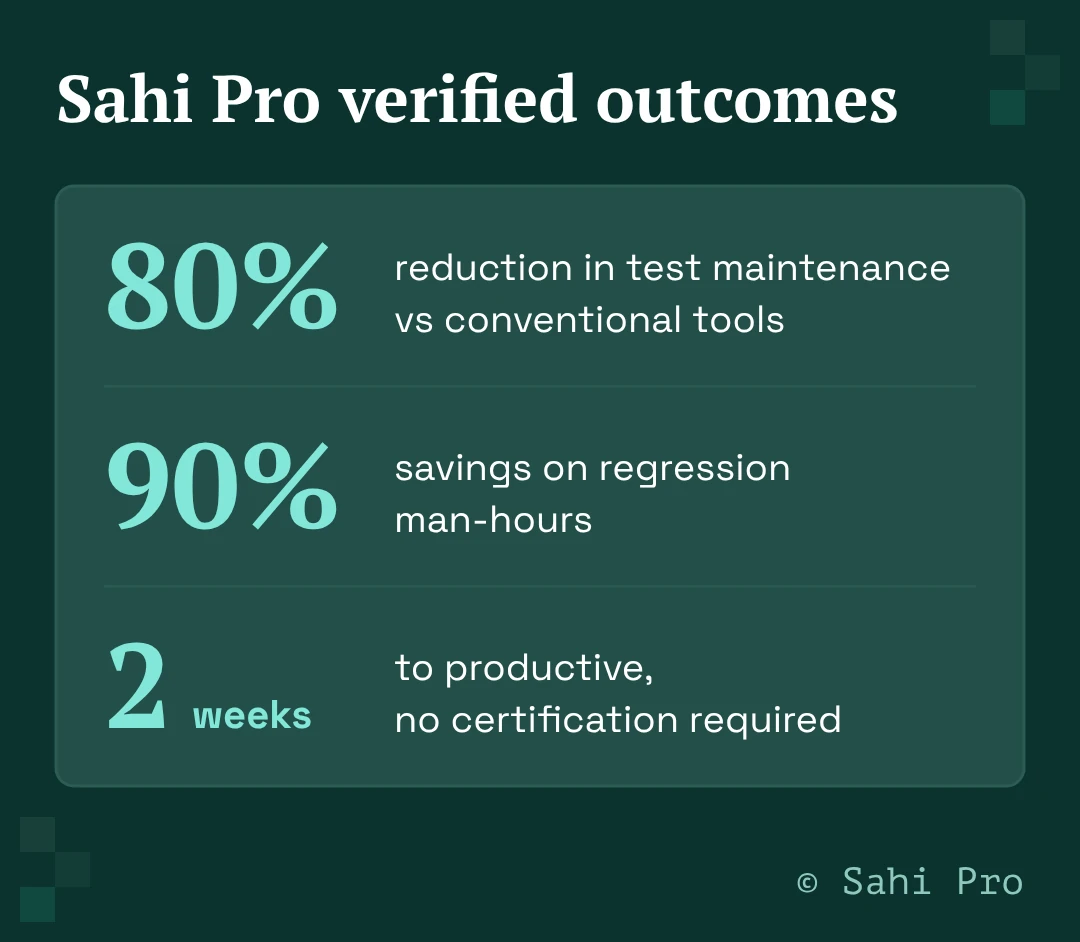
- Sahi Pro leads with verified outcomes: an 80 percent reduction in test maintenance and 90 percent savings on regression man-hours, on a proprietary engine.
- Honest caveat: no tool removes the human judgment about what to test. Treat any vendor that claims full autonomy as selling a demo.
Open ten testing-tool websites and you will read the same four words on nine of them. AI-powered, intelligent, autonomous, next. The words are free. What separates a tool that saves your team real hours from one that adds a chatbot to a dashboard is whether there is a working mechanism underneath, and whether anyone can show you the result on a real suite.
This is the honest list. It covers what AI testing tools are, the four questions that expose a weak claim, the tools worth knowing in 2026 and what each one’s AI genuinely does, and how to choose for your situation. Everyone claims AI. The ones worth your budget can show the receipts.
What are AI testing tools?
AI testing tools are test automation platforms that use machine learning or generative models to help create, maintain, or run tests, rather than relying only on hand-written scripts. The AI usually shows up as one or more of four capabilities: generating tests from plain language or an application, healing broken element locators after a UI change, detecting flaky or redundant tests, and prioritizing which tests to run. Treat “AI-powered” as a claim about one of those specific jobs, and ask which one.
How do you judge an AI testing tool?
Judge an AI testing tool on evidence you can check, not on the language on its homepage. Four questions do most of the work. They separate a tool with a real mechanism from one that has wrapped a model around an old product and relabeled it.
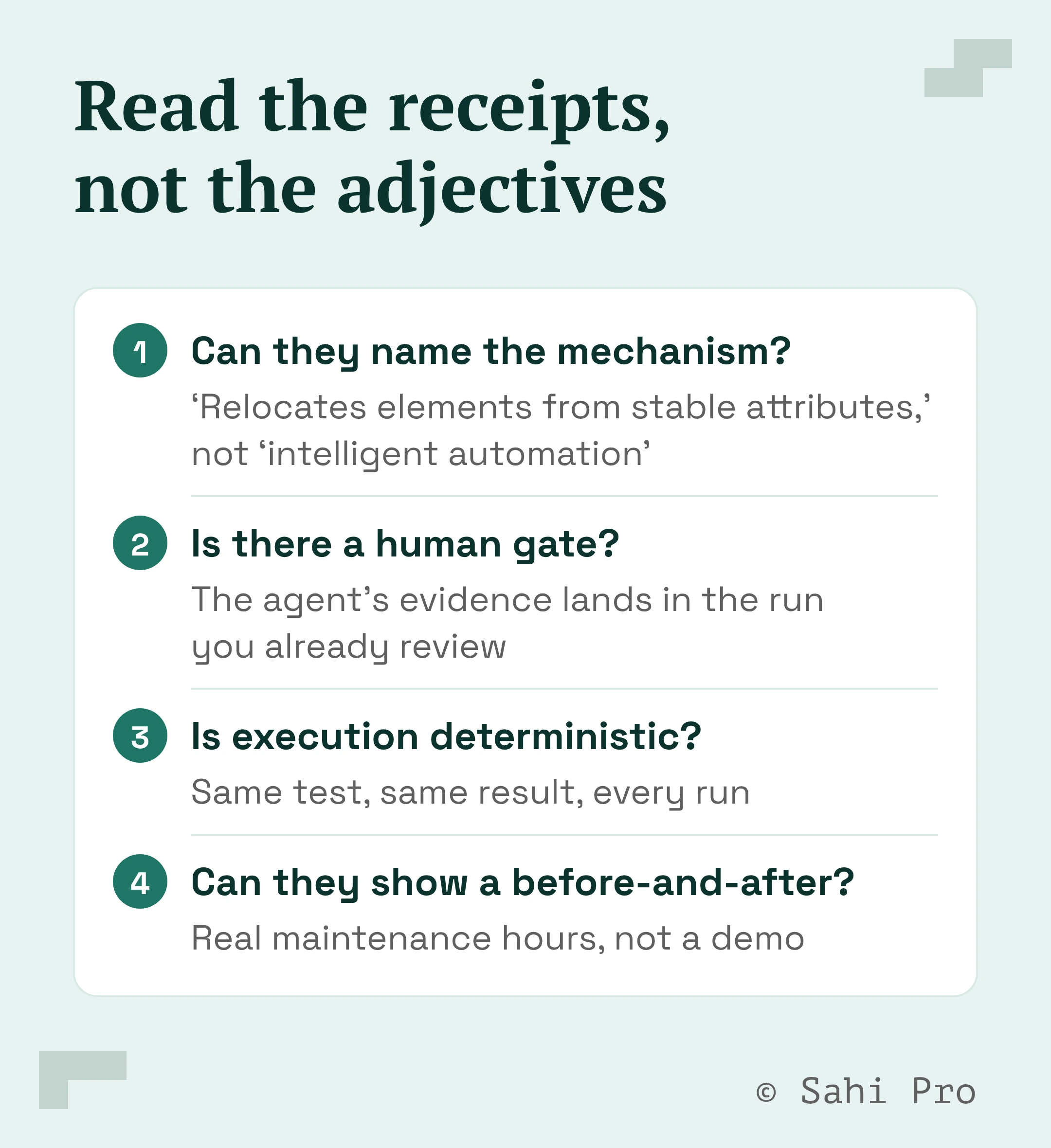
The checks:
- What exactly does the AI do, and can they name the mechanism? “Self-healing by relocating elements from stable attributes” is a mechanism. “Intelligent automation” is not.
- Is there a human gate on any agent? A credible agent product scopes its work and lands its evidence in the run your team already reviews. Be wary of any vendor that removes the human from the sign-off.
- Is execution deterministic? The same test must give the same result every run. A generative feature that produces a different test or outcome each time has built flakiness into the tool.
- Can they show a real before-and-after? Ask for one team’s maintenance hours or coverage before and after, not a staged demo. A vendor with a working mechanism has these numbers.
The AI testing tools worth knowing in 2026
The market has a tool for most situations, and each leading product has a different center of gravity. Here is what each one’s AI genuinely does, described by capability rather than by its own marketing.
Sahi Pro runs on a proprietary execution engine, not built on Selenium or Appium, and identifies elements by relationship and context so tests survive UI changes. Its single-flow architecture runs one script across web, desktop, mobile, SAP, and API without handoffs. Atlas, its AI design studio, builds a verified specification of application behavior and generates a deterministic test suite from it. The receipts are an 80 percent reduction in test maintenance and 90 percent savings on regression man-hours.
Katalon offers an AI Assistant that turns natural language into test cases and a prompt-to-script “Run with AI” loop, still in beta. It is a full-stack option across web, mobile, API, and desktop, and a common starting point for teams that want a broad tool with a gentle on-ramp.
Testsigma centers on plain-English test authoring with self-healing, aimed at letting manual testers write automation without code. It suits teams that want natural-language authoring as the default rather than an add-on.
testRigor also leads with plain-English test creation and generative authoring, and is known for codeless tests that non-engineers can maintain. Its strength is lowering the skill barrier to writing and updating tests.
mabl is a low-code platform with an agentic tester, a test-creation agent, and conversational failure analysis, built for Agile and DevOps teams. It is a fit for teams that want AI woven through an existing CI pipeline.
Applitools is the reference tool for visual AI. It uses visual checkpoints to catch rendering and layout regressions a functional assertion would miss, and offers Applitools Autonomous for test generation. Use it where visual correctness is the risk.
Functionize focuses on NLP-based test authoring and self-healing for enterprise teams, with a Studio agent. It publishes a 99.97 percent element-recognition figure that is self-reported, so confirm it against your own suite before relying on it.
Tricentis Tosca runs model-based automation with component modules assembled per technology, and an AI Workspace of agents for authoring and risk-based prioritization. It is established in large enterprise and SAP estates. Its execution is component-based, which means a change often touches modules in several places rather than a single continuous flow.
LambdaTest KaneAI creates, plans, and debugs tests from natural language and pairs with a large cross-browser and device cloud. It is strongest where the main challenge is coverage across many browsers and devices.
Where Sahi Pro fits
Sahi Pro is built for teams whose pain is maintenance and cross-technology flows, and it competes on verified outcomes rather than AI language. Because the engine is proprietary and identifies elements relationally, tests stay stable through UI changes, which is why maintenance drops 80 percent against conventional tools. Because one script runs continuously across web, desktop, mobile, SAP, and API with session state carried through, teams testing a business process that crosses systems do it in a single flow instead of stitching tools together. On-premise deployment is available for regulated industries that cannot send application data to the cloud. Teams reach productivity in about two weeks with no certification required.
Which AI testing tool should you pick?
Pick by your dominant problem, not by the longest feature list. If maintenance and cross-system flows are eating your week, weigh a stable proprietary engine with relational element identification. If visual regressions are your risk, visual AI is the category to shortlist. If your blocker is coverage across many browsers and devices, a device-cloud tool earns its place. If you need non-engineers to write tests, lead with natural-language authoring. Then apply the four-question test to whichever two or three you shortlist, and ask each one for a real before-and-after.
Shortlist by your biggest problem, then ask for receipts
The AI testing market is loud, and most of the noise is adjectives. Sort it by the four checks, shortlist by the problem that costs you the most hours, and make every finalist show you a real before-and-after. If maintenance and cross-technology flows are your constraint, see what Sahi Pro’s engine does on your own application in a working session.
Sources
- Best AI Testing Tools Compared: Katalon, Testim, Applitools and more (2026), TestCollab, 2026. https://testcollab.com/blog/ai-testing-tools
- AI Testing Tools: What Works in Test Automation and What Doesn’t, Sauce Labs, 2026. https://prod-marketing.saucelabs.com/resources/blog/ai-testing-tools-what-works-in-test-automation-and-what-doesnt