


TL;DR
- Self-healing test automation keeps a test working after the UI changes by relocating an element the original locator can no longer find.
- The common mechanism is a fallback chain: store several ways to identify each element, and when the primary locator fails, score alternatives and update it.
- The real risk is a false heal. A naive system can relocate to the wrong element and mark a genuine regression as passing, which is worse than a failing test.
- The safer path is to not depend on a fragile locator at all. Identify elements by their stable attributes and their relationship to nearby labels, not by DOM position or a generated ID.
- Healing must classify before it repairs: locator drift gets healed and logged, a real behavior change gets reported as a bug.
- Honest caveat: relational identification and healing reduce maintenance, but text-based healing is fragile under localization and ambiguous labels. No approach removes all of it.
Self-healing is the most marketed and least understood term in test automation. A vendor says a suite heals itself, a buyer pictures tests that never break, and nobody explains what happens underneath or where it goes wrong. The mechanism is real and useful. It is also easy to implement in a way that quietly passes broken software.
This is the engineering view. It covers what self-healing is, what a fragile locator actually looks like, how healing resolves and scores a replacement, the failure mode that makes a bad implementation dangerous, the edge cases that trip it, and the approach that removes most of the need to heal at all.
What is self-healing test automation?
Self-healing test automation is the ability of a test to keep finding an element after the UI changes, by using an alternative way to identify that element instead of failing. When a developer renames a CSS class, restructures a component, or ships a framework upgrade, the original locator breaks. A self-healing system detects that break and relocates the element from other attributes, so the test continues rather than reporting a false failure.
What a fragile locator actually looks like
The reason suites break is visible in the locator itself. A locator that encodes position or a generated value is a bet that the page structure will not change, and that bet loses on the next release.
Here is the same login email field, located three fragile ways:
// Absolute XPath: breaks if any ancestor div is added or reordered
driver.findElement(By.xpath(“/html/body/div[2]/div/form/div[3]/input”));
// nth-child CSS: breaks if a field is inserted above it
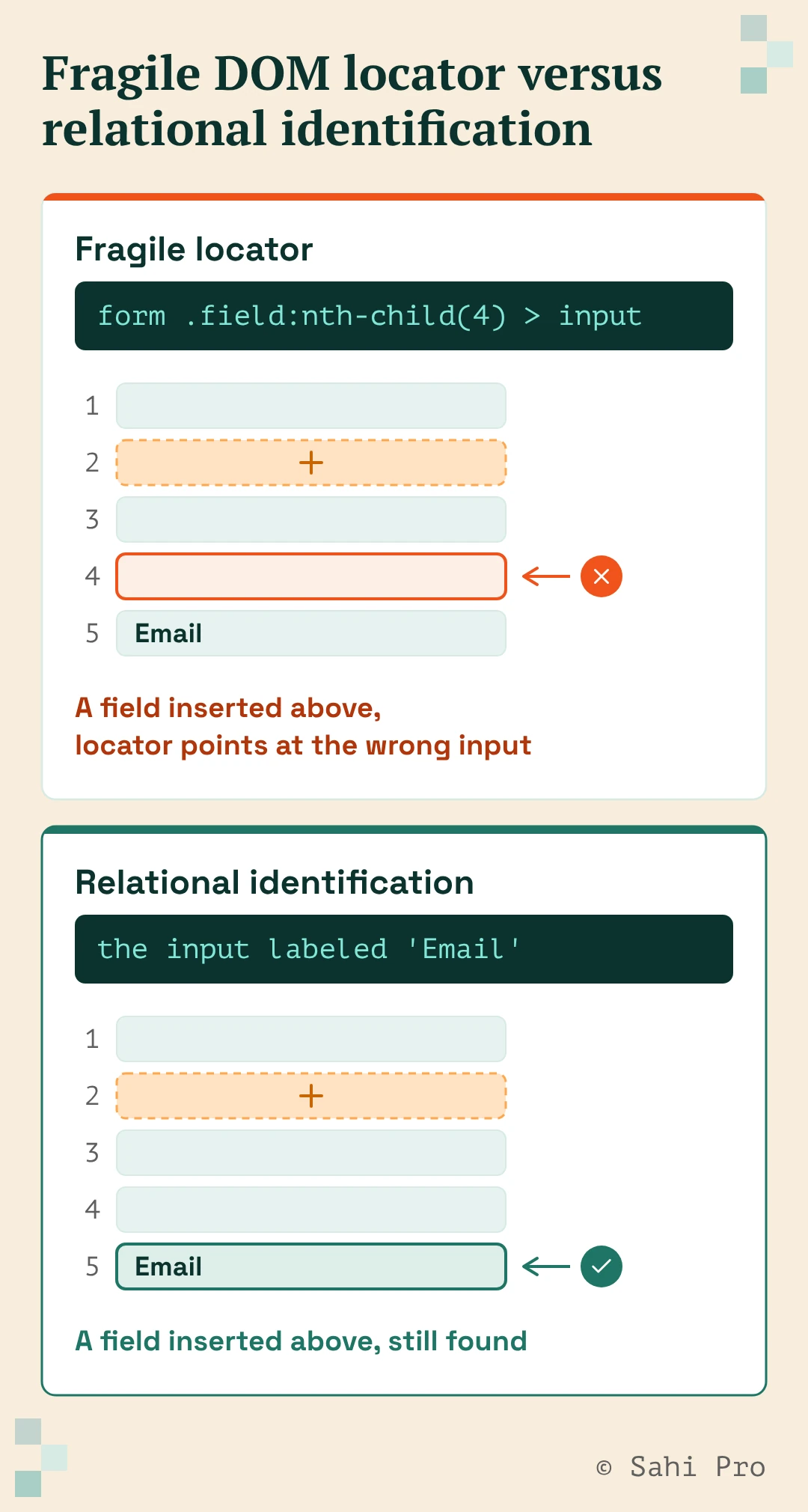
driver.findElement(By.cssSelector(“form .field:nth-child(4) > input”));
// Auto-generated ID: changes on every build in many frameworks
driver.findElement(By.id(“ember-input-427”));
Each one works today and fails on a cosmetic change that did not touch the login behavior. Add a marketing banner div, insert a phone-number field above email, or let the framework regenerate IDs, and all three miss. That is the failure self-healing exists to catch, and it is also the failure a better locator avoids in the first place.
A relationally identified locator describes the element the way a person would, by the visible label it belongs to:
// Intent, not position: “the input associated with the label ‘Email'”
the text field whose label or adjacent text reads “Email”
That description survives the banner, the inserted field, and the regenerated ID, because none of them change the fact that the field still sits with the word Email.
How does self-healing actually resolve a replacement?
Self-healing works by storing more than one way to find each element and scoring candidates when the primary one fails. A traditional test keeps a single selector. A self-healing system keeps a ranked chain of identifiers and a model for picking the right element after a change. The honest versions add a classification step that matters more than the healing itself.
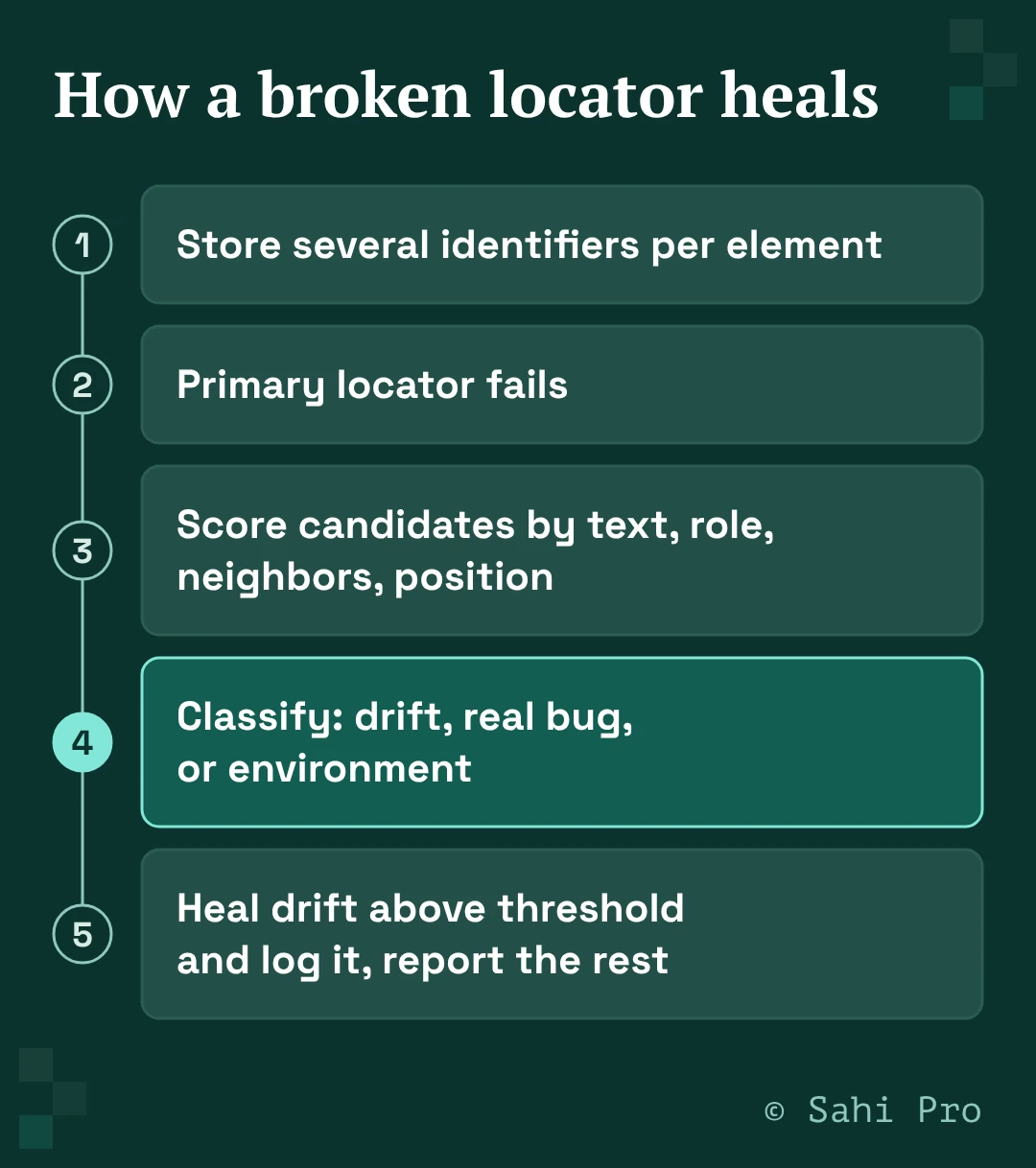
The steps an engine runs:
- Store multiple identifiers per element. A ranked chain such as ID, then name, then ARIA label, then visible text, then relationship to a nearby label, then DOM position, then visual coordinates.
- Detect the broken locator. The primary identifier returns zero matches or more than one, so the engine moves to the next strategy.
- Score the candidates. Rather than take the first fallback, the stronger approach models each candidate’s text, position, size, neighboring elements, and semantic role, and picks the one with the highest overall similarity rather than a match on any single attribute.
- Classify the failure before healing. Sort the result into a locator drift to heal, a genuine missing element or changed behavior to report as a bug, or an environment issue to flag.
- Update and log. If a candidate clears the confidence threshold, update the primary locator and record the change so the heal is auditable.
In plain terms, an illustrative heal decision reads like this, and the exact format and thresholds vary by tool:
LOCATOR DRIFT field “Email”
primary #ember-input-427 -> 0 matches
resolved [name=email] similarity 0.94 (label+role+position)
action healed, locator updated, logged
BEHAVIOR CHANGE button “Submit order”
primary button[data-test=submit] -> 0 matches
nearest candidate similarity 0.41 (below threshold)
action NOT healed, reported as failure
The second case is the important one. When no candidate clears the threshold, the correct output is a reported failure, not a forced relocation.
The risk nobody puts on the slide
The danger in self-healing is the false heal. A system that relocates aggressively without a confidence threshold can bind to the wrong element and mark a real regression as passing, which is worse than a failing test because it gives confidence in broken software. If healing has no audit trail, trust in the suite erodes, because nobody knows what changed or why.
This is why failure classification is the line between a safe self-healing system and a dangerous one. A tool that heals every failure is not a testing tool, it is a tool that makes red turn green. The suite exists to tell you when behavior changed, so a heal must never silence that signal.
The edge cases that trip self-healing
A technical evaluation should push on where healing breaks, because that is where false heals hide:
- Ambiguous labels. Two fields both labeled “Amount” on the same form. Text and label strategies return more than one candidate, so the engine must disambiguate by section or nearest heading, or refuse to heal.
- Localization. Text-based healing keys on visible words, so a locale switch from “Email” to “Correo” breaks every text-anchored locator at once. Relationship and role strategies survive it, pure text does not.
- Dynamic lists and virtualized grids. Rows that render on scroll have no stable position, so position-based fallbacks are useless and the engine has to anchor on row content or a stable row key.
- Shadow DOM and iframe boundaries. Candidates on the other side of a shadow root or iframe are invisible to a flat DOM query, so the engine needs to pierce those boundaries or it will heal to the wrong element in the parent document.
- Near-duplicate components. A design system renders the same card ten times. Similarity scoring on appearance alone is weak here, so the engine must weight unique text content over layout.
A tool that cannot tell you how it handles these is a tool that will false-heal in production.
A steadier approach: don’t depend on a fragile locator
Most healing exists to repair locators that were fragile from the start. Sahi Pro identifies elements by relationship and context, by the label next to a field or the text on a button, so the element is still found after a layout change without any locator to repair. Its engine is proprietary and not built on Selenium or Appium, which is why it reads the page relationally and handles shadow DOM and iframes directly rather than through brittle XPath workarounds. Its Auto-healing feature then covers the cases that remain, and because the engine classifies failures, a real behavior change is still reported. The waits are automatic too, so a test does not act before the application is ready.
What stable identification does to maintenance
Stable identification shows up as maintenance hours, because maintenance is where locator fragility is paid for. In a Sahi Pro benchmark that rebuilt a brittle Selenium suite across equivalent scenarios, regression maintenance fell 80 percent, maintenance effort dropped from a score of 89 to 27, and the number of scenarios the team could cover rose from 23 to 144 with the same people. The hours that went into patching selectors went into coverage instead.
Fewer breaks beats faster repairs
Self-healing is worth having, with one condition. It must classify failures against a confidence threshold and log every change, or it trades broken tests for hidden bugs. The larger win comes earlier, from identifying elements by what they are and what sits beside them, so most UI changes never break the test at all. See how Sahi Pro handles element identification and healing on your own application in a working session.
Sources
- Self-Healing Tests Explained: How AI Fixes Brittle Test Suites, TestSprite, 2026. https://www.testsprite.com/blog/self-healing-tests-explained-how-ai-fixes-brittle-test-suites
- Self-Healing Test Automation: Full Guide (2026), Quashbugs, 2026. https://quashbugs.com/blog/self-healing-test-automation-guide