


Prompt-to-test AI tools are fast. They are also not repeatable, and that’s a bigger problem than it sounds.
TL;DR
- AI tools that generate tests directly from a prompt produce different output each time, even for identical prompts against identical application behavior.
- Non-determinism is fine for exploratory work. It breaks down the moment a test suite needs to be trusted in CI/CD.
- Teams using these tools often can’t explain why a specific test exists or what it was meant to verify, because no human decided that on purpose.
- “Test coverage” loses its meaning when the tests behind that coverage number change every time they’re regenerated.
- The missing piece isn’t a smarter AI model. It’s a verified specification the AI generates tests from, instead of generating tests directly from a prompt.
- Teams evaluating AI test generation should ask one specific question before adopting any tool: run the same prompt twice, and see if you get the same tests.
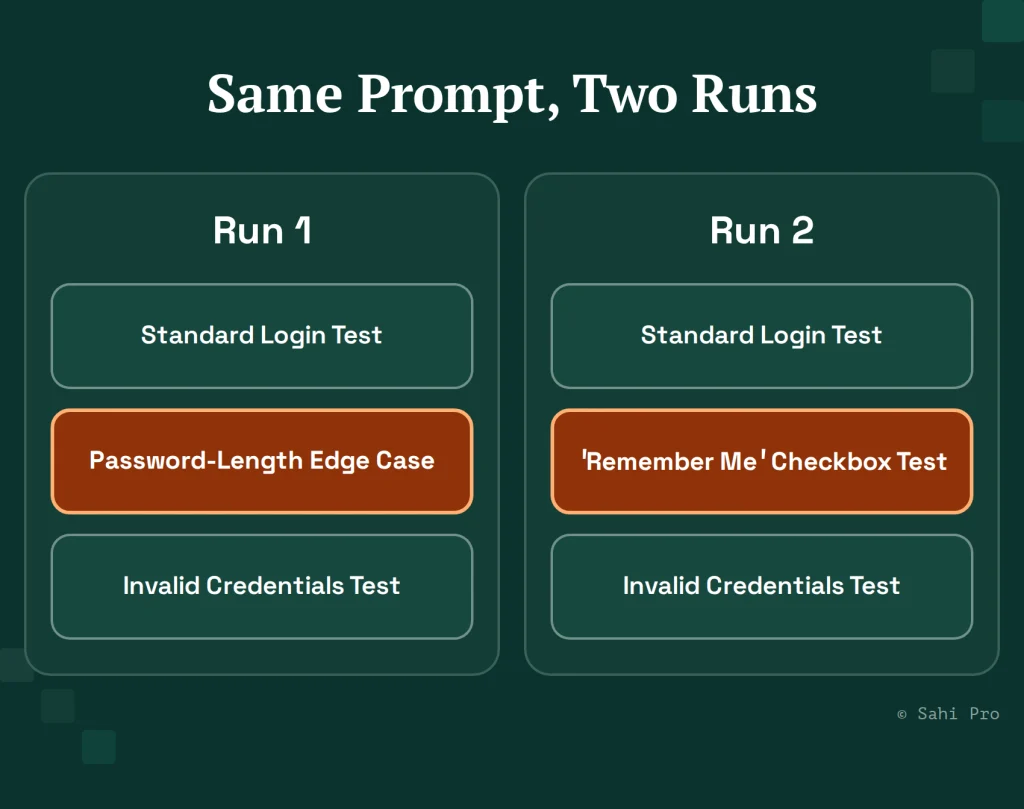
Two engineers on the same team, on the same day, ask the same AI test generation tool to write tests for the same login flow. Same application, same prompt, same tool version.
They get different test cases. Not radically different, but different: one set covers a password-length edge case the other doesn’t. One checks the “remember me” checkbox behavior, the other doesn’t mention it. Neither engineer did anything wrong. Neither set of tests is incorrect. They are just not the same tests, generated from what was supposed to be the same input.
Now scale that to a CI/CD pipeline running thousands of times a month. If the tests aren’t the same run to run, “coverage” stops meaning what everyone assumes it means.
The appeal of prompt-to-test, and why it’s real
Prompt-to-test tools exist because they solve a genuine problem: writing test cases by hand is slow, and a natural-language description of a feature is a fast way to get a first draft of test coverage. Describe the login flow, get test cases back in seconds instead of the hour it would take a QA engineer to write them manually.
For early exploration, this is a legitimate use. A developer wants a quick sense of what edge cases they might be missing. An AI-generated first pass, reviewed critically, can surface things a rushed manual pass would skip.
The appeal breaks down the moment that first pass becomes the system of record for what “tested” means, because a system of record needs to be reproducible, and prompt-to-test output isn’t.
Why non-determinism breaks CI trust
A CI/CD pipeline runs the same test suite over and over, and the entire value of that repetition depends on the tests staying constant between runs, so that a failure means “something in the application changed” rather than “something in the test generation changed.”
Prompt-to-test tools built on large language models inherit those models’ inherent variability. Ask the same model the same question twice and you can get two different, both-reasonable answers, because the model is sampling from a distribution of plausible outputs, not retrieving a fixed answer. That’s a feature for creative writing. It’s a liability for a test suite, because it means a “failure” in CI could mean the application broke, or it could mean the AI generated a different test this time that happens to fail against unchanged application behavior.
Once a QA team has been burned by a handful of false failures traced back to test-generation variance rather than actual regressions, trust in the whole suite erodes fast. Engineers start ignoring red builds “just in case it’s the AI being weird again,” which defeats the entire purpose of automated testing: catching real problems before they reach production.
What “coverage” means when you can’t reproduce it
Test coverage as a metric assumes a fixed set of tests exists that either does or doesn’t exercise a given line or branch of code. That assumption collapses when the test set itself is regenerated and changes shape between generations.
A team using a prompt-to-test tool might report “85% coverage” on Monday and “83% coverage” on Wednesday, with zero application code changes in between, purely because regenerating the tests produced a slightly different set. Neither number is wrong, but neither is meaningfully comparable to the other, and neither tells a QA lead whether the application’s actual risk surface is covered, because the tests behind the number aren’t the same tests.
This matters most in regulated or high-stakes environments, where a coverage report is sometimes the artifact an auditor or compliance reviewer actually asks for. A coverage number attached to a non-reproducible test set doesn’t hold up to that scrutiny, because there’s no way to point to exactly what was tested and reproduce that same test on demand.
The missing layer: a verified spec, not a prompt
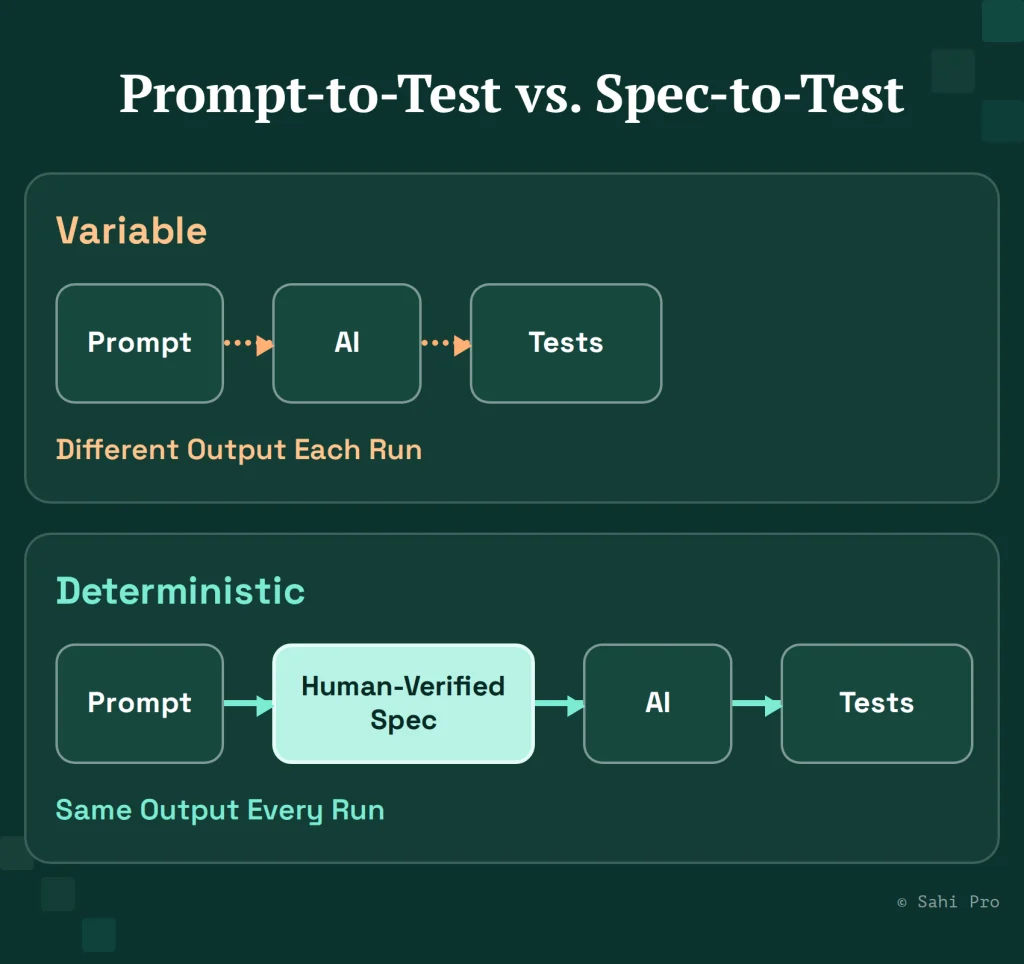
The failure here isn’t that AI is bad at generating tests. It’s that prompt-to-test tools skip a step: they go straight from a loose natural-language description to concrete test cases, with no intermediate artifact a human actually reviewed and confirmed as correct.
A prompt is not a specification. A prompt is an instruction to a model to guess at a specification based on however the prompt was worded, and different wording, or the same wording run twice, can produce different guesses. A specification, by contrast, is a fixed, human-verified description of exactly what should happen: these inputs, these expected outputs, these edge cases explicitly included or explicitly out of scope.
The fix that actually holds up under CI/CD scrutiny isn’t a better prompt or a more advanced model. It’s inserting a verified specification between the human’s intent and the AI’s test generation, so that the AI generates tests from something fixed and reviewed, not from a fresh guess every time. Generate the same tests from the same spec, every time, and the reproducibility problem disappears, because the variance that caused it never enters the process in the first place.
That shift, from prompt-to-test to spec-to-test, is a design decision most teams evaluating AI test tools haven’t been asked to consider yet, because most of the tools on the market aren’t built to make that decision available to them.
Sources
- Anthropic, Model Card documentation on output variability in large language models
- IEEE Software, research on flaky tests and CI/CD trust erosion
- ISTQB (International Software Testing Qualifications Board), foundational material on test coverage and traceability