


Tosca licensing for a 10-person automotive Teamcenter QA team is approximately five times Sahi Pro’s. That gap only matters if Sahi Pro covers the Teamcenter scenarios your team actually runs. This comparison starts there.
TL;DR
- Tosca’s model-based test automation requires TBox-certified engineers for authoring and maintenance, teams without certified staff cannot self-maintain their automation suites
- Sahi Pro uses proximity-based identification with a no-code interface, allowing any QA engineer to author and maintain Teamcenter tests without specialist certification
- Both tools cover Teamcenter Active Workspace and the Java Rich Application Client; the difference is in maintenance overhead after the suite is built and after every Teamcenter upgrade
- Based on a published case study of 10 QA engineers over 12 months targeting 2,000 test cases, Year 1 total cost is approximately $432K for Tosca and $223K for Sahi Pro, with Tosca producing a negative first-year ROI and Sahi Pro producing 35%
- For teams where certified specialists own the automation and budget is not a constraint, Tosca is a defensible choice; for teams where QA engineers need to own their own suite, Sahi Pro closes the capability gap at significantly lower total cost
The Context: What Automotive Teamcenter Teams Are Actually Evaluating
Automotive OEM and Tier 1 supplier QA teams evaluating Teamcenter automation are not choosing between two abstract tools. They are choosing between two organizational models for how automation gets built and maintained.
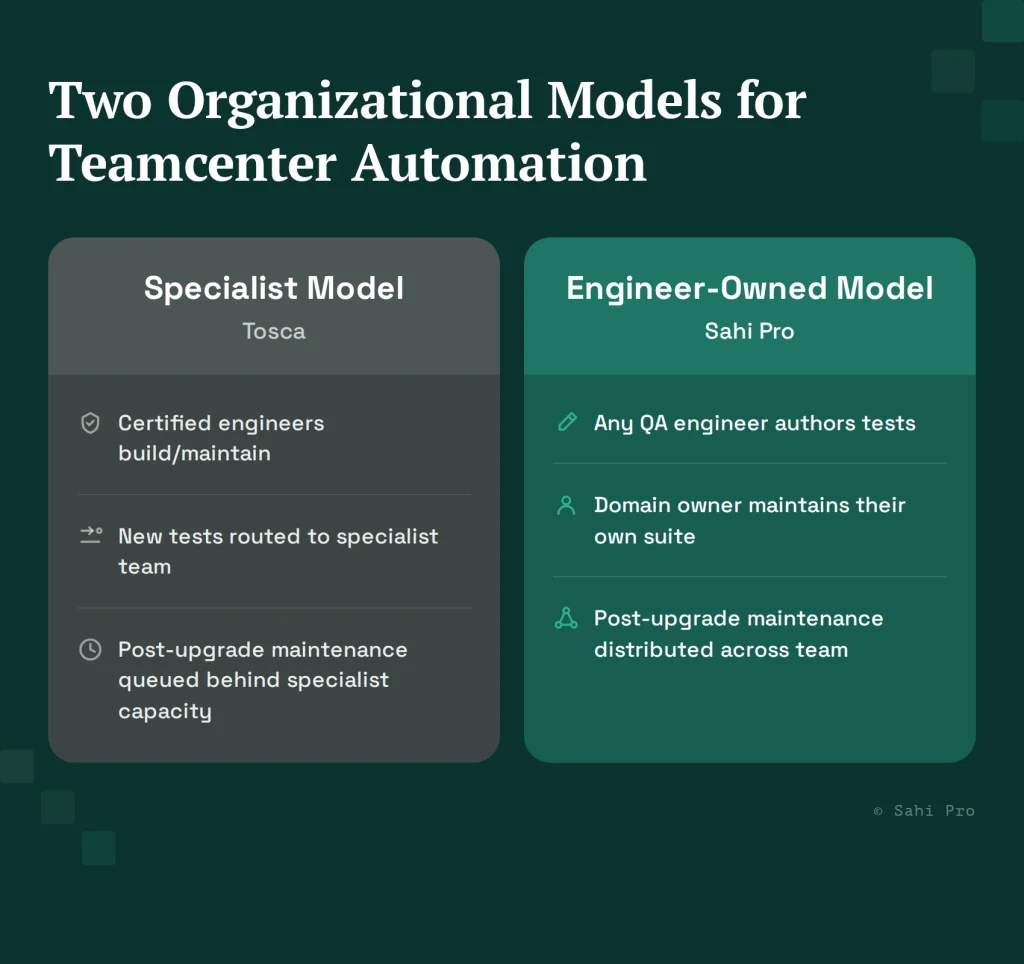
The first model: a centralized automation team of certified specialists builds and maintains the suite on behalf of the QA organization. New test requirements go to the automation team, who develop and deliver scripts. Maintenance after Teamcenter upgrades runs through the same team. This model works when the automation team is adequately staffed, specialist-certified, and protected from competing priorities.
The second model: QA engineers across the team author and maintain their own tests. Each engineer owns the automation for their domain. New requirements are handled by the QA engineer who understands the workflows. Upgrades are handled in-place without routing through a specialist team. This model works when the tool makes authoring accessible to non-specialists and identification is resilient enough that upgrades do not generate large maintenance backlogs.
Tosca is built for the first model. Sahi Pro is built for the second. The choice between them is partly a capability question and partly an organizational design question. Answering the organizational question first makes the capability comparison much cleaner.
What Tosca Does Well on Teamcenter
Tosca has genuine strengths that the comparison must acknowledge honestly, because the teams that select Tosca for Teamcenter do so for real reasons.
Tosca’s model-based architecture creates a structured, governed test asset library. Models are reusable across test cases. When a Teamcenter workflow changes, a single model update propagates across every test that references it. For large programmes with hundreds of Teamcenter test cases and a dedicated automation team, this creates a compounding efficiency advantage over time.
Tosca’s enterprise support organization provides SLA-backed response times and dedicated programme support. For automotive programmes where a Teamcenter outage during a launch programme is a direct cost, having vendor-backed support with defined escalation paths has real value.
Tosca has deep integrations with enterprise test management platforms, qTest, Azure DevOps, Jira, that automotive programmes running formal validation processes use to manage traceability from requirement to test to evidence. These integrations are mature and well-documented.
For programmes running Teamcenter Active Workspace BOM workflows alongside SAP transactions, Tosca covers both in one platform. The coverage breadth across enterprise applications is genuine.
Where Tosca Creates Overhead for Automotive Teamcenter Teams
The overhead compounds in three places, and each place has a specific dollar figure when you calculate it.
Specialist certification. Tosca TBox certification requires six to eight weeks of training. In a team of 10 QA engineers, not all will become certified, typically two to four engineers carry the automation burden for the full team. This creates a bottleneck: when new Teamcenter test requirements arrive, they wait for certified capacity. When Teamcenter upgrades break models, the same certified engineers absorb the maintenance work. The team’s overall automation coverage is constrained by how much certified capacity is available.
Maintenance after Teamcenter upgrades. Tosca model-based identification for Java Rich Client components breaks when major Teamcenter releases restructure the component hierarchy. Model updates require certified specialist involvement, which means the maintenance cost routes through the certification bottleneck described above.
Year 1 cost. The published Sahi Pro vs Tosca case study (10 QA testers, 12 months, 2,000 test cases across web and desktop applications) shows the following numbers: Tosca license and training approximately $120K, Sahi Pro license and training approximately $25K. Total Year 1 cost including tester time for setup, development, and maintenance is approximately $432K for Tosca and $223K for Sahi Pro. Year 1 ROI: Tosca negative at approximately -30%, Sahi Pro positive at approximately +35%.
These figures come from a Sahi Pro-produced case study and should be weighted accordingly. However, the structural cost driver, licensing delta plus specialist certification plus higher maintenance overhead, holds independently of the specific numbers.
How Sahi Pro Handles the Same Teamcenter Scenarios
Sahi Pro’s core technical answer to the Teamcenter automotive context: proximity-based identification for Active Workspace, native Java SWT coverage for the Rich Application Client, OCR for CATIA plugin windows, and a no-code authoring interface that any QA engineer can operate without specialist training.
Active Workspace: Tests locate elements by visible label and spatial context rather than DOM XPath. When Siemens releases an Active Workspace update that restructures the React component tree, which happens with every major release, tests continue resolving elements by what they visibly say and where they visibly sit. A Siemens AG team running 340 Teamcenter BOM tree test cases saw zero script regressions after an Active Workspace 6.x upgrade.
Java Rich Application Client: The Desktop add-on provides native Java Swing, AWT, and SWT access. BOM management panels, engineering change workflows, and part classification interfaces in the RAC run in the same test script as Active Workspace browser automation. No context switch, no second tool.
CATIA plugin windows: The AI Assist OCR add-on reads controls that render outside the browser DOM. Automotive teams running CATIA-integrated Teamcenter workflows, design check automation, CATIA model validation within Active Workspace sessions, require this capability and most tools in the market do not provide it.
Authoring accessibility: Sahi Pro’s no-code flowchart interface lets QA engineers design and run tests without writing code. Engineers who understand Teamcenter workflows author tests for those workflows. The suite is not bottlenecked by certified specialist capacity.
The Numbers Side by Side
The following table reproduces key metrics from the Sahi Pro vs Tosca case study. Numbers assume a team of 10 QA engineers targeting 2,000 test cases over 12 months across web and desktop applications. Source: Sahi Pro published case study.
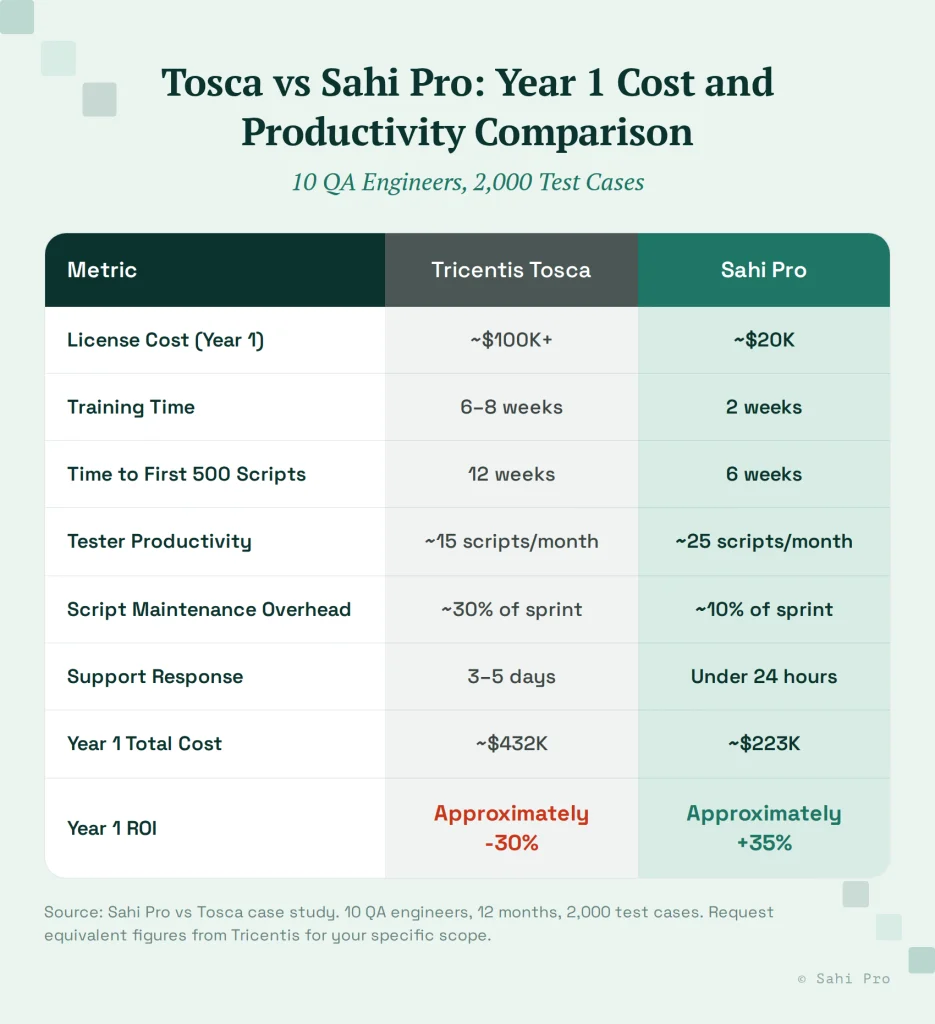
These figures come from Sahi Pro’s own case study material. Teams should request equivalent figures from Tricentis directly for their specific team size and Teamcenter scope before using this comparison as a decision input.
The Other Three Tools: Where UFT One, TestComplete, and Selenium Fit
UFT One has the strongest compliance documentation history in this comparison group and is the right choice for programmes where regulatory audit history and enterprise support SLAs outweigh cost considerations. Java Rich Client coverage is genuine. The primary challenges are licensing cost under OpenText and maintenance overhead when major Teamcenter versions restructure the RAC element tree.
TestComplete handles Active Workspace browser automation and Java Rich Client through its Java bridge with flexible scripting. For automotive teams already running TestComplete for other applications, consolidating Teamcenter coverage avoids adding another vendor. CATIA plugin window automation and IATF 16949-ready records require additional custom development beyond the standard product.
Selenium covers Active Workspace browser workflows reliably. For automotive Teamcenter programmes where browser-portal automation is the only requirement and Java Rich Client workflows are handled by a separate tool or not automated, Selenium is a viable and low-cost starting point. It is included here to represent the open-source baseline rather than as a recommendation for programmes with RAC coverage and compliance record requirements.
Deciding Which Context Favors Each Tool
Tosca is the right answer for programmes with these characteristics: a dedicated centralized automation team with Tosca-certified engineers, a large, relatively stable Teamcenter test suite that benefits from model-based governance, a budget that accommodates Tosca’s Year 1 cost, and an organizational preference for vendor-backed SLA support over internal ownership.
Sahi Pro is the right answer for programmes with these characteristics: QA engineers who need to own their own automation without specialist certification, Teamcenter test scopes that span Active Workspace and the Java Rich Client, CATIA plugin window automation requirements, and programmes where Year 1 ROI is a real budget consideration.
The comparison between the remaining tools is mainly about where an existing tool investment already exists. If UFT One is already deployed for other applications, Teamcenter coverage within UFT One is worth evaluating seriously before adding a new tool. Same for TestComplete.
Sources
- Sahi Pro vs Tosca Case Study: From Overhead to Efficiency, available via Sahi Pro Knowledge Transfer folder
- Sahi Pro: 7 Best Teamcenter Test Automation Tools for BOM and Workflow Testing in 2026 (Siemens AG case study), sahipro.com/best-teamcenter-test-automation-tools-bom-workflow-testing-2026/
- IATF 16949:2016: Quality Management Systems Requirements for the Automotive Industry, iatfglobaloversight.org
- Tricentis Tosca documentation: TBox certification requirements, tricentis.com
- Siemens Teamcenter Rich Application Client and Active Workspace documentation, sw.siemens.com