


Three different bets on how a test survives change, and each one pays off differently the day your PLM vendor ships a version upgrade
TL;DR
- Tosca, UFT, and Sahi Pro represent three distinct automation architectures: model-based, object-repository-based, and relational/proximity-based.
- The real cost difference between them shows up at PLM version upgrades, not at initial build, since each approach breaks differently when the underlying UI changes.
- Tosca’s model-based approach typically requires certified training to operate at scale; UFT’s object repository requires ongoing maintenance as object properties shift; Sahi Pro’s relational APIs are built to tolerate ID and layout changes without re-identifying every element.
- Compliance and audit-trail generation differ across all three, which matters more than raw feature count for regulated-industry buyers.
- This piece gives a framework for weighting the decision to your own environment, not a single declared winner.
Three paradigms, three bets on how a test survives change
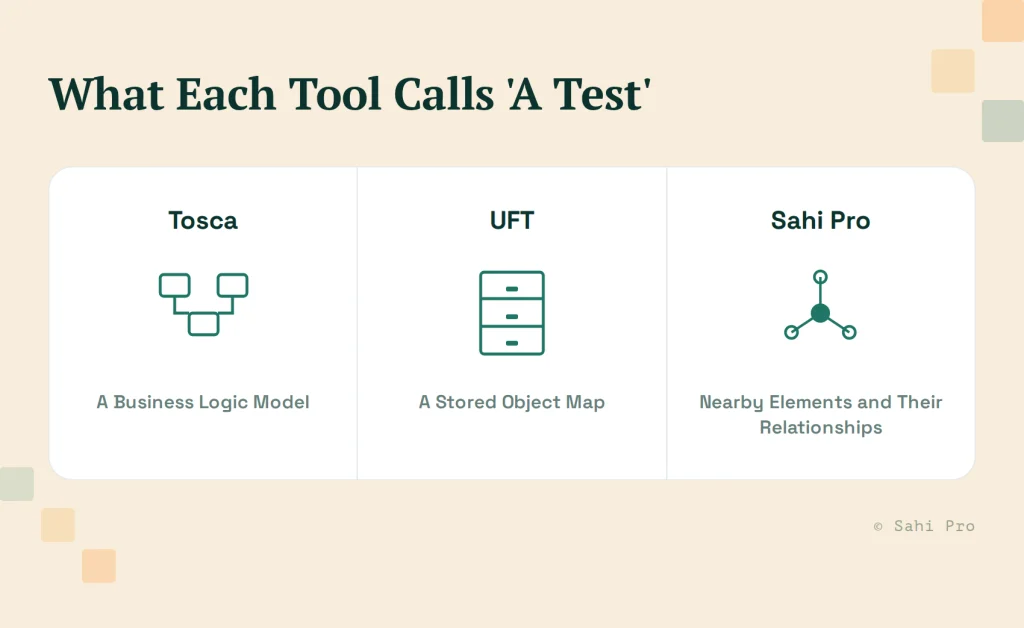
Tosca is a model-based testing tool. Rather than scripting steps directly against the application, Tosca builds a model of the application’s business logic and generates test cases from that model. UFT (formerly QTP) is built around an object repository, a stored map of UI elements and their properties that scripts reference to interact with the application. Sahi Pro identifies elements by relational, proximity-based context rather than storing a fixed object map, which is designed specifically to tolerate the kind of change that breaks the other two approaches. The full architectural breakdown against Tosca specifically is covered in Sahi Pro vs Tricentis Tosca.
Each of these is a genuine engineering bet on what a test “is.” For Tosca, a test is a path through a business model. For UFT, a test is a script that references a stored object map. For Sahi Pro, a test is a description of what an element is near, not where it sits in a fixed object tree.
How each handles a Teamcenter, Windchill, or ENOVIA upgrade
Consider a Teamcenter upgrade that restyles a form or moves a button. In a model-based Tosca setup, the underlying business model may still hold if the workflow’s logic hasn’t changed, but any modules mapped directly to the old UI layout typically need remodeling. In a UFT object repository, a moved or restyled element frequently changes underlying object properties, which breaks the stored reference and requires updating the repository entry. In Sahi Pro, because identification is proximity-based rather than fixed-position, a moved button that retains its relationship to nearby labels or fields often continues to resolve correctly without a script update.
None of these outcomes is universal. The specific severity depends on what changed and how each product’s model or repository was built in the first place. The pattern worth testing directly, on your own environment, is how much manual rework each approach demands after a real upgrade, not a theoretical one. This is the same upgrade-resilience question covered from an automotive-OEM angle in PLM Testing Best Practices: What QA Leads at Automotive OEMs Get Right.
Migration effort if you’re moving from an existing suite
Teams moving from UFT to Tosca are typically re-architecting scripts into models, a substantial upfront investment that pays off if the underlying business logic is stable across future UI changes. Teams moving from either UFT or Tosca to Sahi Pro are generally reworking element identification logic rather than an entire modeling layer, since Sahi Pro’s relational approach does not require a stored object map or a business-logic model to be built first. Be honest with your team about switching costs in either direction. Migration effort is a real cost of any change, not just a one-time inconvenience to absorb.
Cost of ownership at enterprise scale
Licensing models and effective cost per seat vary significantly by vendor, contract structure, and negotiated enterprise terms, and current figures should be confirmed directly with each vendor rather than assumed from list pricing. What’s more stable across time is the shape of the cost: Tosca’s model-based approach concentrates cost in initial model-building and certified skill development, since Tricentis offers formal Tosca certification programs for this reason. UFT’s cost concentrates in ongoing object repository maintenance as the application evolves. Sahi Pro’s enterprise customers report an 80% reduction in test maintenance relative to conventional tools, which shifts the cost profile toward the maintenance side of the ledger specifically.
Compliance and audit-trail generation across all three
Regulated-industry buyers, automotive IATF 16949, medical device 21 CFR Part 11, industrial ISO standards, care about audit-grade documentation as much as raw automation capability. All three tools can produce execution logs and reporting; the differences show up in how directly that reporting maps to a compliance framework versus requiring custom reporting work on top of the tool. This is worth verifying directly against your specific compliance requirement before assuming any of the three covers it out of the box, and it’s a large part of what separates a general PLM automation tool roundup from one built for a regulated environment specifically.
A framework for weighting this decision to your own priorities
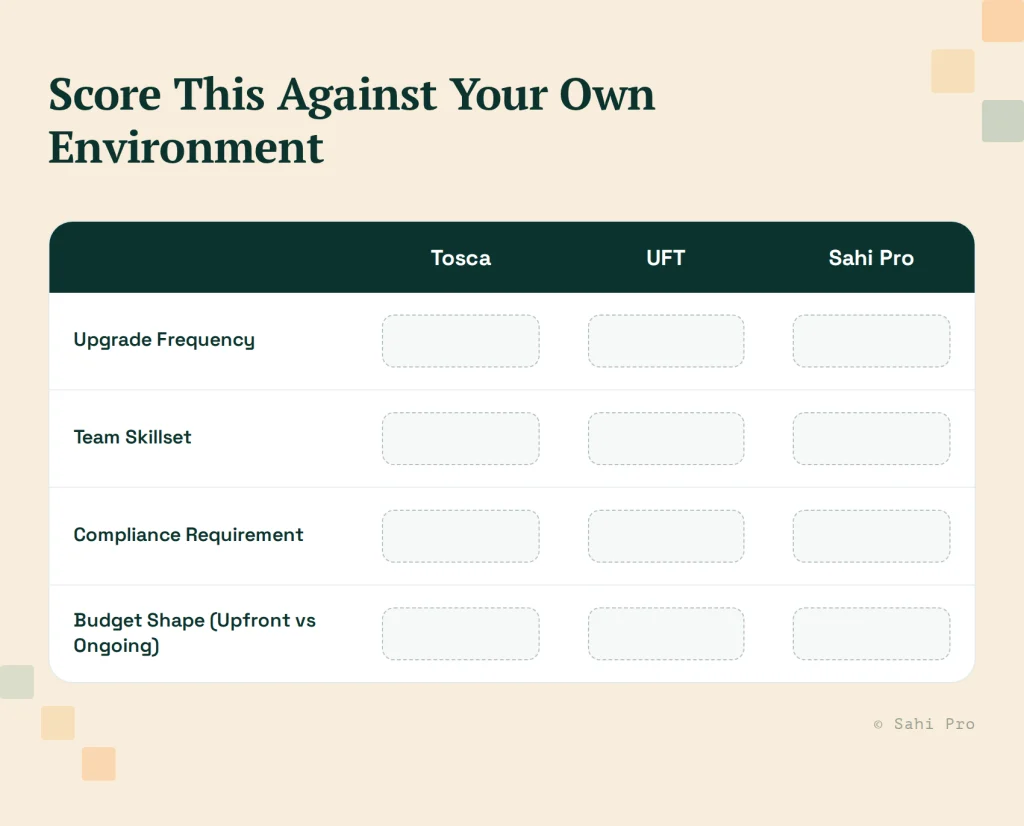
Rather than declaring a single winner, weigh four factors against your own environment: how frequently your PLM platform issues version upgrades that touch your test surface, your team’s existing skillset (certified Tosca modelers, UFT scripters, or QA staff without a coding background), your specific compliance and audit requirements, and your available budget for either upfront model-building or ongoing maintenance. A team with certified Tosca staff and a stable business-logic layer may have a very different right answer than a team that just lost its one UFT scripter and needs testers to author scripts without a coding background.
Sources
- Sahi Pro vs Tricentis Tosca
- Tricentis Tosca product and certification documentation (Tricentis)
- OpenText UFT One product documentation (OpenText)
- Siemens Teamcenter, PTC Windchill, and Dassault ENOVIA/3DEXPERIENCE architecture documentation