



A semiconductor QA lead searches this blog for Windchill guidance and finds it split between aerospace compliance and general manufacturing throughput, neither addressing the actual problem: 40 ECOs landing in a single sprint, each touching a BOM with hundreds of part variants
TL;DR
- Windchill’s Java thick client and canvas-rendered attribute grids create the same automation ceiling for semiconductor manufacturers as for any other industry running the platform.
- What changes for semiconductor and electronics specifically is velocity: engineering change order (ECO) volume and BOM variant count are typically far higher than in general manufacturing, which makes test maintenance cost the deciding factor, not just initial coverage.
- Six tools are ranked here specifically on Java Rich Client BOM coverage, canvas-rendered attribute grid handling, and how each approach holds up under high ECO velocity and version-upgrade churn.
- This is the third Windchill platform piece on this blog across two months, scoped to semiconductor/electronics specifically, distinct from the Manufacturing and Aerospace QA pieces already calendar-scheduled for August.
- A high-mix BOM revision scenario, one ECO touching a parent assembly and a dozen variant child parts, is used as the running example throughout.
Why this is a different Windchill question than the other two on this blog
Two other Windchill pieces are already scheduled for this blog’s August calendar, one scoped to general manufacturing, one to aerospace QA teams. Neither addresses what actually distinguishes a semiconductor or electronics manufacturer’s Windchill usage: not a new technical layer, the Java thick client and canvas rendering are the same everywhere Windchill runs, but volume. A semiconductor BOM structure commonly carries hundreds of part variants across a product family, and ECOs, formal change requests that update part specifications, revisions, or relationships, land far more frequently than in general manufacturing, where product changes tend to be less frequent and less variant-heavy. This piece is scoped to that velocity question directly, rather than asking a semiconductor reader to extrapolate from content built around a different industry’s change cadence.
What Windchill’s Java thick client and canvas layer mean for a semiconductor BOM
PTC Windchill’s PDMLink runs as a web portal, but BOM management, revision control, and several administrative functions still route through a Java thick client, and attribute grids inside that interface render on canvas rather than as standard, addressable DOM elements. For a semiconductor BOM specifically, this matters at the exact point where volume is highest: editing attribute values across a large set of variant child parts, a workflow that lives almost entirely inside the canvas-rendered grid layer, not the web portal’s standard forms.
A tool with no path into the Java thick client or canvas layer can typically confirm a BOM record exists and that a workflow was triggered, but can’t verify the actual attribute edits landed correctly across a dozen or more variant parts in a single ECO, which is precisely the high-volume, high-error-risk part of the workflow this evaluation needs to cover.
The six tools, ranked on semiconductor/electronics Windchill fit
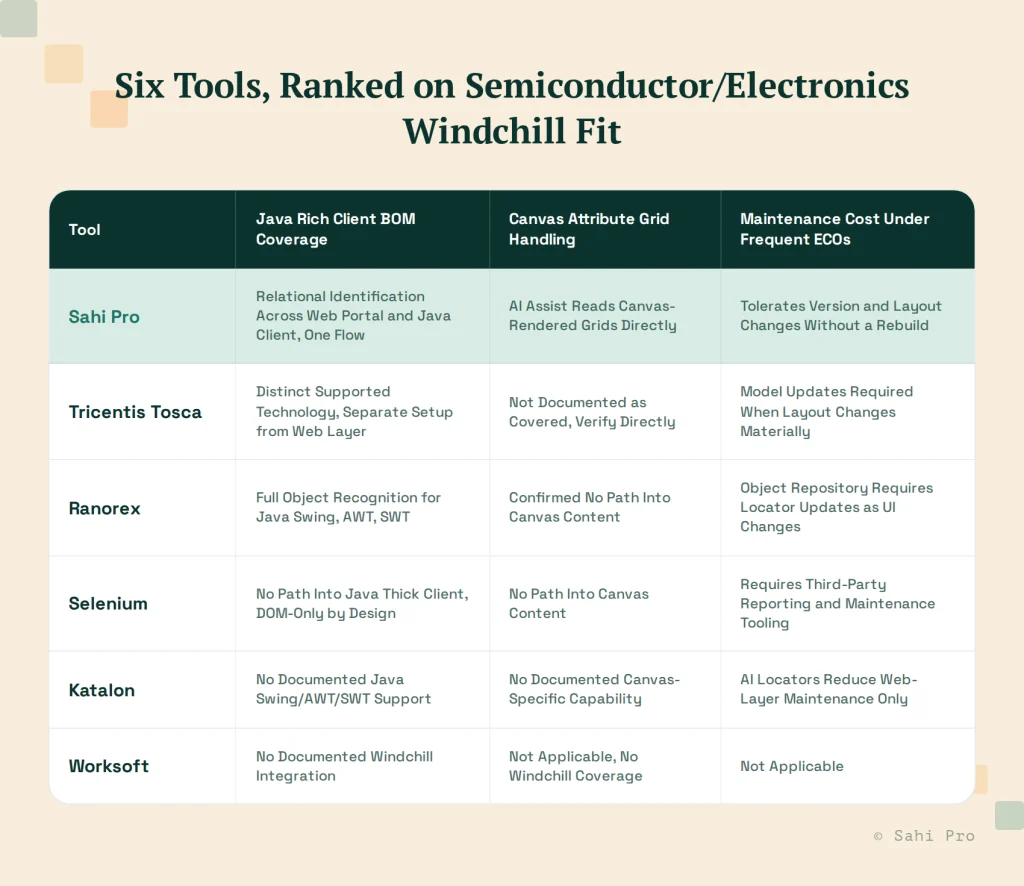
Sahi Pro identifies elements relationally across both the Windchill web portal and the Java thick client, letting a single test flow follow an ECO from its web-portal initiation into the Java client’s BOM management screens without a tool handoff. For the canvas-rendered attribute grid specifically, AI Assist reads the rendered region directly, since no object model exists there for any recognition-based approach to query. This combination is what lets a single flow validate an attribute edit across a dozen variant child parts in one continuous script.
Tricentis Tosca documents Java desktop application support as a distinct supported-technology category from its web engine, with its own dedicated engine documentation separate from the web-testing configuration. This means the Java thick client portion of a Windchill workflow needs its own setup within Tosca rather than being covered automatically by a web-layer configuration, and canvas-rendered content needs its own verification on top of that, worth confirming against Tosca’s current documented capability directly rather than assuming coverage either way.
Ranorex genuinely stands out here relative to the other web-focused tools on this list: it documents full object recognition for Java Swing, AWT, and SWT applications specifically, which means it has a real, working path into Windchill’s Java thick client, not just standard Windows technologies. Where it falls short for this specific evaluation is canvas-rendered content: Ranorex’s own support community confirms that a canvas element is treated as a single image with no addressable elements inside it, with no out-of-the-box solution, only coordinate-based clicking as a workaround, the same ceiling that applies to any object-recognition-based tool once content stops being exposed as recognizable objects at all.
Selenium has no path into the Java thick client by design, since WebDriver operates against the DOM and the Java thick client exposes none. For a semiconductor BOM workflow that routes through that layer for the bulk of its attribute editing, this is a hard boundary on how much of the actual workflow Selenium can cover.
Katalon‘s documented desktop testing scope is Windows-technology-specific (UWP, WinForms, WPF, Win32), with no documented Java Swing, AWT, or SWT support, the same limitation covered in this blog’s dedicated Katalon Java-layer comparison. This rules out the Java thick client portion of a Windchill BOM workflow entirely.
Worksoft documents PLM support limited to Siemens Teamcenter, with no documented Windchill-specific integration at all, consistent with its core focus on SAP and enterprise application automation rather than PTC’s platform specifically.
A high-mix ECO scenario, walked through
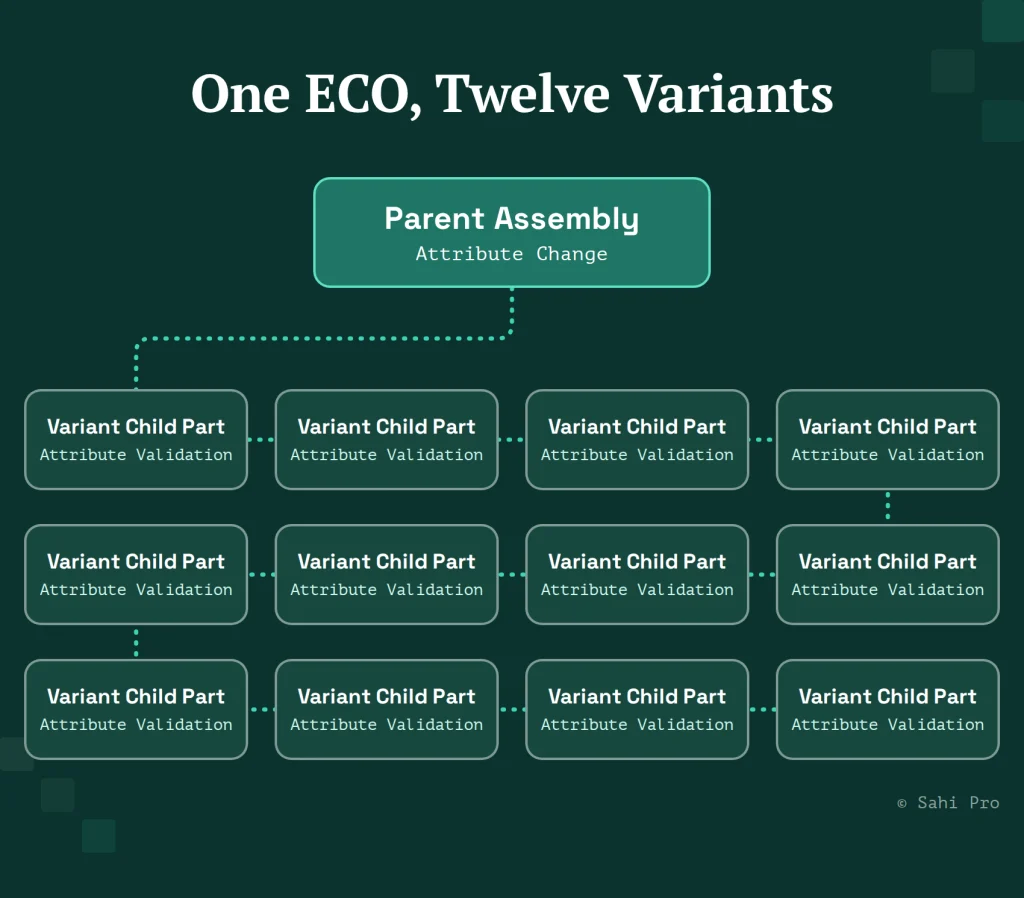
Consider a routine semiconductor ECO: a parent assembly’s specification changes, and that change cascades to twelve variant child parts sharing the same base design but differing in a handful of attributes, package type, pin count, or tolerance class, for instance. Validating this ECO means confirming the parent assembly’s attribute update landed correctly, then confirming each of the twelve variant children inherited or correctly overrode that change in the canvas-rendered attribute grid, a workflow that’s almost entirely BOM-and-grid work rather than standard web-form interaction.
A tool without Java thick client and canvas coverage can confirm the ECO was submitted and routed for approval, but can’t verify any of the twelve variant-level attribute outcomes, which means the actual validation work still falls to a person, manually checking each variant, for the exact category of change that happens most frequently in this industry.
Why maintenance cost matters more here than in a lower-ECO-velocity industry
A tool that requires script or model rework after every Windchill version upgrade, UI tweak, or attribute grid layout change carries a real cost regardless of industry, but that cost compounds differently depending on how often it’s triggered. In a general manufacturing environment where ECOs land monthly, occasional rework is an annoyance. In a semiconductor or electronics environment where ECOs land weekly or more, the same rework cadence turns into a standing tax on the QA team’s time, since every layout tweak or version bump potentially touches dozens of variant-part test scripts rather than a handful. This is the same underlying relational-identification-versus-fixed-locator distinction covered elsewhere on this blog, applied here to a specific volume of change that makes the distinction matter more, not differently.
Sources
- 6 Best Teamcenter Test Automation Tools for Semiconductor Companies
- PLM Test Automation Tools for High-Mix Manufacturing
- Sahi Pro vs Katalon
- PTC Windchill Java Platform Support documentation (support.ptc.com), and PTC’s Engineering Change Order overview (ptc.com/en/blogs/plm)
- Ranorex Java test automation documentation (ranorex.com/java-test-automation), confirms full Swing/AWT/SWT object recognition, verified this session
- Ranorex support community, HTML5 canvas element limitation thread (ranorex.info), confirms no addressable elements inside canvas content, verified this session
- Tricentis Tosca supported technologies page (tricentis.com) and Java Engine 3.0 documentation reference (documentation.tricentis.com), confirms Java as a distinct supported technology with its own engine, verified this session
- Worksoft Certify documented integrations and scope (worksoft.com)
- Katalon Studio desktop testing documentation (katalon.com/desktop-testing)