

Mabl’s self-healing AI locators are genuinely strong at web apps, right up until the app in question has a Java thick client Mabl was never built to see
TL;DR
- Mabl is an AI-native platform purpose-built for web, mobile, API, and AI-application testing, with self-healing test recovery built into its core architecture.
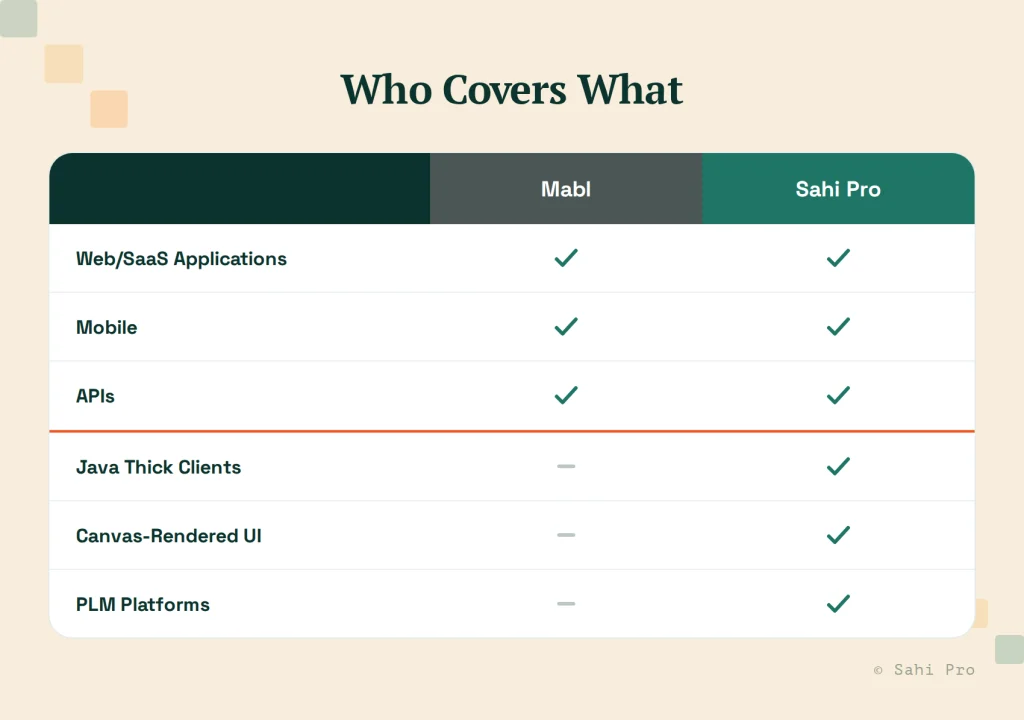
- Mabl’s documented platform coverage does not extend to desktop applications, Java thick clients, or PLM systems.
- Sahi Pro covers web, desktop, Java Rich Client, canvas-rendered UI, and API inside a single flow, but does not offer Mabl’s AI-native self-healing model built specifically for modern SaaS web testing.
- For most readers, this is a complement scenario, not a replace scenario: the two tools serve different parts of the same organization’s testing surface.
- The deciding factor is which of your testing surfaces each tool actually covers, not which tool is generally “better.”
What Mabl is actually built for
Mabl is an AI-native testing platform with self-healing built into its core design. When a test encounters an app change or an unexpected UI state mid-run, Mabl’s platform investigates the failure automatically, classifying whether it reflects a genuine regression or environmental noise, and keeps the pipeline moving rather than simply failing the run. Its documented coverage spans web applications, mobile (iOS and Android), APIs, including direct Postman collection integration, and increasingly, validation of AI-powered application features. For a team building and shipping a modern SaaS product on a continuous deployment cycle, this is a strong, purpose-built fit.
Where that strength runs into a wall at PLM
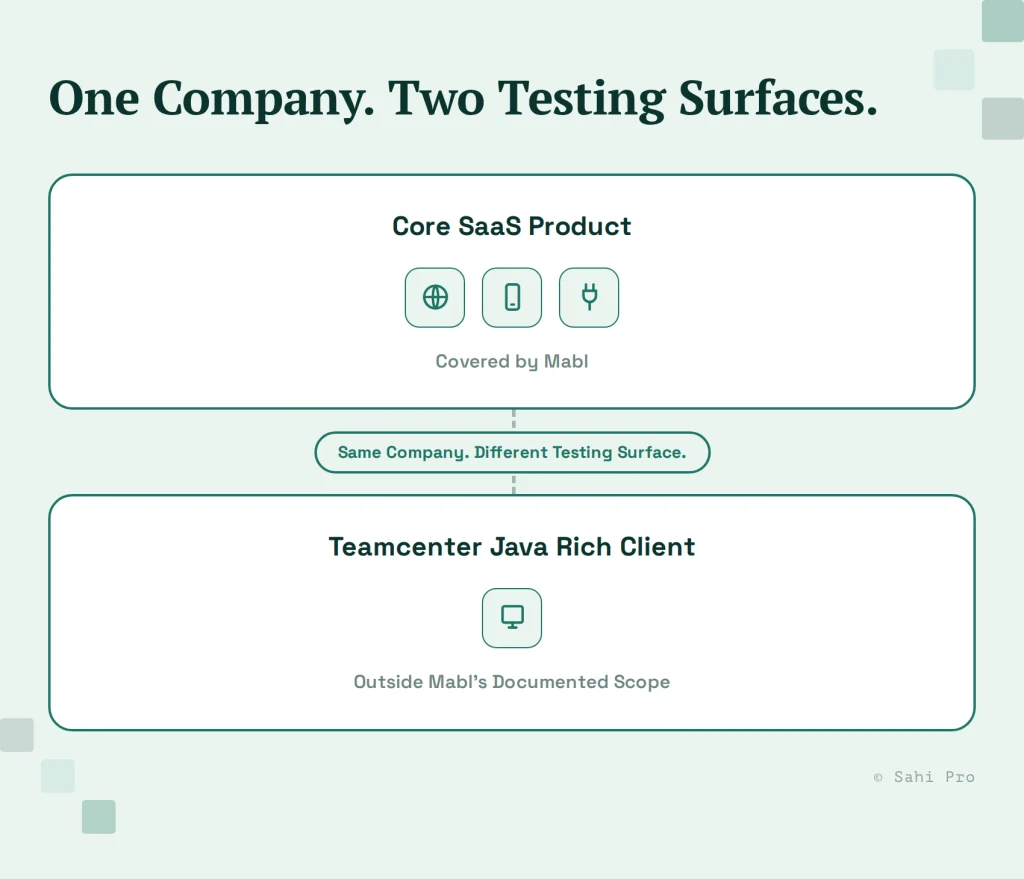
Mabl’s documented platform coverage does not extend to desktop applications, Java thick clients, or PLM systems. This reflects a deliberate scope decision: Mabl is built for the web, mobile, and API layer, not for native desktop rendering. The same web-layer boundary shows up in Sahi Pro’s comparison against Selenium, a different tool with a similar structural limit.
Picture a company running Mabl successfully across its core SaaS product, then acquiring a manufacturing division that runs Siemens Teamcenter. Teamcenter’s Active Workspace has a modern web interface, but BOM management and several administrative workflows still route through a Java Rich Client built on Swing and AWT, a layer with no DOM for a web-focused AI locator strategy to identify. A Mabl script pointed at a Teamcenter Java dialog has nothing to self-heal against, because there’s no web-based object model there to begin with. This exact platform gap is why Teamcenter-specific automation tools exist as their own category rather than being covered by general web-testing platforms.
How Sahi Pro approaches the same PLM scenario
Sahi Pro identifies elements by relational, proximity-based context across web, Java Rich Client, and canvas-rendered UI in a single test flow, and for canvas-painted elements with no exposed object model at all, AI Assist reads the rendered region directly. For the Teamcenter scenario above, that means a single script can move from the Active Workspace web interface into the Java thick client without switching tools or frameworks. This is the specific gap Sahi Pro is built to close, not a general claim that it out-performs Mabl at web testing.
The realistic team setup: both tools, different scope
Most teams in this situation are not choosing one tool over the other. They’re running Mabl for their core web/SaaS product, where its AI-native self-healing genuinely earns its place, and Sahi Pro for the PLM or desktop scope Mabl was never built to reach. In practice this means keeping test reporting organized by testing surface rather than trying to force one unified dashboard across fundamentally different application layers, and making sure CI/CD pipeline stages are scoped so each tool runs against the part of the estate it’s actually built for.
When you’d actually need to choose one over the other
If your entire testing surface is modern web or SaaS with no desktop, Java thick-client, or PLM component anywhere in scope, Mabl alone may be sufficient, and introducing Sahi Pro’s desktop and canvas capabilities would be unnecessary for a testing surface that doesn’t have that problem. Sahi Pro’s differentiators matter specifically where a Java thick client, canvas-rendered UI, or PLM platform is part of what you’re testing, a scope covered in more depth across the PLM test automation framework roundup. Where none of that is present, this comparison doesn’t change your decision.
Sources
- Mabl platform documentation (mabl.com/platform)
- Mabl auto-healing tests documentation (mabl.com/auto-healing-tests)
- Siemens Teamcenter Active Workspace and Java Rich Client architecture documentation (Siemens Digital Industries Software)