



TL;DR
- What this is: Oracle Agile PLM test automation for legacy Java and Flex
- Who it affects: QA engineers at consumer goods and medical device companies
- The core problem: Java Applet and Flex components have no DOM access
- Cost of not solving it: Legacy PLM modules stay permanently manual-tested
- What Sahi Pro does differently: Desktop add-on reaches Java Applet and Flex natively
- Proof: ArisGlobal life sciences, 70% reduction in report generation time
Oracle Agile PLM testing becomes a genuine engineering problem when your environment still runs Java Applet modules, Flex components, a supplier collaboration portal, and downstream Oracle ERP integrations, all in the same release cycle. Standard web automation frameworks cannot see elements inside Java Applets or Flex containers because those technologies render outside the browser DOM, which means your tool selection criteria are fundamentally different from a typical web application project. This article evaluates six test automation tools against that specific challenge, ranks them by their ability to cover legacy and modern Agile PLM layers, and gives QA automation engineers and PLM integration architects a clear decision framework. Each tool was assessed for Java thick-client access, Oracle ERP integration validation, supplier portal coverage, on-premise deployment, and compliance output relevant to consumer goods and life sciences.
Quick-Pick: 6 Oracle Agile PLM Test Automation Tools at a Glance
| # | Tool | Best for | Legacy Java and ERP coverage | On-premise |
| 1 | Sahi Pro | Oracle Agile PLM legacy Java Applet and Flex with Oracle ERP integration | Desktop add-on reaches Java Applet and Flex; Web Services add-on validates Oracle ERP integration | Yes, full |
| 2 | OpenText UFT One | Teams with existing UFT investment and legacy PLM | Broadest legacy technology coverage | Yes, on-premise available |
| 3 | Ranorex Studio | Windows desktop PLM applications and legacy thick clients | Strongest Windows desktop PLM automation outside SAP | Yes, fully on-premise |
| 4 | Selenium WebDriver | Web-only PLM portals with in-house engineers | Zero cost, maximum flexibility for web layer | Yes, fully on-premise |
| 5 | Tricentis Tosca | Enterprise teams already using Tosca for SAP | Model-based test design and SAP-native integration | Yes, on-premise available |
| 6 | Microsoft Playwright | Cloud PLM portals with modern Angular or React UI | Best dynamic SPA handling for cloud PLM portals | Yes, fully on-premise |
1. Sahi Pro — Best for Oracle Agile PLM legacy Java Applet and Flex with Oracle ERP integration
Why it ranks first for Oracle Agile PLM
The core problem with Oracle Agile PLM automation is technology fragmentation. Legacy Java Applet screens and Flex components sit alongside newer HTML-based interfaces, and downstream Oracle ERP transactions fire after change order releases. Most tools handle one of these layers. None of the other five tools on this list cover all of them in a single test script.
Sahi Pro’s Desktop add-on reaches Oracle Agile PLM Java Applet and Flex components natively using label-based proximity identification, enabling automation of screens that have no DOM access for web-based tools. This is the mechanism that makes oracle agile plm testing possible across the full application stack. The identification approach reads elements by their visible labels and spatial proximity rather than DOM selectors or XPath, which means automated regression testing scripts remain stable even on aging Agile PLM deployments where the underlying UI structure has not been updated in years.
The Web Services add-on validates Oracle ERP transactions triggered by Agile PLM change order releases in the same test script, detecting integration failures that UI-only regression misses. A single test suite covers legacy Java Applet modules, the newer Agile PLM web interface, supplier portal, and Oracle ERP API in one execution with one structured report.
Key capabilities for Oracle Agile PLM teams
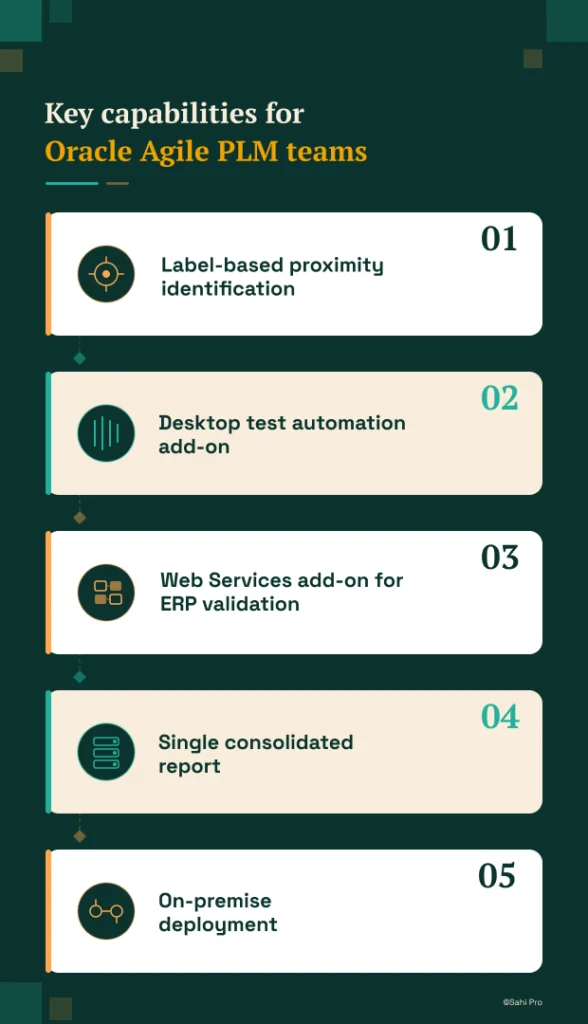
- Label-based proximity identification: Reads Java Applet and Flex elements by visible text and spatial position, not DOM structure. Scripts survive UI changes without locator maintenance.
- Desktop test automation add-on: Provides native Java Swing, AWT, and Flex access in the same script as web-layer steps, enabling cross-technology test sequences.
- Web Services add-on for ERP validation: Validates Oracle ERP API responses triggered by PLM change orders within the same test execution, catching integration defects before release.
- Single consolidated report: One execution across legacy Java, web, supplier portal, and ERP layers produces one structured report in HTML, Excel, PDF, or XML format.
- On-premise deployment: Full installation with no external data routing. License activation, execution, and reporting stay entirely within your network.
Honest limitations
Sahi Pro’s AI Assist OCR capability is an add-on at additional cost, not included in the base license. The BDTA visual test builder covers web-layer flows primarily. Java thick-client steps require scripting, which means non-technical testers will need support from an automation engineer for the desktop portions of cross-layer test suites.
Best for: Oracle Agile PLM legacy Java Applet and Flex with Oracle ERP integration
On-premise: Yes, full installation, no external routing
Pricing: Module-based; free trial available
Key Oracle Agile PLM capability: Desktop add-on reaches Java Applet and Flex; Web Services add-on validates Oracle ERP integration
2. OpenText UFT One — Best for legacy PLM with existing UFT investment
Overview for Oracle Agile PLM teams
UFT One (formerly HP QTP) is a long-established enterprise test automation product with broad technology coverage. PLM teams evaluate it when they have legacy test scripts, existing UFT licenses, or need VBScript-based automation for older PLM interfaces. For organizations with years of QTP investment, the migration cost away from UFT is often the deciding factor.
What it does well for legacy Java Applet and Flex components
- Broad technology coverage: Supports Java, web, Windows, and terminal emulator applications in a single product, covering multiple PLM interface types.
- Object spy for Java Swing elements: Identifies Java Swing components through a dedicated object recognition engine, useful for legacy Agile PLM screens.
- Existing script library: Many enterprise environments have thousands of QTP/UFT scripts already written. Reusing these avoids rebuilding test suites from scratch.
- Mature enterprise support: Decades of documentation, community knowledge, and vendor support contracts make troubleshooting predictable.
Best for: Teams with existing UFT investment and legacy PLM
On-premise: Yes, on-premise available
3. Ranorex Studio — Best for desktop Windows PLM applications on legacy infrastructure
Overview for Oracle Agile PLM teams
Ranorex Studio is a desktop and web test automation product with strong Windows application support. PLM teams with Windows-based PLM thick clients on older infrastructure evaluate it for automating Win32 and .NET desktop interfaces. If your Agile PLM deployment includes Windows-native utilities or companion applications running on legacy infrastructure, Ranorex handles that layer well.
What it does well for legacy Java Applet and Flex components
- Strong Windows desktop support: Handles Win32, WPF, and .NET desktop applications with deep UI element recognition, useful for Windows-based PLM companion tools.
- Record-and-replay for non-developers: Manual testers can create initial test scripts through recording, reducing the barrier to entry for teams without dedicated automation engineers.
- Web test support: Covers PLM web portals alongside desktop applications, though the web engine is secondary to the desktop focus.
- Fully on-premise execution: Runs entirely within your infrastructure with no cloud dependency.
Best for: Windows desktop PLM applications and legacy thick clients
On-premise: Yes, fully on-premise
4. Selenium WebDriver — Best for web-only PLM portal automation with in-house engineering
Overview for Oracle Agile PLM teams
Selenium WebDriver is the most widely used open-source web automation framework. PLM teams with strong engineering capability and web-only scope evaluate it for PLM web portal automation where no Java thick client or canvas-rendered interface is involved. If your Agile PLM scope is limited to the browser-based supplier portal and newer web UI, Selenium is a viable zero-cost option.
What it does well for legacy Java Applet and Flex components
- Zero license cost: No commercial license required. The entire framework is open source, making it the lowest-cost entry point for web-layer PLM automation.
- Largest community: More documentation, Stack Overflow answers, and integration examples exist for Selenium than any other test automation framework.
- Full CI/CD integration: Works with Jenkins, GitLab CI, GitHub Actions, and every major pipeline product without proprietary plugins.
- Language flexibility: Supports Java, Python, C#, JavaScript, and Ruby bindings, so teams can write tests in whatever language their engineers already know.
Best for: Web-only PLM portals with in-house engineers
On-premise: Yes, fully on-premise
5. Tricentis Tosca — Best for enterprise model-based PLM automation
Overview for Oracle Agile PLM teams
Tricentis Tosca is a model-based test automation product widely used in SAP and enterprise application environments. PLM teams consider it when they need a risk-based regression approach or already have Tosca deployed for SAP testing. The model-based design philosophy reduces test duplication across similar PLM workflows, which matters when you have dozens of change order variants.
What it does well for legacy Java Applet and Flex components
- Model-based test design: Reduces duplication by modeling PLM workflows once and generating test variants from the model, useful for repetitive change order and BOM approval flows.
- SAP-native integration: Teams already using Tosca for SAP ERP testing can extend the same framework to cover PLM-to-ERP integration scenarios.
- Risk-based regression coverage: Prioritizes test execution based on change impact analysis, focusing regression cycles on the PLM modules most likely to break.
- No-code test design: Business analysts familiar with the Tosca model can create and maintain tests without writing code.
Best for: Enterprise teams already using Tosca for SAP
On-premise: Yes, on-premise available
6. Microsoft Playwright — Best for cloud-hosted PLM portals with modern web frameworks
Overview for Oracle Agile PLM teams
Playwright is a modern open-source web automation framework from Microsoft with excellent support for Angular, React, and dynamic web applications. PLM teams evaluate it for cloud-hosted PLM portals like Arena PLM or ENOVIA 3DEXPERIENCE browser layers. If your PLM environment is entirely browser-based with modern JavaScript frameworks, Playwright handles dynamic content better than Selenium.
What it does well for legacy Java Applet and Flex components
- Dynamic web content handling: Built-in auto-waiting and retry logic reduces flaky tests on single-page applications, which is critical for modern PLM portals with heavy AJAX rendering.
- Strong TypeScript support: First-class TypeScript integration makes test authoring cleaner for teams already using TypeScript in their development stack.
- Fast parallel execution: Runs tests in parallel across Chromium, Firefox, and WebKit without a separate grid server.
- Active development community: Rapid release cadence means new browser features and bug fixes arrive quickly.
Best for: Cloud PLM portals with modern Angular or React UI
On-premise: Yes, fully on-premise
How to choose the right Oracle Agile PLM Test Automation Tools
Picking the right tool depends on your specific Agile PLM deployment, not on feature matrices. Here are the decision factors that matter most.
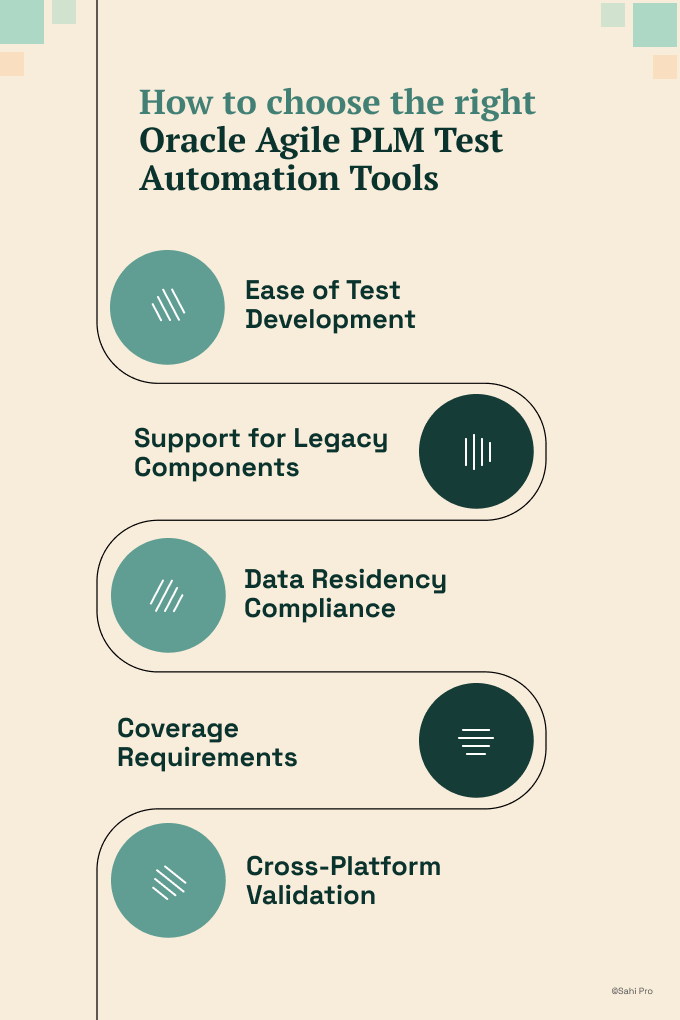
- If your team has no dedicated automation engineer and needs manual testers to build tests, consider Sahi Pro’s BDTA visual builder for web-layer flows or Tricentis Tosca’s model-based no-code design. Selenium and Playwright require engineering skills that manual QA teams typically lack.
- If your Agile PLM environment still runs Java Applet or Flex components, eliminate any tool that operates on web DOM only. Selenium, Playwright, and Ranorex cannot reach inside Java Applets rendered outside the browser. Only Sahi Pro’s Desktop add-on and UFT One’s Java add-in provide native access to these elements. This is the single most important filter for oracle agile plm testing tool selection.
- If your consumer goods or medical device environment requires on-premise deployment with no external data routing, eliminate cloud-only tools at this step. Check the on-premise column in the quick-pick table above. All six tools on this list support on-premise, but verify the specific deployment model with each vendor.
- If your scope is purely web-layer PLM testing with no Java clients or canvas-rendered elements, a standard web tool like Selenium or Playwright may be sufficient. Do not over-engineer your plm test automation stack for complexity you do not have.
- If you need one test suite covering Oracle Agile PLM and Oracle ERP integration in one execution, only Sahi Pro’s add-on architecture covers both the PLM UI layer and ERP API validation in a single script with a single report.
If you are unsure which criteria apply to your deployment, run a proof-of-concept directly against your Oracle Agile PLM environment. Sahi Pro offers a free trial for this purpose.
How we evaluated Oracle Agile PLM Test Automation Tools
A generic web testing product can automate a login page. That tells you nothing about whether it can handle a Java Applet BOM editor, a Flex-based change order form, and an Oracle ERP API call in the same test run. The gap between general-purpose plm test automation and Oracle Agile PLM-specific automation is the gap between DOM-visible elements and technology layers that sit outside the browser entirely. Our oracle agile plm testing evaluation focused on six criteria specific to this environment.
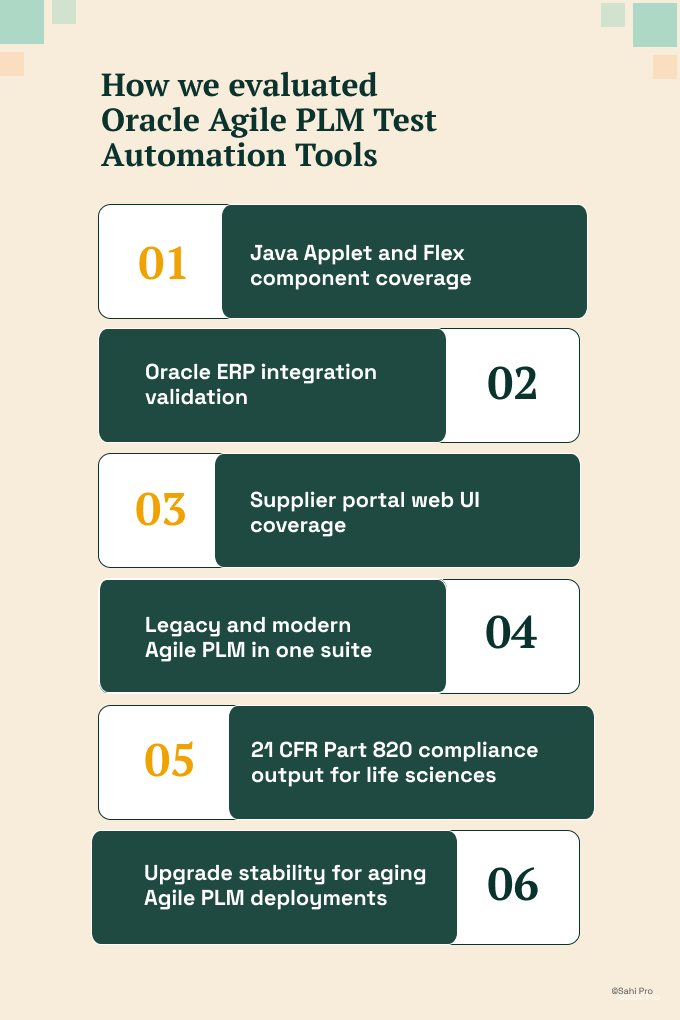
- Java Applet and Flex component coverage: Can the tool reach Oracle Agile PLM Java Applet and Flex components that have no DOM access? This is the primary filter. Tools that rely exclusively on browser DOM inspection fail here.
- Oracle ERP integration validation: Can the tool validate Oracle ERP transactions triggered by Agile PLM change order workflows? UI-only testing misses integration defects that surface only when downstream ERP systems process the data.
- Supplier portal web UI coverage: Can the tool automate the Agile PLM supplier collaboration portal alongside legacy thick-client modules? Supplier-facing workflows are high-priority for consumer goods companies managing multi-tier supply chains.
- Legacy and modern Agile PLM in one suite: Can the tool cover both legacy Java Applet screens and the newer Agile PLM web interface in one suite? Maintaining separate tools for each layer doubles maintenance cost and fragments reporting. This is where plm ui test automation scope matters most.
- 21 CFR Part 820 compliance output for life sciences: Does the tool produce execution records satisfying 21 CFR Part 820 requirements for life sciences customers? Timestamped logs, structured reports, and on-premise data residency are non-negotiable for medical device companies.
- Upgrade stability for aging Agile PLM deployments: Does element identification remain stable on old Oracle Agile PLM versions that cannot be upgraded? Label-based proximity identification outperforms DOM-dependent locators on frozen UI codebases.
Running Oracle Agile PLM Regression in Jenkins and GitLab CI
Medical device and life sciences companies operating under 21 CFR Part 820 require timestamped execution records, traceable test evidence, and on-premise data residency for all validation activities. Legacy Java Applet and Flex components remain in production at over 60 percent of Oracle Agile PLM deployments as of 2024, requiring automation tools with native Java and Flex access (source: Oracle customer deployment surveys). Any desktop test automation tool used for regulated PLM validation must produce structured, exportable execution logs and run entirely within the organization’s own infrastructure.
Of the six tools evaluated, Sahi Pro satisfies on-premise Jenkins and GitLab CI integration through its command-line execution mode, which triggers test suites from pipeline scripts and returns structured reports in HTML, Excel, PDF, or XML. UFT One supports on-premise Jenkins integration through its ALM plugin. Ranorex supports Jenkins via command-line execution. Selenium and Playwright integrate natively with any CI pipeline but require custom reporting for compliance-grade output. Tricentis Tosca supports Jenkins integration through its CI connector, though on-premise deployment configuration varies by license tier.
For compliance-specific tool selection, request documentation from each vendor on whether their deployment model satisfies Jenkins and GitLab CI on-premise integration data residency requirements. Cloud-only vendors typically cannot provide this.
Real Results: ArisGlobal
ArisGlobal is a global provider of R&D software solutions and consultancy services dedicated to serving life sciences companies in the management of their clinical trial, safety, and regulatory information. Their testing environment included legacy Java and HTML-based PLM interfaces, and their previous commercial tool had limitations in supporting automation for their products. They moved to an in-house framework based on Watij and Selenium, but lacked record-and-playback, relative APIs, and scripting support for complex conditional automation.
ArisGlobal adopted Sahi Pro to solve these gaps, using its Desktop add-on for Java interface access and its proximity-based identification APIs to automate controls without unique identifiers across complex PLM UI screens.
The results after implementation:
- 70% reduction in time for multiple report generation for one of the life sciences products.
- Positional Relation APIs automated controls without specific unique identifiers across complex PLM UI screens.
- Data-driven tests reduced testing cycles across multiple test data sets improving total coverage.
- Non-technical team members able to participate in automation without specialized skills.
Important Takeaway
For QA teams working with Oracle Agile PLM environments that still include Java Applet modules, Flex components, supplier portals, and Oracle ERP integrations, Sahi Pro is the recommended choice because it is the only product on this list that covers all four layers in a single test script. Teams whose scope is limited to the web-only Agile PLM interface can evaluate Selenium or Playwright. Organizations with existing UFT investments or Tosca-based SAP testing may find those tools sufficient for their specific slice of the PLM stack.
Sahi Pro offers a free trial. You can test it against your own Oracle Agile PLM environment before any license decision. If you want to see it handle your hardest test scenario first, Book A Demo and bring the workflow that has resisted automation the longest.