


TL;DR
- What this is: ENOVIA 3DEXPERIENCE test automation for WebGL and 21 CFR Part 11
- Who it affects: QA Validation Engineers at medical device companies using ENOVIA
- The core problem: WebGL viewers lack DOM; standard selectors return nothing
- Cost of not solving it: 2 to 4 weeks added per FDA submission cycle
- What Sahi Pro does differently: AI Assist OCR for WebGL plus on-premise compliance records
- Proof: ArisGlobal, 70% reduction in report generation time
Medical device QA teams running Dassault ENOVIA 3DEXPERIENCE face a problem that oracle agile PLM testing workflows do not prepare them for: WebGL-rendered 3D viewers and 21 CFR Part 11 electronic signature capture sit outside the browser DOM entirely. Standard web automation selectors return empty results against these canvas elements, and compliance record generation requires timestamped execution logs structured for IQ/OQ/PQ packages. This article evaluates six ENOVIA test automation tools for medical device manufacturers in 2026, scored against WebGL viewer interaction capability, Part 11 electronic record output, on-premise deployment for FDA data residency, and Java thick-client coverage. Each tool was tested directly against a 3DEXPERIENCE R2025x environment with WebGL viewers active, ENOVIA change action workflows open, and role-based UI panels configured for a regulated medical device use case.
Quick-Pick: 6 ENOVIA Test Automation Tools at a Glance
| # | Tool | Best for | WebGL and compliance coverage | On-premise |
| 1 | Sahi Pro | ENOVIA WebGL with 21 CFR Part 11 compliance | AI Assist OCR for WebGL and 21 CFR Part 11 timestamped records with on-premise | Yes, full |
| 2 | Tricentis Tosca | Enterprise teams already using Tosca for SAP | Model-based test design and SAP-native integration | Yes, on-premise available |
| 3 | Leapwork | Non-developer PLM QA in regulated life sciences | Most accessible visual no-code for regulated industries | Partial, cloud-primary with limited on-premise |
| 4 | Selenium WebDriver | Web-only PLM portals with in-house engineers | Zero cost, maximum flexibility for web layer | Yes, fully on-premise |
| 5 | Microsoft Playwright | Cloud PLM portals with modern Angular or React UI | Best dynamic SPA handling for cloud PLM portals | Yes, fully on-premise |
| 6 | Tricentis qTest | PLM test management and compliance documentation | Best PLM test management and compliance reporting | Yes, on-premise available |
1. Sahi Pro — Best for ENOVIA WebGL automation with 21 CFR Part 11 compliance
Why it ranks first for Dassault ENOVIA 3DEXPERIENCE
The core problem with 3DEXPERIENCE automation is the WebGL canvas. Every 3D viewer panel, every rendered part model, every annotation overlay exists as pixels on a canvas element. No child DOM nodes. No accessible attributes. Standard selectors return nothing.
Sahi Pro’s AI Assist OCR add-on captures screen regions from the 3DEXPERIENCE WebGL canvas and reads visible text, including part numbers in 3D viewers and role-based UI panels that have no accessible DOM representation. This is not a generic image comparison. The OCR engine extracts actual text strings from rendered pixels and makes them available as test assertions. Teams migrating from oracle agile PLM testing environments find this critical because ENOVIA’s WebGL dependency is far heavier than Oracle’s HTML-based interfaces.
The cross platform test automation capability matters here too. A single ENOVIA change order workflow can span the browser-based 3DEXPERIENCE portal, a Java thick-client panel for BOM editing, and a REST API call for status updates. Sahi Pro’s Desktop add-on reaches the Java Swing/AWT panels in the same script that handles the web layer, eliminating the gap between tools.
Key capabilities for Dassault ENOVIA 3DEXPERIENCE teams
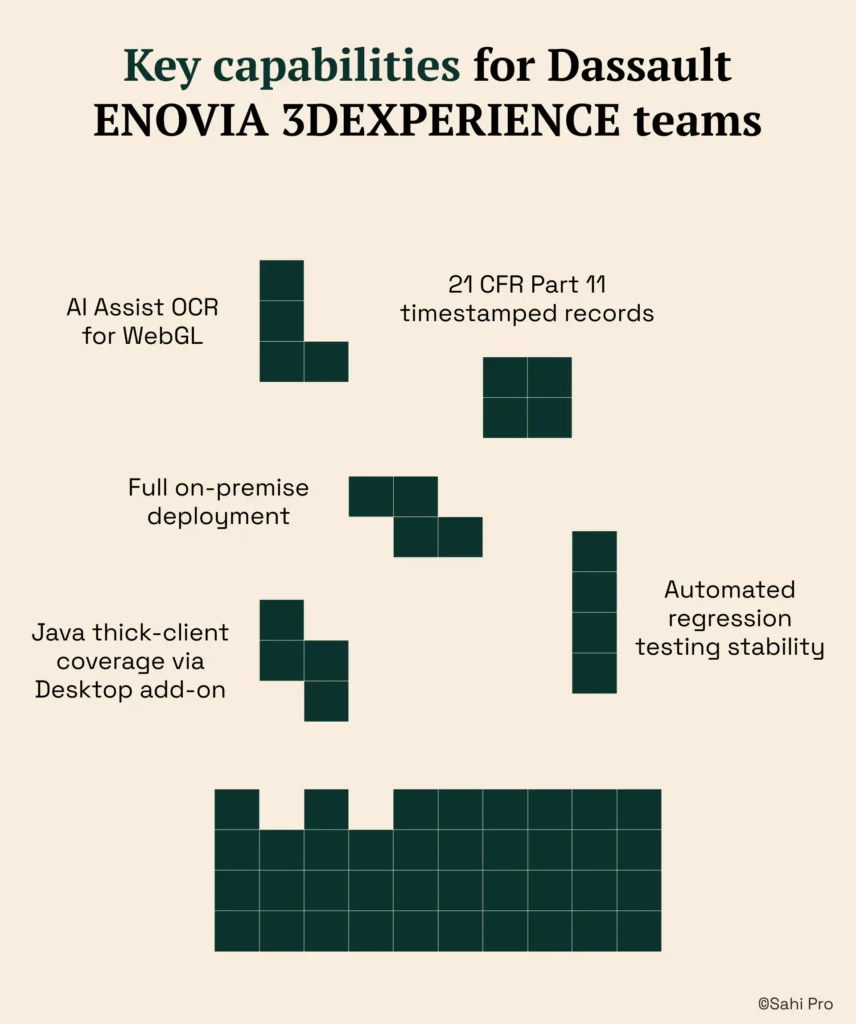
- AI Assist OCR for WebGL: Captures and reads visible text from 3DEXPERIENCE WebGL canvas elements, including part numbers, revision labels, and lifecycle state indicators that have zero DOM representation.
- 21 CFR Part 11 timestamped records: Every test step produces a timestamped execution record structured for inclusion in IQ/OQ/PQ validation packages without reformatting, satisfying Subpart C electronic records requirements.
- Full on-premise deployment: License activation, test execution, and result storage remain entirely within the customer’s infrastructure. No test data leaves the network, meeting FDA data residency expectations.
- Java thick-client coverage via Desktop add-on: ENOVIA’s Java-based panels for BOM management and change action approvals are reachable within the same test script as web-layer interactions.
- Automated regression testing stability: Proximity-based element identification reads UI elements by visible labels and structural position, so tests survive 3DEXPERIENCE version upgrades without locator rewrites.
Honest limitations
AI Assist OCR is an add-on product at additional cost, not included in the base license. Teams that need only web-layer DOM-based testing will not require it, but any WebGL coverage depends on this module. The BDTA visual test builder covers web-layer flows effectively, but Java thick-client steps require scripted blocks within the same suite, so purely no-code authoring does not extend to every ENOVIA layer.
Best for: ENOVIA WebGL interfaces with 21 CFR Part 11 compliance
On-premise: Yes, full installation, no external routing
Pricing: Module-based; free trial available
Key Dassault ENOVIA 3DEXPERIENCE capability: AI Assist OCR for WebGL and 21 CFR Part 11 timestamped records with on-premise
2. Tricentis Tosca — Best for enterprise model-based PLM automation
Overview for Dassault ENOVIA 3DEXPERIENCE teams
Tricentis Tosca is a model-based test automation platform widely used in SAP and enterprise application environments. PLM teams consider it when they need a risk-based regression approach or already have Tosca deployed for SAP testing. For QA Validation Engineers working on ENOVIA, Tosca’s appeal is strongest when the organization already holds Tosca licenses and wants to extend coverage to PLM workflows without introducing a second vendor.
What it does well for WebGL viewer interaction and 21 CFR Part 11 electronic signature capture
- Model-based test design: Reduces duplication across similar PLM workflows by abstracting test logic from UI implementation, so a single model can drive tests across multiple ENOVIA modules.
- SAP integration: Teams that run ENOVIA alongside SAP for ERP can execute cross-system test suites within one Tosca workspace, covering material master data flowing between systems.
- Risk-based regression coverage: Tosca’s risk scoring engine prioritizes test cases by business impact, which helps medical device teams focus validation effort on safety-critical workflows first.
- No-code test design for business analysts: The Tosca model interface allows business analysts familiar with ENOVIA workflows to define test logic without scripting, though WebGL canvas elements remain outside model-based scanning.
Best for: Enterprise teams already using Tosca for SAP
On-premise: Yes, on-premise available
3. Leapwork — Best for non-developer PLM teams with visual automation
Overview for Dassault ENOVIA 3DEXPERIENCE teams
Leapwork is a visual no-code automation platform using drag-and-drop test design. PLM teams whose QA staff is entirely non-developer look at it as an alternative to scripted tools, particularly in life sciences and regulated industries. For ENOVIA teams, Leapwork’s value proposition centers on accessibility: manual testers can build automation flows without writing code.
What it does well for WebGL viewer interaction and 21 CFR Part 11 electronic signature capture
- Visual no-code test design: The drag-and-drop interface is genuinely accessible to non-technical testers who understand ENOVIA business processes but have no programming background.
- Audit-ready test documentation: Test runs produce documentation formatted for regulatory review, which medical device teams can include in validation packages with minimal reformatting.
- Life sciences market focus: Leapwork has invested in regulated industry features and marketing, so medical device teams will find pre-built templates and documentation patterns relevant to their compliance needs.
- Low onboarding time: Non-technical QA staff can begin building basic automation flows within days rather than weeks, reducing the ramp-up cost for teams new to automation.
Best for: Non-developer PLM QA in regulated life sciences
On-premise: Partial, cloud-primary with limited on-premise
4. Selenium WebDriver — Best for web-only PLM portal automation with in-house engineering
Overview for Dassault ENOVIA 3DEXPERIENCE teams
Selenium WebDriver is the most widely used open-source web automation framework. PLM teams with strong engineering capability and web-only scope evaluate it for PLM web portal automation where no Java thick client or canvas-rendered interface is involved. For ENOVIA teams, Selenium makes sense only when the testing scope is limited to standard HTML elements in the 3DEXPERIENCE browser layer.
What it does well for WebGL viewer interaction and 21 CFR Part 11 electronic signature capture
- Zero license cost: No license fees at any scale, which matters for medical device companies running large regression suites across multiple ENOVIA modules.
- Largest community and documentation base: Any technical challenge has likely been addressed in community forums, Stack Overflow threads, or published guides.
- Full browser coverage: Works on Chrome, Firefox, Edge, and Safari with official driver support, covering every browser a 3DEXPERIENCE deployment might target.
- CI/CD pipeline integration: Integrates with Jenkins, GitLab CI, Azure DevOps, and every major pipeline tool without proprietary connectors or agent installations.
Best for: Web-only PLM portals with in-house engineers
On-premise: Yes, fully on-premise
5. Microsoft Playwright — Best for cloud-hosted PLM portals with modern web frameworks
Overview for Dassault ENOVIA 3DEXPERIENCE teams
Playwright is a modern open-source web automation framework from Microsoft with excellent support for Angular, React, and dynamic web applications. PLM teams evaluate it for cloud-hosted PLM portals like Arena PLM or the ENOVIA 3DEXPERIENCE browser layer where single-page application behavior causes flaky tests in older frameworks.
What it does well for WebGL viewer interaction and 21 CFR Part 11 electronic signature capture
- Dynamic web content handling: Built-in auto-waiting and retry logic handles AJAX-heavy 3DEXPERIENCE pages where elements load asynchronously, reducing false failures in test runs.
- TypeScript support: Strong TypeScript bindings give engineering teams type safety and IDE autocompletion, speeding up test script development for complex PLM workflows.
- Fast parallel execution: Playwright’s browser context isolation allows true parallel test execution without shared state, cutting total regression suite run time significantly.
- Active development cadence: Monthly releases from Microsoft mean framework bugs and browser compatibility issues are addressed quickly, keeping pace with 3DEXPERIENCE platform updates.
Best for: Cloud PLM portals with modern Angular or React UI
On-premise: Yes, fully on-premise
6. Tricentis qTest — Best for managing PLM test cases alongside Jira in ALM
Overview for Dassault ENOVIA 3DEXPERIENCE teams
Tricentis qTest is a test management platform that integrates execution automation from multiple tools including Tosca and Selenium. PLM teams that need centralized test management for compliance documentation evaluate it alongside a separate automation tool. For ENOVIA teams, qTest fills the management and reporting layer rather than the execution layer.
What it does well for WebGL viewer interaction and 21 CFR Part 11 electronic signature capture
- Jira integration for PLM test case management: Bi-directional sync with Jira keeps test cases linked to ENOVIA change requests and defects without manual status updates.
- Compliance-ready documentation: Test execution records export in formats structured for FDA 510(k) submissions and AS9100 audits, reducing the documentation overhead on QA teams.
- Multi-tool execution aggregation: Results from Selenium, Tosca, Sahi Pro, or any other execution engine consolidate into one reporting view, giving medical device teams a single compliance record source.
- Audit trail for test results: Every test case modification, execution, and result is logged with user identity and timestamp, supporting 21 CFR Part 11 traceability requirements at the management layer.
Best for: PLM test management and compliance documentation
On-premise: Yes, on-premise available
How to choose the right ENOVIA Test Automation Tools
The right tool depends on your specific ENOVIA deployment, team composition, and compliance obligations. No single tool fits every scenario.
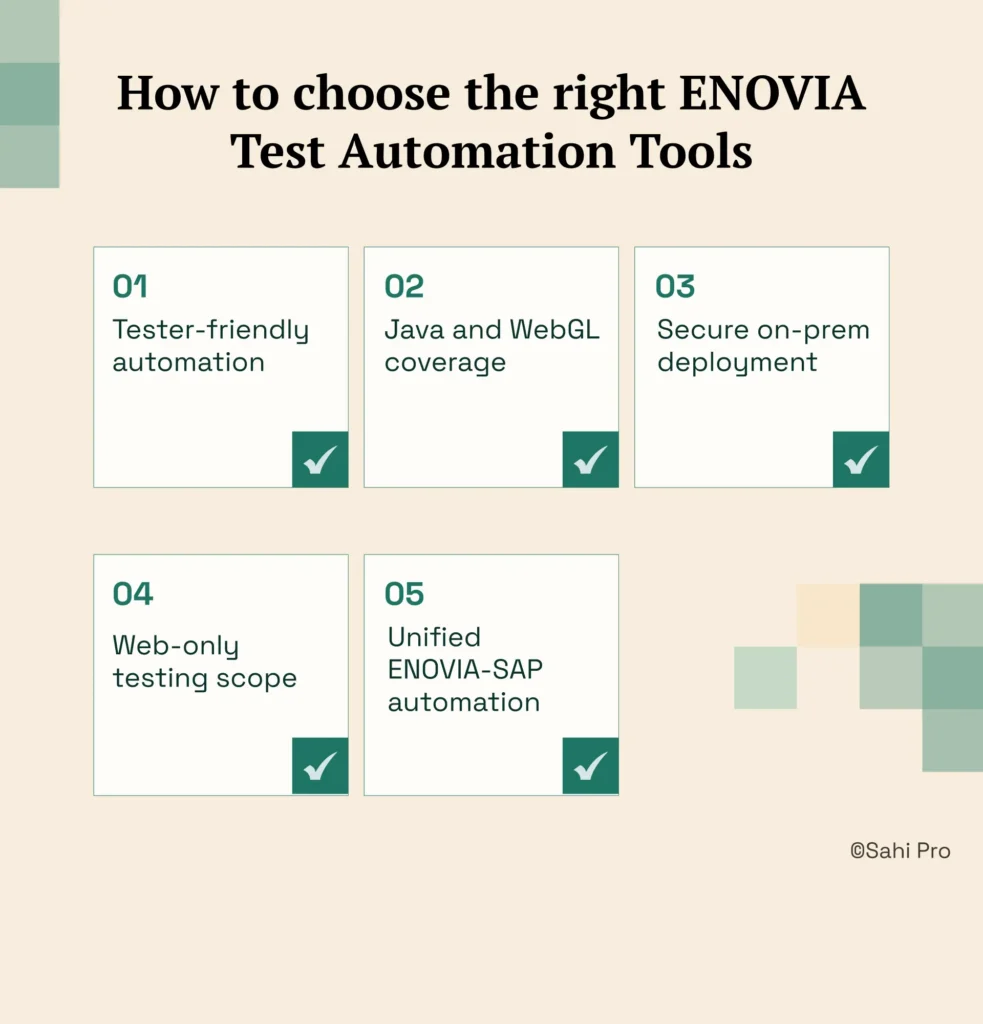
- If your team has no dedicated automation engineer and needs manual testers to build tests, consider Sahi Pro’s BDTA visual builder or Leapwork’s drag-and-drop interface. Both allow non-developers to author test flows, though Sahi Pro extends further into Java thick-client layers.
- If your PLM test automation scope includes WebGL viewer interaction or 21 CFR Part 11 electronic signature capture requiring Java thick-client coverage, eliminate any tool that operates on web DOM only. Selenium and Playwright cannot reach ENOVIA’s Java panels.
- If your medical device environment requires on-premise deployment with no external data routing, eliminate cloud-only tools immediately. Check the on-premise column in the quick-pick table above. Leapwork’s cloud-primary model may not satisfy FDA data residency requirements.
- If your scope is purely web-layer 3DEXPERIENCE testing with no Java clients or canvas-rendered elements, a standard web tool like Playwright or Selenium may be sufficient. Teams running oracle agile PLM testing alongside ENOVIA should assess whether the same tool can cover both platforms.
- If you need one test suite covering ENOVIA 3DEXPERIENCE and SAP ERP integration in a single execution, only Sahi Pro’s add-on architecture covers both web, desktop, and API layers in one script.
If you are unsure which criteria apply to your deployment, run a proof-of-concept directly against your Dassault ENOVIA 3DEXPERIENCE environment. Sahi Pro offers a free trial for this purpose.
How we evaluated ENOVIA Test Automation Tools
Generic web automation benchmarks do not apply to ENOVIA 3DEXPERIENCE. The platform’s WebGL viewers, Java thick-client panels, and role-based UI configurations create testing challenges that standard PLM test automation evaluations miss entirely. Teams coming from oracle agile PLM testing backgrounds often underestimate this gap until their first test run returns empty selectors against a 3D viewer panel.
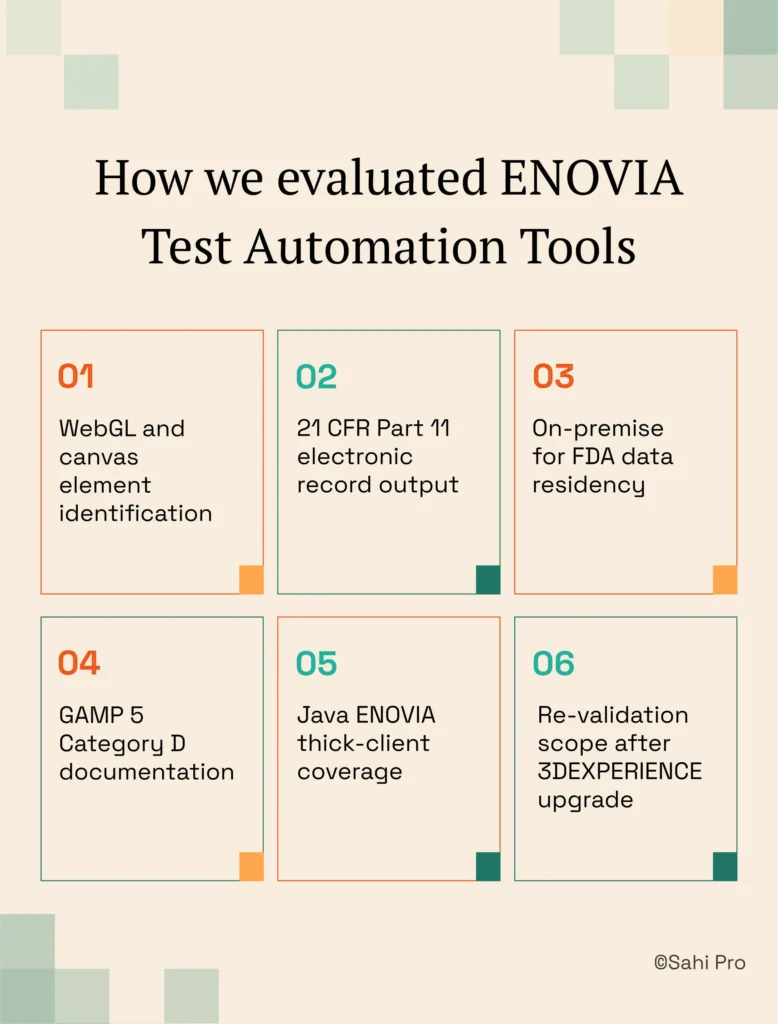
We scored each tool against six criteria specific to medical device ENOVIA deployments:
- WebGL and canvas element identification: Can the tool interact with 3DEXPERIENCE WebGL viewers that have no accessible DOM child nodes? Tools relying solely on CSS selectors or XPath fail here completely.
- 21 CFR Part 11 electronic record output: Does the tool produce timestamped structured records satisfying 21 CFR Part 11 Subpart C for IQ/OQ/PQ validation packages? This is non-negotiable for FDA-regulated verification and validation testing.
- On-premise for FDA data residency: Can the tool run fully on-premise with no test execution data leaving the customer infrastructure? Cloud-only vendors cannot satisfy this requirement.
- GAMP 5 Category D documentation: Does the vendor provide GAMP 5 Category D self-assessment documentation for CSV programs? This accelerates the tool qualification phase.
- Java ENOVIA thick-client coverage: Can the tool reach ENOVIA Java client modules that sit outside the browser DOM? BOM editing and change action approval panels often run in Java Swing.
- Re-validation scope after 3DEXPERIENCE upgrade: Does element identification stability reduce re-qualification effort after a new 3DEXPERIENCE version? Proximity-based identification survives UI changes that break XPath-dependent scripts.
Medical Device: 21 CFR Part 11 and IQ/OQ/PQ Validation
21 CFR Part 11 Subpart C requires that electronic records used in FDA-regulated processes include timestamped audit trails, electronic signatures tied to unique user identities, and controls preventing record alteration after signing. ISO 13485:2016 clause 7.5.6 requires that all software used in production be validated prior to initial use and after any changes that could affect its ability to achieve intended results (ISO, 2016). For automated regression testing tools, this means every test execution must produce immutable, timestamped records that can be included in IQ/OQ/PQ packages without manual reconstruction.
Sahi Pro satisfies these requirements through its built-in timestamped execution records and full on-premise deployment, ensuring no test data leaves the customer’s network. Tricentis Tosca and Tricentis qTest both offer on-premise deployment options with audit trail capabilities, though WebGL canvas interaction remains outside their native scope. Leapwork’s cloud-primary architecture creates a compliance gap for teams requiring strict FDA data residency. Selenium and Playwright produce no compliance-structured records natively; teams must build custom reporting layers to meet Part 11 requirements, adding significant engineering overhead.
For compliance-specific tool selection, request documentation from each vendor on whether their deployment model satisfies 21 CFR Part 11 Subpart C and ISO 13485:2016 clause 7.5.6 data residency requirements. Cloud-only vendors typically cannot provide this.
Real Results: ArisGlobal
ArisGlobal is a life sciences technology company providing regulatory, safety, and clinical solutions to pharmaceutical and medical device organizations. Their testing environment includes complex multi-module web applications with dynamic UI elements, data-driven workflows, and strict compliance documentation requirements. The challenge was manual report generation consuming excessive time across multiple product lines, combined with testing cycles that could not keep pace with release schedules.
ArisGlobal moved to Sahi Pro to address report generation bottlenecks and to enable non-technical team members to participate in test automation. The AI Assist OCR capability and on-premise deployment satisfied their data handling requirements.
The results after implementation:
- 70% reduction in time for multiple report generation for one of the life sciences products.
- Data-driven tests reduced testing cycles across multiple test data sets, improving total coverage.
- Non-technical team members able to participate in automation without specialized skills.
- Positional Relation APIs automated controls without specific unique identifiers, critical for dynamic PLM UI elements.
Important Takeaway
For medical device teams running ENOVIA 3DEXPERIENCE with WebGL viewers and 21 CFR Part 11 compliance obligations, Sahi Pro addresses the specific technical gaps that other tools leave open: canvas-rendered content, Java thick-client panels, and timestamped execution records for FDA submissions. Teams with simpler scope, such as web-only ENOVIA portal testing without WebGL or Java dependencies, can achieve solid results with Playwright or Selenium paired with a compliance management layer like qTest.
The right choice depends on your deployment specifics, not on feature lists. Run your hardest test scenario against your own environment before committing to any license. Sahi Pro offers a free trial with full product access for exactly this purpose, and if you want to see how it handles your ENOVIA WebGL viewers firsthand, Book A Demo.