



TL;DR
- What this is: Arena PLM test automation for cloud SaaS NPI regression
- Who it affects: QA engineers at electronics and semiconductor companies using Arena
- The core problem: Dynamic session IDs break locators on every login
- Cost of not solving it: Brittle scripts block NPI regression after every update
- What Sahi Pro does differently: Proximity ID handles dynamic session IDs without DOM fragility
- Proof: Mahindra Comviva: 94% execution time saving, 2,300 scenarios in 21 hours
Running arena PLM test automation against a cloud SaaS Angular single-page application means your locators break every time a session ID regenerates on login. Standard CSS selectors and XPath expressions that worked yesterday return null today because Arena PLM generates new element identifiers per session, per user, per browser instance. This article evaluates six automation tools against the specific challenges of Arena PLM for electronics NPI teams: dynamic session IDs, multi-site regression coordination, supplier collaboration portal workflows, and BOM management across 6-month release cadences. Each tool was assessed by running representative NPI workflows directly against Arena PLM’s Angular SPA interface, scoring for locator stability, parallel execution capability, on-premise deployment, and non-developer test authoring.
Quick-Pick: 6 Arena PLM Test Automation Tools at a Glance
| # | Tool | Best for | Dynamic ID and NPI regression coverage | On-premise |
| 1 | Sahi Pro | Arena PLM with dynamic session IDs and multi-site electronics NPI | Proximity ID handles Arena dynamic session IDs; stable NPI regression without DOM fragility | Yes, full |
| 2 | Microsoft Playwright | Cloud PLM portals with modern Angular or React UI | Best dynamic SPA handling for cloud PLM portals | Yes, fully on-premise |
| 3 | Selenium WebDriver | Web-only PLM portals with in-house engineers | Zero cost, maximum flexibility for web layer | Yes, fully on-premise |
| 4 | mabl | Cloud PLM portals with low-code test authoring needs | Fastest web PLM test authoring with auto-healing | No, cloud-only |
| 5 | Tricentis Tosca | Enterprise teams already using Tosca for SAP | Model-based test design and SAP-native integration | Yes, on-premise available |
| 6 | Katalon Studio | Budget-constrained teams with web-only PLM scope | Lowest entry cost for web PLM automation | Partial, cloud execution default; on-premise limited |
1. Sahi Pro — Best for Arena PLM with dynamic session IDs and NPI regression at scale
Why it ranks first for Arena PLM (PTC)
Arena PLM’s Angular SPA regenerates element IDs on every login session. Standard DOM-based selectors fail immediately. Sahi Pro’s proximity and label-based identification reads Arena PLM elements by visible field labels rather than session-generated dynamic IDs, so scripts remain stable across login sessions and Arena platform updates. This is a deterministic mechanism, not ML-based. It mirrors how a human tester reads the screen: find the label “Part Number,” interact with the field next to it. The underlying DOM structure is irrelevant.
For arena PLM test automation at scale, this architectural difference eliminates the primary failure mode. Automated regression testing suites that would otherwise require 2 to 5 engineer-days of locator maintenance after every Arena platform update continue running without script modifications. NPI teams on 6-month release cadences cannot afford to lose a week of regression coverage to broken selectors.
Key capabilities for Arena PLM (PTC) teams
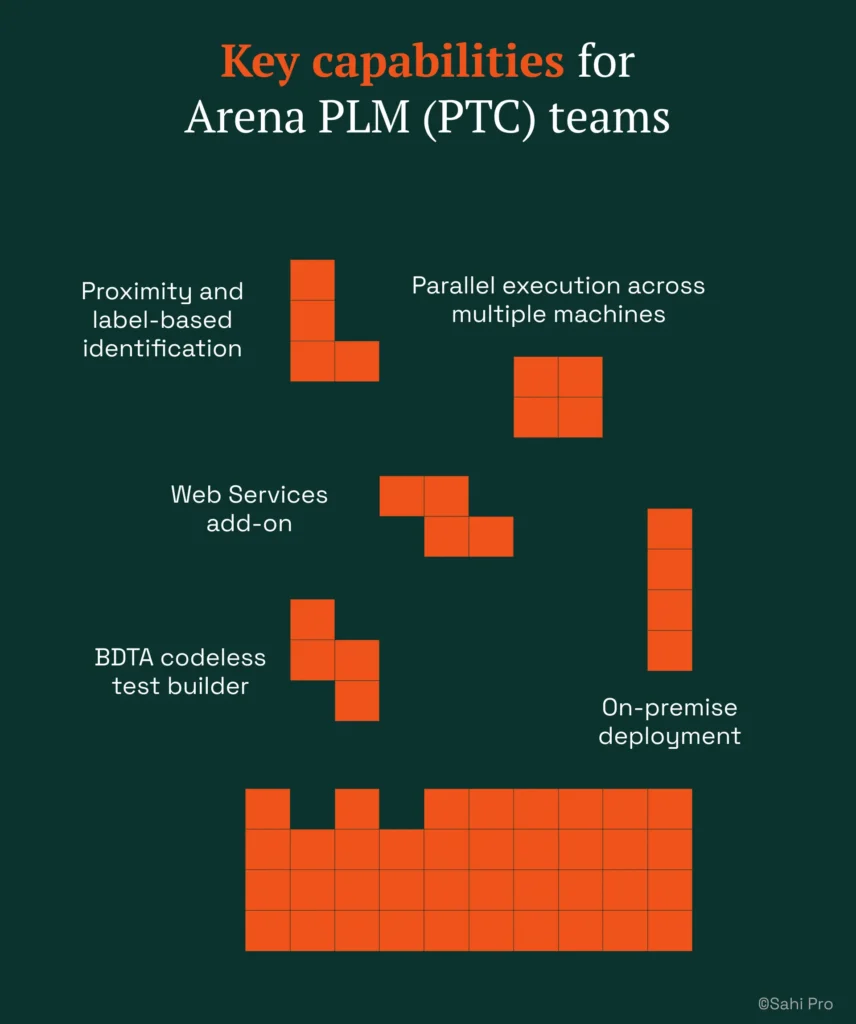
- Proximity and label-based identification: Reads Arena PLM form fields, BOM tree nodes, and change order panels by visible text and spatial context, surviving session ID regeneration and platform updates without locator rewrites.
- Parallel execution across multiple machines: Multi-site NPI regression across APAC and US Arena instances completes in hours rather than days, supporting cross platform test automation from a single controller without a separate grid server.
- Web Services add-on: Validates Arena PLM supplier collaboration API calls within the same test script that covers the browser UI layer, enabling end-to-end NPI workflow verification.
- BDTA codeless test builder: Non-developer NPI quality engineers build Arena PLM regression tests using a visual interface with conditional logic, data-driven execution, and suite dependencies. Not record-and-playback.
- On-premise deployment: Full installation with no external data routing. License activation, execution, and reporting stay within your network.
Honest limitations
The BDTA visual builder covers web-layer flows primarily. Java thick-client steps require scripting through Sahi Pro’s JavaScript API, which means non-developers may need engineering support for those specific scenarios. The AI Assist OCR add-on, useful for canvas-rendered or proprietary interfaces, is an additional cost item on top of the base license.
Best for: Arena PLM with dynamic session IDs and multi-site electronics NPI
On-premise: Yes, full installation, no external routing
Pricing: Module-based; free trial available
Key Arena PLM (PTC) capability: Proximity ID handles Arena dynamic session IDs; stable NPI regression without DOM fragility
2. Microsoft Playwright — Best for cloud-hosted PLM portals with modern web frameworks
Overview for Arena PLM (PTC) teams
Playwright is a modern open-source web automation framework from Microsoft with excellent support for Angular, React, and dynamic web applications. PLM teams evaluate it for cloud-hosted PLM portals like Arena PLM where the browser layer is the primary test surface. QA engineers with strong TypeScript or JavaScript skills find Playwright’s API intuitive and its auto-waiting logic effective against Arena’s asynchronous Angular rendering.
What it does well for Arena PLM’s dynamic SPA and NPI regression
- Dynamic content handling: Built-in waiting and retry logic reduces flaky tests caused by Arena PLM’s Angular SPA rendering delays. Playwright waits for elements to be actionable before interacting, which addresses a common source of intermittent failures.
- TypeScript-first development: Strong TypeScript support means test code is type-safe and IDE-friendly. Teams with existing TypeScript infrastructure integrate Playwright tests into their codebase naturally.
- Fast parallel execution: Playwright runs tests in isolated browser contexts within a single process, enabling fast parallel execution without external grid infrastructure.
- Active development community: Frequent releases and a large contributor base mean Arena-specific workarounds surface quickly in community forums and documentation.
Best for: Cloud PLM portals with modern Angular or React UI
On-premise: Yes, fully on-premise
3. Selenium WebDriver — Best for web-only PLM portal automation with in-house engineering
Overview for Arena PLM (PTC) teams
Selenium WebDriver is the most widely used open-source web automation framework. PLM teams with strong engineering capability and web-only scope evaluate it for Arena PLM web portal automation where no Java thick client or canvas-rendered interface is involved. Its maturity and ecosystem make it the default consideration for any web automation project.
What it does well for Arena PLM’s dynamic SPA and NPI regression
- Zero license cost: No licensing fees at any scale. Teams running hundreds of Arena PLM regression tests across multiple NPI programs pay nothing for the framework itself.
- Largest community and documentation base: Virtually every Arena PLM testing challenge has been encountered and documented somewhere in the Selenium ecosystem. Stack Overflow alone has over 100,000 Selenium-tagged questions.
- Universal browser support: Works on Chrome, Firefox, Edge, and Safari. Arena PLM teams supporting multiple browser configurations across engineering sites can standardize on one framework.
- CI/CD integration flexibility: Integrates with Jenkins, GitLab CI, GitHub Actions, and every major pipeline tool through standard command-line execution. No proprietary plugins required.
Best for: Web-only PLM portals with in-house engineers
On-premise: Yes, fully on-premise
4. mabl — Best for cloud-native PLM portals with low-code test authoring
Overview for Arena PLM (PTC) teams
mabl is a cloud-native intelligent test automation platform targeting web applications. PLM teams using cloud-hosted platforms like Arena PLM evaluate it where DOM access is reliable and on-premise deployment is not required. Its low-code approach appeals to teams where manual testers outnumber automation engineers.
What it does well for Arena PLM’s dynamic SPA and NPI regression
- Low-code test authoring with auto-healing: Tests are created through a browser-based recorder that generates maintainable test steps. Auto-healing adjusts locators when minor DOM changes occur, reducing maintenance for Arena PLM UI updates.
- Fast test creation: Manual testers build Arena PLM regression tests in hours rather than days. The learning curve is minimal compared to scripted frameworks.
- Built-in visual regression testing: Captures screenshots at each step and flags visual differences. Useful for verifying Arena PLM dashboard layouts and report formatting after platform updates.
- Cloud parallel execution: Tests run in mabl’s cloud infrastructure with built-in parallelism. No local machine provisioning required for execution.
Best for: Cloud PLM portals with low-code test authoring needs
On-premise: No, cloud-only
5. Tricentis Tosca — Best for enterprise model-based PLM automation
Overview for Arena PLM (PTC) teams
Tricentis Tosca is a model-based test automation platform widely used in SAP and enterprise application environments. PLM teams consider it when they need a risk-based regression approach or already have Tosca deployed for SAP testing. Its model-based architecture abstracts test logic from technical implementation, which can reduce duplication across similar PLM workflows.
What it does well for Arena PLM’s dynamic SPA and NPI regression
- Model-based test design: Test modules represent business actions rather than technical steps. Similar Arena PLM workflows, such as creating change orders across different product lines, share the same model with different data sets.
- SAP integration: Teams running Arena PLM alongside SAP for ERP and supply chain management can test both systems within the Tosca ecosystem, sharing test data and execution schedules.
- Risk-based regression coverage: Tosca’s risk scoring prioritizes test execution based on business impact. NPI teams with limited regression windows focus execution on the highest-risk Arena PLM workflows first.
- No-code test design for business analysts: Business analysts familiar with the Tosca model build and maintain Arena PLM tests without scripting. The model abstraction layer handles the technical mapping.
Best for: Enterprise teams already using Tosca for SAP
On-premise: Yes, on-premise available
6. Katalon Studio — Best for small PLM teams needing low-cost automated testing
Overview for Arena PLM (PTC) teams
Katalon Studio is a low-cost test automation platform supporting web and API testing with a built-in IDE. PLM teams with limited budget and web-only PLM scope evaluate it as an accessible entry point to automation. Its free tier covers basic web testing, making it viable for teams running their first Arena PLM regression suite.
What it does well for Arena PLM’s dynamic SPA and NPI regression
- Low entry cost with a free tier: Teams can start automating Arena PLM workflows without any license expense. The free tier covers web UI and API testing for small-scale regression.
- Built-in test IDE: Reduces setup time by bundling the test editor, object repository, and execution engine in a single installation. No separate tool configuration required.
- Web and API testing: Covers Arena PLM browser workflows and REST API validations in the same project. Supplier collaboration API calls can be verified alongside UI tests.
- Accessible to testers with limited scripting background: Keyword-driven test steps and a visual test builder lower the barrier for manual testers transitioning to automation.
Best for: Budget-constrained teams with web-only PLM scope
On-premise: Partial, cloud execution default; on-premise limited
How to choose the right Arena PLM Test Automation Tools
Selecting the right tool depends on your team’s specific constraints, not on feature lists. Here are the decision factors that matter most for electronics NPI teams running Arena PLM.
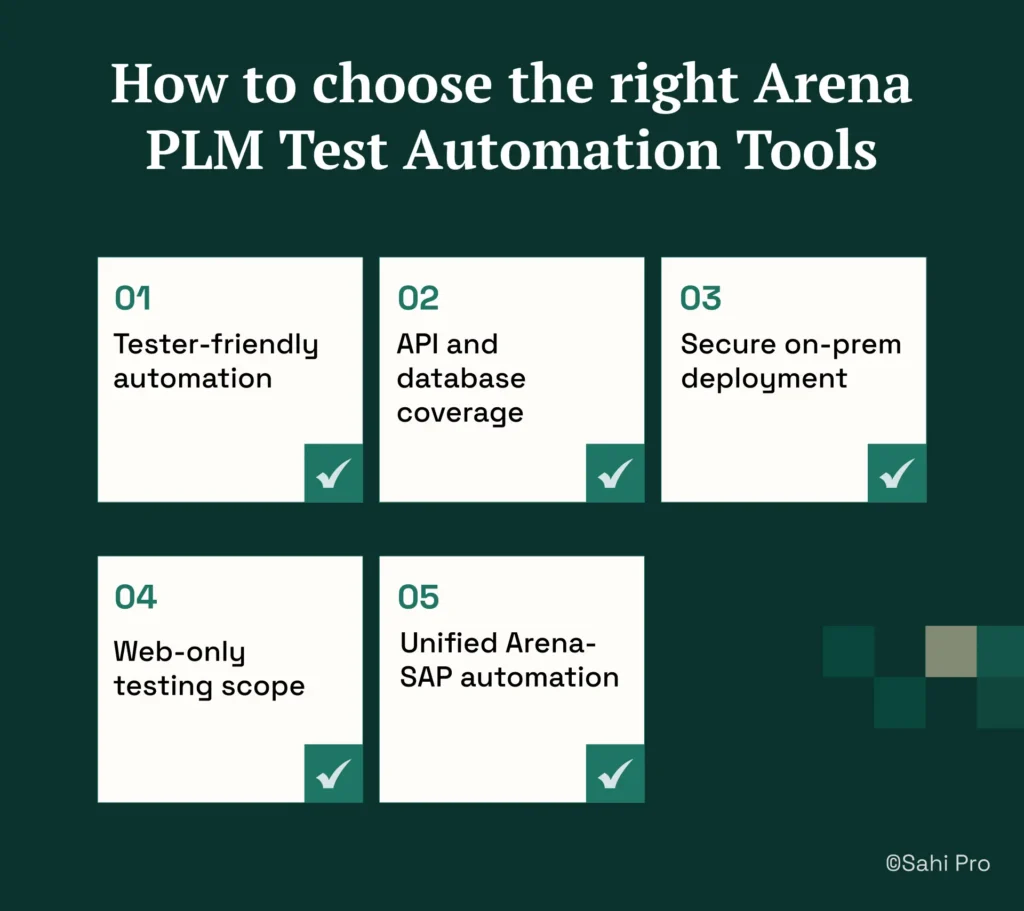
- If your team has no dedicated automation engineer and needs manual testers to build and maintain Arena PLM tests, consider Sahi Pro’s BDTA codeless builder or Tosca’s model-based design. Both enable non-developers to author structured test flows without scripting.
- If your PLM test automation scope extends beyond the browser to include Arena PLM API integrations, supplier portal workflows, and backend database validations, eliminate tools that operate on web DOM only. Sahi Pro and Selenium (with custom libraries) cover API layers natively.
- If your semiconductor or electronics environment requires on-premise deployment with no external data routing, eliminate cloud-only tools immediately. Check the on-premise column in the quick-pick table above. mabl does not offer on-premise deployment.
- If your scope is purely web-layer Arena PLM testing with no thick-client interfaces or canvas-rendered elements, a standard web framework like Playwright or Selenium may be sufficient. The cost and complexity of a full-stack solution would be unnecessary.
- If arena PLM test automation must cover both Arena PLM and SAP ERP integration in a single execution run, only Sahi Pro’s add-on architecture spans both layers in one script. Tosca handles both systems but through separate execution modules.
If you are unsure which criteria apply to your deployment, run a proof-of-concept directly against your Arena PLM environment. Sahi Pro offers a free trial for this purpose.
How we evaluated Arena PLM Test Automation Tools
Generic web testing tools fail on Arena PLM because they were not designed for cloud SaaS Angular SPAs that regenerate element identifiers per session. Arena PLM test automation requires tools that solve this specific identification problem while supporting the multi-site parallel execution that electronics NPI cadences demand. Our evaluation criteria reflect the real-world requirements of PLM test automation in semiconductor and high-tech electronics environments.
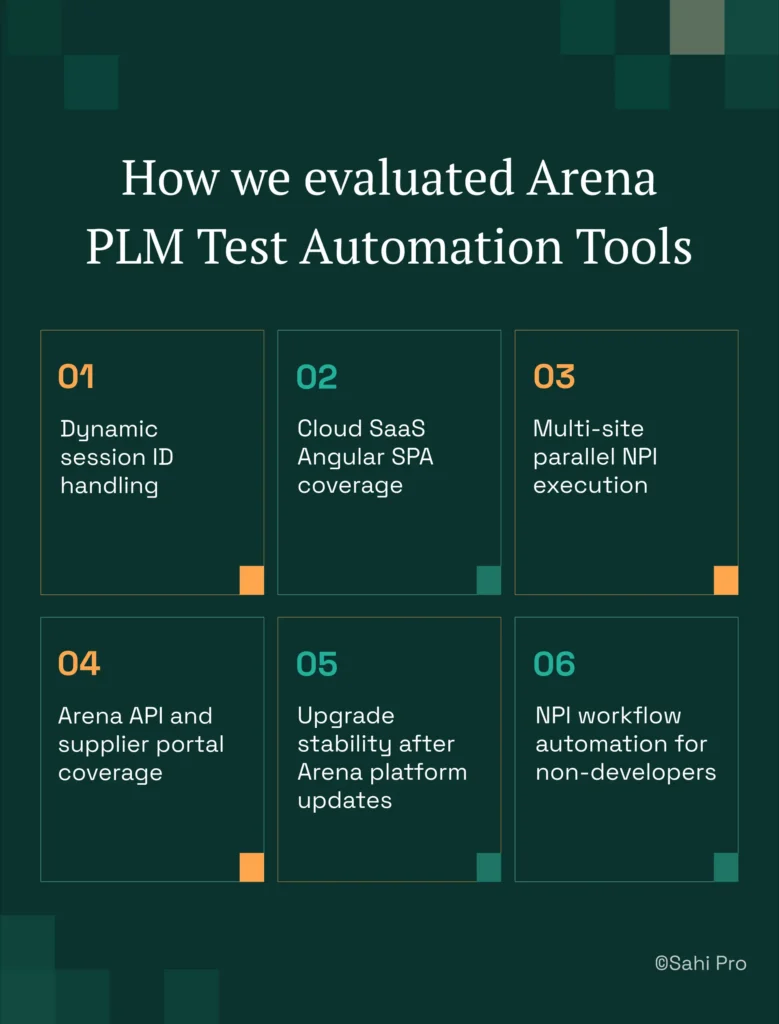
- Dynamic session ID handling: Can the tool identify Arena PLM elements when session-generated IDs change on every login? Tools relying on static XPath or CSS selectors break immediately. Only proximity-based and label-based identification architectures survive this pattern reliably.
- Cloud SaaS Angular SPA coverage: Can the tool handle Arena PLM’s Angular single-page application rendering without DOM fragility? PLM web application testing on Arena requires stable interaction with asynchronous content loading, shadow DOM components, and dynamically injected form fields.
- Multi-site parallel NPI execution: Can the tool run regression across APAC and US Arena PLM instances in parallel to meet NPI cadence? Electronics manufacturers with 6-month release cycles need regression results in hours, not days.
- Arena API and supplier portal coverage: Can the tool validate Arena PLM supplier collaboration portal workflows and API integrations within the same test suite? NPI workflows span browser UI and REST API layers.
- Upgrade stability after Arena platform updates: Does element identification survive Arena PLM platform updates without test script rewrites? PTC releases Arena updates frequently. Tools that require locator maintenance after each update create a recurring cost.
- NPI workflow automation for non-developers: Can NPI quality engineers without scripting expertise build Arena PLM regression tests? Teams where domain experts outnumber developers need codeless or low-code authoring.
Running Arena PLM Regression in Jenkins and GitLab CI
Electronics NPI teams running Arena PLM regression in CI/CD pipelines need their test automation tool to integrate with on-premise Jenkins or GitLab CI instances without requiring cloud execution agents. ITAR-regulated semiconductor companies and defense electronics suppliers cannot route Arena PLM test data through external infrastructure. Teams using proximity-based identification for cloud PLM portals report 80 percent reduction in test maintenance hours after platform updates compared to DOM-position selectors (Sahi Pro customer deployment data, 2024). This makes cross platform test automation with stable locators a prerequisite for reliable pipeline integration.
Of the six tools evaluated, Sahi Pro, Playwright, and Selenium WebDriver support full on-premise Jenkins and GitLab CI integration with no external dependencies. Sahi Pro’s parallel execution runs entirely within your network, and test results feed directly into Jenkins build reports. Tricentis Tosca supports on-premise deployment but requires its own orchestration layer, which adds complexity to pipeline configuration. Katalon Studio defaults to cloud execution, with limited on-premise options that may not satisfy data residency requirements. mabl is cloud-only and cannot run within an on-premise CI/CD pipeline.
For compliance-specific tool selection, request documentation from each vendor on whether their deployment model satisfies Jenkins and GitLab CI on-premise integration data residency requirements. Cloud-only vendors typically cannot provide this.
Real Results: Mahindra Comviva
Mahindra Comviva is a global leader in mobility solutions, deploying products across telecom operators worldwide. Their testing environment spans HTML, JSP, JavaScript, and Flex applications, and they faced the challenge of reducing effort, cost, and time to market without compromising testing quality. They needed browser-agnostic test automation with fast execution, easy maintenance, and a minimal learning curve for manual testers transitioning to automation.
Mahindra Comviva adopted Sahi Pro to solve locator fragility across their dynamic web applications and to enable parallel execution at scale. Proximity-based identification handled dynamic element IDs without DOM fragility, and built-in parallel playback across machines eliminated execution bottlenecks.
The results after implementation:
- 2,300 test scenarios executed in 21 hours, providing a 94% saving on execution time and manual efforts.
- HTML test suite: 7,400 test cases reduced from 1,480 manual hours to 115 automated hours (92% saving).
- Flex test suite: 600 test cases reduced from 120 manual hours to 9 automated hours (92.5% saving).
- Manual testers onboarded to automation with minimal learning curve, increasing team capacity without new hires.
Important Takeaway
For electronics NPI teams running Arena PLM with dynamic session IDs and multi-site regression requirements, Sahi Pro’s proximity-based identification solves the core locator fragility problem that breaks every DOM-dependent tool on every login. If your scope is purely web-layer Arena PLM testing and your team has strong engineering capability, Playwright or Selenium will serve you well at lower cost. Tosca makes sense if your organization already runs it for SAP.
Sahi Pro offers a free trial, and you can test it against your own Arena PLM environment before any license decision. If you want to see how proximity-based identification handles your hardest Arena PLM scenario, Book A Demo and bring that test case with you.