



TL;DR
- What this is: Oracle Agile PLM test automation for pharma regulatory workflows
- Who it affects: QA Validation Engineers at pharma and biotech using Agile PLM
- The core problem: Java Applet panels have no DOM for web tools
- Cost of not solving it: Manual FDA submission prep takes weeks per cycle
- What Sahi Pro does differently: Desktop add-on for Java Applet plus 21 CFR Part 820 records
- Proof: ArisGlobal, 70% reduction in regulatory report generation time
Running oracle agile PLM testing against regulatory submission workflows means confronting a problem most web-based automation tools cannot solve: Java Applet panels that render outside the browser DOM. Standard selectors, whether XPath or CSS, return nothing because there is no document object model to query. The interface exists as a thick-client layer embedded inside the browser window, and every submission workflow, change order, and Device History Record entry passes through it.
Choosing the right tool here is harder than selecting a typical web testing solution. You need a tool that can reach Java Swing components natively, produce execution records that satisfy 21 CFR Part 820 quality system regulation requirements, and run entirely on-premise so FDA-regulated submission data never leaves your infrastructure. Most tools fail on at least one of these criteria.
This article evaluates six automation tools against those specific requirements. Each tool was assessed for Java Applet coverage, regulatory evidence output, on-premise deployment capability, and data-driven submission variant testing. By the end, you will know which tool fits your Oracle Agile PLM environment and which ones to eliminate before a proof-of-concept.
Quick-Pick: 6 Oracle Agile PLM Test Automation for Pharma at a Glance
| # | Tool | Best for | Java Applet and regulatory evidence coverage | On-premise |
| 1 | Sahi Pro | Pharma regulatory submissions, 21 CFR Part 820 | Desktop add-on for Java Applet regulatory workflows + 21 CFR Part 820 timestamped records | Yes, full |
| 2 | OpenText UFT One | Teams with existing UFT investment | Broadest legacy technology coverage | Yes, on-premise available |
| 3 | Leapwork | Non-developer PLM QA in life sciences | Most accessible visual no-code for regulated industries | Partial, cloud-primary with limited on-premise |
| 4 | Selenium WebDriver | Web-only PLM portals, in-house engineers | Zero cost, maximum flexibility for web layer | Yes, fully on-premise |
| 5 | Tricentis Tosca | Enterprise teams already using Tosca for SAP | Model-based test design and SAP-native integration | Yes, on-premise available |
| 6 | Tricentis qTest | PLM test management, compliance documentation | Best PLM test management and compliance reporting | Yes, on-premise available |
1. Sahi Pro: Best for Oracle Agile PLM pharma regulatory submissions with 21 CFR Part 820 compliance
Why it ranks first for Oracle Agile PLM
The core challenge with oracle agile PLM testing in pharma is the Java Applet interface. Regulatory submission panels, change order forms, and quality record entry screens all render as Java Swing components. No browser DOM exists for these elements. Every web-only tool stops at this boundary.
Sahi Pro’s Desktop add-on reaches Oracle Agile PLM Java Applet regulatory submission panels natively using label-based proximity. It identifies elements by their visible text labels and spatial relationships, the same way a human tester reads the screen. This means verification and validation testing scripts do not break when Oracle upgrades shift element positions or internal IDs change. The web layer and the Java thick-client layer execute in a single test script, so a regulatory submission workflow that starts in the browser and passes through an embedded applet runs as one continuous sequence.
Timestamped structured execution records per test step satisfy 21 CFR Part 820 quality system regulation requirements. These records are structured for inclusion in Device History Records and Design History Files without manual reformatting, which eliminates a significant bottleneck in FDA submission preparation.
Key capabilities for Oracle Agile PLM teams
- Label-based proximity identification: Reads Java Applet elements by visible labels and structural proximity, not DOM position or object repository. Scripts remain stable across Agile PLM version updates.
- 21 CFR Part 820 timestamped records: Every test step produces a timestamped execution record formatted for Device History Record and Design History File documentation. No manual log reformatting required.
- Full on-premise deployment: All execution, result storage, and reporting stays within your infrastructure. GAMP 5 Category D documentation is available. FDA data residency requirements are met without exception.
- Data-driven submission variant testing: The same regulatory workflow runs against multiple submission package configurations using parameterized data sets, which is essential for PLM qa automation covering different product variants.
- Single-script cross-layer execution: Web portal, Java Applet panels, REST APIs, and database validations run in one test script. No tool-switching, no integration gaps.
Honest limitations
The AI Assist add-on, which provides OCR and image recognition for proprietary interfaces, is a separate module at additional cost. It is not included in the base license. The visual test builder (BDTA) covers web-layer flows primarily; Java thick-client steps require scripting rather than visual drag-and-drop authoring. Teams with zero scripting capability will need at least one engineer comfortable with Sahi Pro’s JavaScript-based scripting for the desktop layer.
Best for: Oracle Agile PLM pharma regulatory submissions with 21 CFR Part 820 compliance On-premise: Yes, full installation, no external routing Pricing: Module-based; free trial available Key Oracle Agile PLM capability: Desktop add-on for Java Applet regulatory workflows + 21 CFR Part 820 timestamped records
2. OpenText UFT One: Best for legacy PLM with existing UFT investment
Overview for Oracle Agile PLM teams
UFT One (formerly HP QTP) is a long-established enterprise test automation product with broad technology coverage. PLM teams evaluate it when they have legacy test scripts, existing UFT licenses, or need VBScript-based automation for older PLM interfaces. For QA Validation Engineers already maintaining a UFT script library, switching tools carries real migration cost, which makes UFT One a practical choice if the existing investment is significant.
What it does well for Java Applet regulatory submission workflows
- Broad technology coverage: UFT One supports Java, web, Windows, and terminal emulator applications. It can interact with Java Swing elements through its object spy, which is relevant for Agile PLM’s embedded applet interfaces.
- Existing script libraries: Many enterprise environments have years of VBScript-based test scripts. UFT One preserves that investment without requiring a full rewrite.
- Object spy for Java Swing: The built-in object spy can identify Java Swing elements in Agile PLM panels, though it relies on object repository maintenance rather than label-based identification.
- Mature enterprise support: Extensive documentation, a large user community, and long-term vendor support contracts are available. Enterprise procurement teams are familiar with the licensing model.
Best for: Teams with existing UFT investment and legacy PLM On-premise: Yes, on-premise available
3. Leapwork: Best for non-developer PLM teams with visual flowchart automation
Overview for Oracle Agile PLM teams
Leapwork is a visual no-code automation product using drag-and-drop test design. PLM teams whose QA staff is entirely non-developer look at it as an alternative to scripted tools, particularly in life sciences and regulated industries. Its marketing presence in pharma and biotech is strong, and the visual approach lowers the barrier to entry for manual testers transitioning to automation.
What it does well for Java Applet regulatory submission workflows
- Fully visual no-code test design: Test flows are built by arranging visual blocks rather than writing code. Manual testers and regulatory affairs staff can create and maintain tests without developer support.
- Audit-ready test documentation: Leapwork generates structured test documentation designed for regulated environments, which supports compliance reporting for 21 CFR Part 820 and similar standards.
- Strong life sciences positioning: The product has dedicated features and templates for regulated industries, including pre-built compliance reporting modules.
- Accessible to non-technical testers: Drag-and-drop test flows mean that domain experts, not just automation engineers, can participate in test creation and review.
Best for: Non-developer PLM QA in regulated life sciences On-premise: Partial, cloud-primary with limited on-premise
4. Selenium WebDriver: Best for web-only PLM portal automation with in-house engineering
Overview for Oracle Agile PLM teams
Selenium WebDriver is the most widely used open-source web automation framework. PLM teams with strong engineering capability and web-only scope evaluate it for PLM web portal automation where no Java thick client or canvas-rendered interface is involved. If your Oracle Agile PLM deployment uses only the web UI layer and your team has engineers who can write and maintain code, Selenium is a viable zero-cost option.
What it does well for web-layer PLM workflows
- Zero license cost: No license fees at any scale. The entire framework is open-source, which eliminates procurement overhead.
- Largest community and documentation base: More tutorials, Stack Overflow answers, and community plugins exist for Selenium than for any other automation framework. Troubleshooting is faster.
- Full browser coverage: Works on Chrome, Firefox, Edge, and Safari. Cross-browser regression testing is straightforward.
- CI/CD pipeline integration: Integrates with Jenkins, GitLab CI, Azure DevOps, and every major CI/CD system. Full flexibility through Java, Python, C#, or JavaScript bindings.
Best for: Web-only PLM portals with in-house engineers On-premise: Yes, fully on-premise
5. Tricentis Tosca: Best for enterprise model-based PLM automation
Overview for Oracle Agile PLM teams
Tricentis Tosca is a model-based test automation product widely used in SAP and enterprise application environments. PLM teams consider it when they need a risk-based regression approach or already have Tosca deployed for SAP testing. If your organization runs both Oracle Agile PLM and SAP ERP, Tosca’s existing footprint may simplify vendor management.
What it does well for Java Applet regulatory submission workflows
- Model-based test design: Tosca reduces duplication across similar PLM workflows by abstracting test logic into reusable models. Changes to one model propagate across all tests that reference it.
- SAP-native integration: For teams already using Tosca for SAP ERP testing, extending coverage to Oracle Agile PLM keeps test management centralized under one product.
- Enterprise risk-based regression: Tosca’s risk-based approach prioritizes test execution based on change impact, which is valuable when regression suites grow large across multiple PLM modules.
- No-code test design for business analysts: Business analysts familiar with the Tosca model can create tests without scripting, though the learning curve for the modeling paradigm itself is non-trivial.
Best for: Enterprise teams already using Tosca for SAP On-premise: Yes, on-premise available
6. Tricentis qTest: Best for managing PLM test cases alongside Jira in ALM
Overview for Oracle Agile PLM teams
Tricentis qTest is a test management product that integrates execution automation from multiple tools including Tosca and Selenium. PLM teams that need centralized test management for compliance documentation evaluate it alongside a separate automation tool. It is not an automation engine itself but a management layer that aggregates results and maintains traceability.
What it does well for Java Applet regulatory submission workflows
- Strong Jira integration: qTest connects PLM test cases to Jira stories and defects, providing bidirectional traceability that auditors expect in regulated environments.
- Compliance-ready documentation: Built-in reporting templates support FDA and AS9100 audit requirements. Test execution history is maintained with full traceability to requirements.
- Multi-tool execution support: qTest aggregates results from Tosca, Selenium, and other execution engines into a single dashboard. Teams using multiple automation tools get unified reporting.
- Audit trail for test results: Every test execution, result change, and approval is logged with timestamps and user attribution, which supports 21 CFR Part 820 record-keeping.
Best for: PLM test management and compliance documentation On-premise: Yes, on-premise available
How to choose the right Oracle Agile PLM Test Automation for Pharma
The right tool depends on your specific technical constraints and team composition. Use these decision factors to narrow the list before running a proof-of-concept.
- If your team has no dedicated automation engineer and needs manual testers to build tests, consider Sahi Pro’s visual builder for web-layer flows or Leapwork’s no-code design. Both lower the engineering barrier, though Sahi Pro retains scripting access for Java thick-client steps.
- If your Oracle Agile PLM deployment includes Java Applet regulatory submission panels, eliminate any tool that operates on web DOM only. Selenium WebDriver cannot reach these panels. This single requirement removes it from consideration for full-scope PLM test automation.
- If your pharma or biotech environment requires on-premise deployment with no external data routing, eliminate cloud-only options at this step. Check the on-premise column in the quick-pick table above. Leapwork’s limited on-premise support may not satisfy FDA data residency requirements.
- If your scope is purely web-layer oracle agile PLM testing with no Java clients or canvas-rendered elements, Selenium or Leapwork may be sufficient. Confirm this by auditing every workflow you plan to automate for embedded applet components.
- If you need one test suite covering Oracle Agile PLM and SAP ERP integration in one execution, only Sahi Pro’s add-on architecture covers both the Java thick-client layer and SAP GUI in a single script.
If you are unsure which criteria apply to your deployment, run a proof-of-concept directly against your Oracle Agile PLM environment. Sahi Pro offers a free trial for this purpose.
How we evaluated Oracle Agile PLM Test Automation for Pharma
A generic web testing product and a tool capable of handling oracle agile PLM testing for pharma regulatory workflows are fundamentally different categories. The difference comes down to whether the tool can reach Java Applet panels that have no DOM, produce records that satisfy FDA quality system regulations, and run without sending data outside your infrastructure. Standard PLM test automation evaluations that focus on browser support and CI/CD integration miss these critical criteria entirely.
Each tool in this article was assessed against six criteria specific to Oracle Agile PLM in pharma and biotech environments:
- Java Applet regulatory submission workflow coverage: Can the tool reach Oracle Agile PLM Java Applet panels that have no DOM access, or does it stop at the browser boundary?
- 21 CFR Part 820 execution record output: Does the tool produce timestamped structured records that satisfy quality system regulation requirements for verification and validation testing documentation?
- On-premise for pharma FDA data residency: Can the tool run fully on-premise with no submission data leaving the company infrastructure?
- Device History Record and DHF integration: Can execution records format directly into Device History Record and Design History File documentation without manual reformatting?
- Data-driven submission package validation: Can the tool run the same regulatory workflow against multiple submission package configurations in a single execution cycle?
- Legacy Agile PLM version stability: Does element identification remain stable on older Oracle Agile PLM versions that cannot be upgraded due to validation constraints?
Pharma and Biotech: 21 CFR Part 820 and Device History Record Validation
FDA 21 CFR Part 820 quality system regulation requires documented verification of all design outputs. Oracle Agile PLM regulatory submission workflows that determine product release status fall under this requirement (21 CFR 820.30(f)). ISO 13485:2016 clause 7.3.5 imposes parallel obligations for medical device companies operating internationally. GAMP 5 Category D classifies Oracle Agile PLM as a configured product requiring documented testing evidence. The specific artefact required is a timestamped execution record per test step, traceable to a requirements specification, with electronic signatures where applicable.
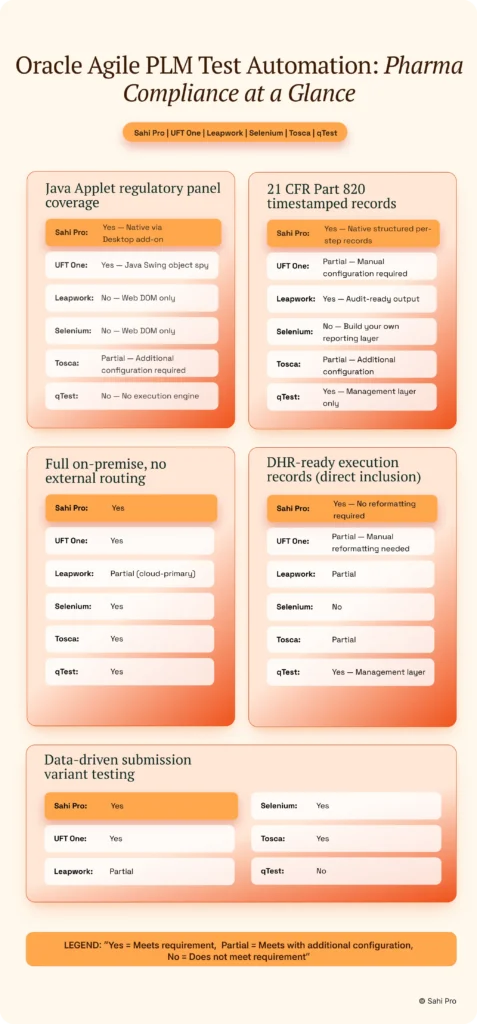
Of the six tools evaluated, their compliance positions differ significantly. Sahi Pro satisfies this requirement through timestamped structured execution records that format directly into Device History Records and Design History Files, combined with full on-premise deployment and GAMP 5 Category D documentation. OpenText UFT One supports on-premise deployment and can produce execution logs, though formatting for DHR inclusion requires manual effort. Tricentis Tosca and qTest both offer on-premise options and compliance reporting, but PLM qa automation for Java Applet panels requires additional configuration. Selenium WebDriver produces no built-in compliance documentation; teams must build their own reporting framework. Leapwork’s cloud-primary architecture may not satisfy FDA data residency requirements for pharma companies that prohibit external data routing.
For compliance-specific tool selection, request documentation from each vendor on whether their deployment model satisfies 21 CFR Part 820 QSR / ISO 13485:2016 / GAMP 5 Category D data residency requirements. Cloud-only vendors typically cannot provide this.
Real Results: ArisGlobal
ArisGlobal is a global provider of R&D software solutions and consultancy services for life sciences companies, managing clinical trial, safety, and regulatory information. They started test automation with a leading commercial tool but encountered limitations: no record-and-playback capability, no relative APIs, inability to automate complex conditional workflows, and mandatory object repository maintenance that consumed significant effort.
ArisGlobal moved to Sahi Pro to solve these specific problems. The Desktop add-on enabled automation of Java-based regulatory workflows that their previous tools could not reach, while timestamped execution records supported their compliance documentation requirements.
The results after implementation:
- 70% reduction in time for multiple regulatory report generation for one of the life sciences products.
- Data-driven tests reduced testing cycles across multiple submission package data sets, improving coverage.
- Non-technical regulatory affairs team members able to participate in automation without specialist skills.
- Positional Relation APIs automated controls without specific unique identifiers in complex regulatory PLM UI.
Which Oracle Agile PLM test automation tool is right for your team?
For pharma and biotech teams running Oracle Agile PLM with Java Applet regulatory submission workflows and 21 CFR Part 820 compliance requirements, Sahi Pro is the strongest fit. Its Desktop add-on solves the Java Applet access problem that eliminates most other tools from consideration, and its timestamped execution records address FDA documentation requirements directly. If your scope is web-only and your team has strong engineering capability, Selenium is a practical zero-cost option. If you already run Tosca for SAP, extending it to Agile PLM keeps your vendor footprint smaller.
Sahi Pro offers a free trial, so you can test it against your own Oracle Agile PLM environment before any license decision. If your regulatory workflows include Java Applet panels, embedded thick-client components, or submission variants that need data-driven coverage, bring your hardest test scenario to a technical demo. The Sahi Pro team will run it with you. Book A Demo.