



TL;DR
- What this is: On-premise PLM test automation, no cloud routing
- Who it affects: QA leads at aerospace, automotive, defence, O&G firms
- The core problem: Cloud tools route IP-sensitive data externally
- Cost of not solving it: Manual testing only, zero sustainable automation
- What Sahi Pro does differently: Fully air-gapped, no phone-home, network-audit verified
- Proof: 40 man-hours reduced to under 10 hours
Running a PLM test automation framework inside an air-gapped network is a different discipline from testing a public-facing web application. Every tool choice carries a data residency question: does any test artefact, script, screenshot, or log file touch infrastructure outside your firewall? Standard web testing tools assume internet access for licence checks, browser provisioning, and cloud dashboards, all of which violate ITAR, automotive OEM IP policies, and defence classification requirements. This article evaluates six on-premise PLM test automation tools against criteria specific to IP-sensitive deployments in aerospace, automotive, defence, and oil and gas. Each tool was assessed for verifiable air-gapped operation, Java thick-client PLM coverage, CI/CD integration without external routing, and compliance posture against ITAR 22 CFR Parts 120-130.
Quick-Pick: 6 On-Premise PLM Test Automation Tools at a Glance
| # | Tool | Best for | Air-gapped and compliance coverage | On-premise |
| 1 | Sahi Pro | Air-gapped PLM, ITAR, automotive IP | Fully air-gapped, no phone-home; verified by network audit at aerospace customers | Yes, full |
| 2 | OpenText UFT One | Existing UFT investment, legacy PLM | Broadest legacy technology coverage | Yes, on-premise available |
| 3 | Ranorex Studio | Windows desktop PLM, legacy thick clients | Strongest Windows desktop PLM automation outside SAP | Yes, fully on-premise |
| 4 | Tricentis Tosca | Enterprise teams using Tosca for SAP | Model-based test design and SAP-native integration | Yes, on-premise available |
| 5 | Selenium WebDriver | Web-only PLM portals, in-house engineers | Zero cost, maximum flexibility for web layer | Yes, fully on-premise |
| 6 | Leapwork | Non-developer QA in regulated life sciences | Most accessible visual no-code for regulated industries | Partial, cloud-primary with limited on-premise |
1. Sahi Pro — Best for genuinely air-gapped PLM with no external data routing of any kind
Why it ranks first for All PLM Platforms
The core requirement for IP-sensitive PLM environments is binary: does any data leave the network, or does it not? Sahi Pro installs the execution server, browser agents, desktop agents, and reporting server entirely within the customer network. No licence validation call. No telemetry. No execution routing touches anything external. This has been verified through network audits at aerospace customers running ITAR-classified programmes.
For desktop test automation against Java thick-client PLM modules, Sahi Pro’s Desktop add-on provides native access to Java Swing, AWT, and SWT elements within the same test script that covers the web portal layer. This matters because most PLM workflows span both the web-based Active Workspace and the Java Rich Client. A PLM test automation framework that only covers the browser layer leaves half the application untested. Sahi Pro’s proximity-based identification reads elements by visible labels and spatial context rather than DOM position, so tests survive PLM version upgrades without locator rewrites.
A global automotive manufacturer used this cross-layer approach to automate PLM regression across web, desktop CAD, and SAP with Sahi Pro, cutting regression time 80% after Selenium and Tricentis Tosca couldn’t cover the full stack.
Key capabilities for All PLM Platforms teams
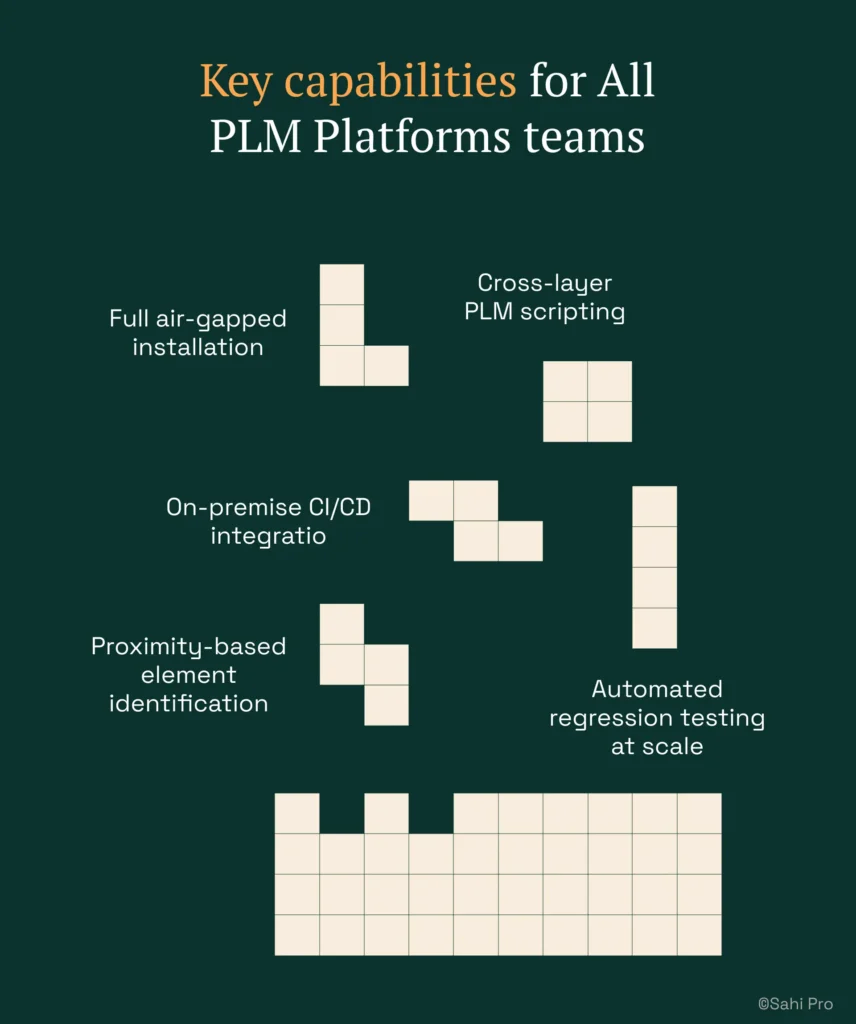
- Full air-gapped installation: Execution server, browser agents, desktop agents, and reporting all run inside the customer network with zero external dependency.
- Cross-layer PLM scripting: Covers Java thick-client PLM modules, web PLM portals, and API integrations in a single test script without switching tools.
- On-premise CI/CD integration: Jenkins, GitLab CI, and Azure DevOps integration works entirely on-premise; multi-site execution across globally distributed air-gapped PLM deployments is supported natively.
- Automated regression testing at scale: Parallel and distributed execution is built in, requiring no separate grid server, which means automated regression testing runs across multiple machines without external orchestration.
- Proximity-based element identification: Tests identify elements by visible labels and structural proximity, not DOM selectors, reducing maintenance after PLM upgrades to near zero.
Honest limitations
The AI Assist OCR add-on, which extends coverage to canvas-rendered and proprietary interfaces, is an additional cost item on top of the base licence. Sahi Pro does not offer native cloud SaaS execution, which is irrelevant for air-gapped environments but limits teams that also need cloud-based load testing. The visual test builder (BDTA) covers web-layer flows primarily; Java thick-client steps require scripting through the Desktop add-on.
Best for: Air-gapped PLM with ITAR, automotive IP, and O&G OT network requirements
On-premise: Yes, full installation, no external routing
Pricing: Module-based; free trial available
Key PLM capability: Fully air-gapped on-premise with no phone-home; verified by network audit at aerospace customers
2. OpenText UFT One — Best for legacy PLM with existing UFT investment
Overview for All PLM Platforms teams
UFT One (formerly HP QTP) is a long-established enterprise test automation tool with broad technology coverage across Java, web, and Windows applications. PLM teams evaluate it when they have legacy test scripts, existing UFT licences, or need VBScript-based automation for older PLM interfaces. For organizations that invested heavily in QTP scripts over the past decade, UFT One provides continuity without a full rewrite.
What it does well for on-premise deployment
- Broad technology coverage: Supports Java, web, and Windows applications through a single IDE, covering most legacy PLM interface types.
- Existing script library: Many enterprise environments have thousands of existing VBScript-based test scripts that run without modification in UFT One.
- Object spy for Java Swing: The built-in object spy identifies Java Swing elements, which is useful for older PLM thick clients still running Swing-based UIs.
- Mature enterprise support: Decades of enterprise documentation, community knowledge, and OpenText support infrastructure reduce onboarding risk for large teams.
Best for: Teams with existing UFT investment and legacy PLM
On-premise: Yes, on-premise available
3. Ranorex Studio — Best for desktop Windows PLM applications on legacy infrastructure
Overview for All PLM Platforms teams
Ranorex Studio is a desktop and web test automation product with strong Windows application support. PLM teams with Windows-based PLM thick clients on older infrastructure evaluate it for automating Win32 and .NET desktop interfaces. If your PLM environment runs primarily on Windows desktop applications rather than web portals, Ranorex is a serious contender.
What it does well for on-premise deployment
- Strong Windows desktop support: Handles Win32 and .NET desktop applications natively, which covers a significant portion of legacy PLM thick clients still in production.
- Record-and-replay for non-developers: Manual testers can capture test flows through recording, reducing the barrier to entry for teams without dedicated automation engineers.
- Web test support: Covers PLM web portals alongside desktop applications, though the desktop layer is where Ranorex excels.
- Fully on-premise operation: The entire product installs and runs locally with no cloud dependency for execution or reporting.
Best for: Windows desktop PLM applications and legacy thick clients
On-premise: Yes, fully on-premise
4. Tricentis Tosca — Best for enterprise model-based PLM automation
Overview for All PLM Platforms teams
Tricentis Tosca is a model-based test automation product widely used in SAP and enterprise application environments. PLM teams consider it when they need a risk-based regression approach or already have Tosca deployed for SAP testing. The model-based design philosophy reduces duplication across similar PLM workflows, which appeals to teams managing hundreds of test cases across multiple product lines.
What it does well for on-premise deployment
- Model-based test design: Reduces test duplication across similar PLM workflows by abstracting test logic from specific UI implementations.
- SAP-native integration: Teams already using Tosca for ERP testing can extend coverage to PLM without introducing a second product.
- Risk-based regression coverage: Tosca’s risk scoring prioritizes test execution based on change impact, which helps large PLM teams focus effort where defect probability is highest.
- No-code test design for business analysts: Business analysts familiar with the Tosca model can author tests without programming, broadening test ownership beyond the QA team.
Best for: Enterprise teams already using Tosca for SAP
On-premise: Yes, on-premise available
5. Selenium WebDriver — Best for web-only PLM portal automation with in-house engineering
Overview for All PLM Platforms teams
Selenium WebDriver is the most widely used open-source web automation framework. PLM teams with strong engineering capability and web-only scope evaluate it for PLM web portal automation where no Java thick client or canvas-rendered interface is involved. If your PLM deployment is entirely browser-based and your team writes code daily, Selenium is a viable option at zero licence cost.
What it does well for on-premise deployment
- Zero licence cost: No vendor fees, no per-execution charges, no licence server to maintain inside the air-gapped network.
- Largest community and documentation base: More Stack Overflow answers, tutorials, and third-party integrations than any other test automation framework.
- Full browser coverage: Works on Chrome, Firefox, Edge, and Safari through standardized WebDriver protocol.
- CI/CD flexibility: Integrates with any pipeline tool through any programming language binding, giving engineering teams complete control over execution architecture.
Best for: Web-only PLM portals with in-house engineers
On-premise: Yes, fully on-premise
6. Leapwork — Best for non-developer PLM teams with visual automation
Overview for All PLM Platforms teams
Leapwork is a visual no-code automation product using drag-and-drop test design. PLM teams whose QA staff is entirely non-developer look at it as an alternative to scripted tools, particularly in life sciences and regulated industries where audit-ready documentation is a compliance requirement. The visual design approach lowers the barrier to test authorship significantly.
What it does well for on-premise deployment
- Fully visual no-code test design: Non-technical testers build test flows through a drag-and-drop interface without writing any code.
- Audit-ready test documentation: Generates documentation that satisfies regulated industry requirements for test traceability and evidence.
- Strong life sciences positioning: Leapwork has invested heavily in marketing and features for regulated life sciences environments.
- Accessible to non-technical testers: The visual approach means domain experts can author tests directly, reducing dependency on automation engineers.
Best for: Non-developer PLM QA in regulated life sciences
On-premise: Partial, cloud-primary with limited on-premise
How to choose the right On-Premise PLM Test Automation Tools
Selecting a PLM test automation tool for an IP-sensitive environment requires filtering on constraints that most tool comparison articles ignore. Here is a practical decision framework.
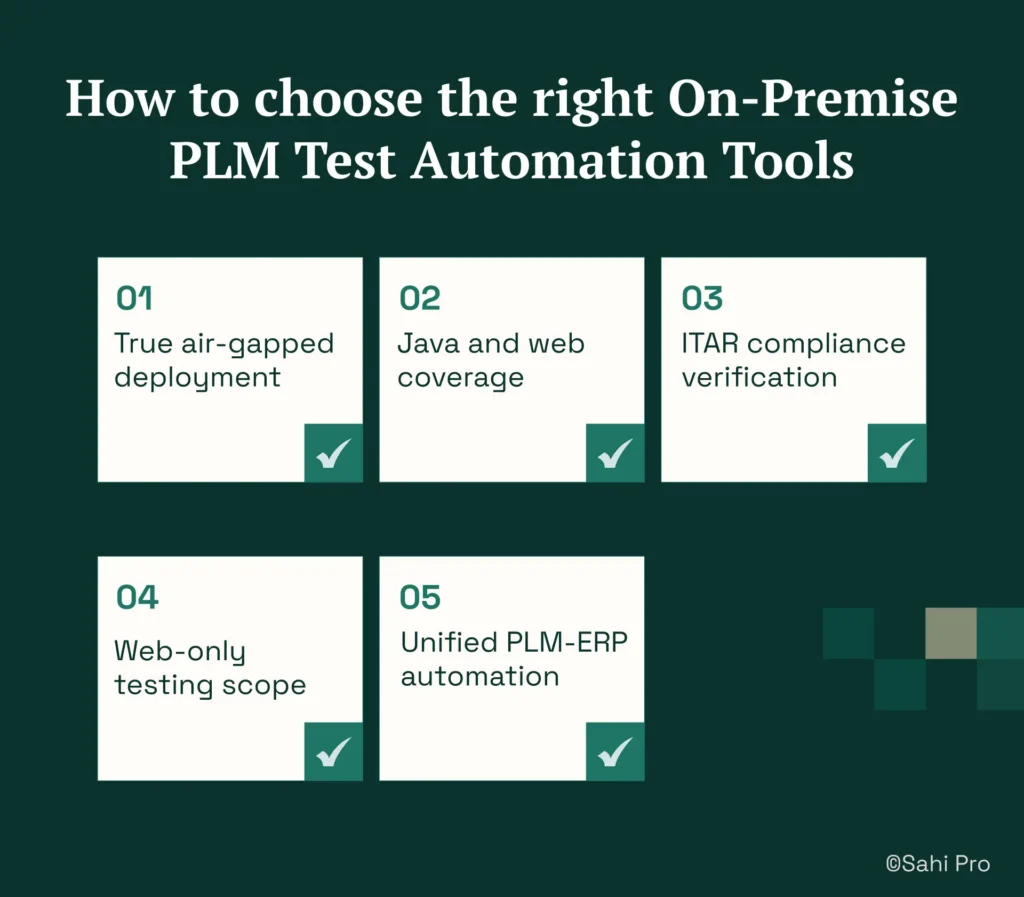
- If your environment requires genuinely air-gapped deployment with no external data routing of any kind, eliminate any tool that phones home for licence validation, telemetry, or cloud-based reporting. Check the on-premise column in the quick-pick table above. Sahi Pro and Selenium are the only two that operate with zero external network dependency by default.
- If your PLM deployment includes Java thick-client modules alongside web portals, eliminate any tool that operates on web DOM only. Selenium cannot reach Java Swing elements. Your PLM test automation scope must cover both layers in a single test sequence, or you will maintain two separate frameworks.
- If your aerospace or defence programme falls under ITAR 22 CFR Parts 120-130, require the vendor to demonstrate no external data routing through network audit, not just contractual assurance. A PLM test automation framework that routes even metadata externally is non-compliant.
- If your scope is purely web-layer PLM portal testing with no Java clients, canvas-rendered elements, or desktop modules, Selenium WebDriver or Ranorex may be sufficient and cost-effective.
- If you need one test suite covering PLM and SAP ERP integration in one execution, only Sahi Pro’s add-on architecture covers both Java thick-client PLM, web portals, APIs, and SAP GUI in a single script.
If you are unsure which criteria apply to your deployment, run a proof-of-concept directly against your PLM environment. Sahi Pro offers a free trial for this purpose.
How we evaluated On-Premise PLM Test Automation Tools
Generic test automation tool comparisons rank products by feature count, browser support, and pricing. None of that matters if the tool cannot operate inside an air-gapped network without routing test data externally. Our evaluation focused on what makes a PLM test automation framework viable for IP-sensitive environments specifically, not on general-purpose automation capability.
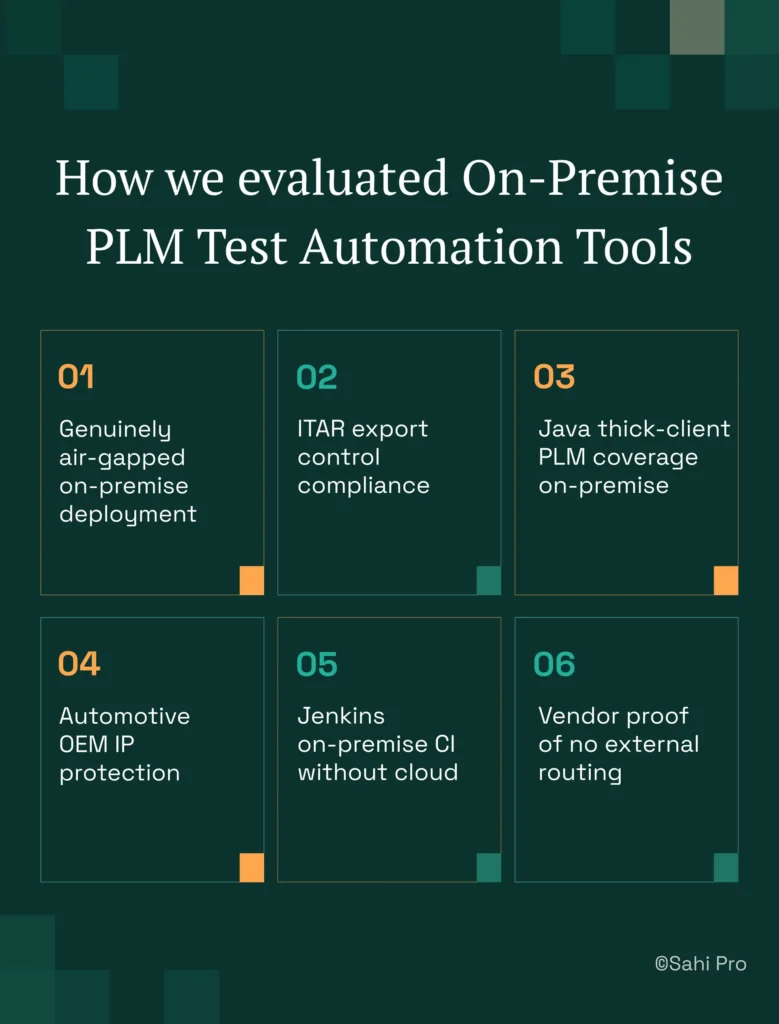
Each tool was assessed against these criteria:
- Genuinely air-gapped on-premise deployment: Is the product verifiably free from phone-home behaviour, telemetry, and external execution routing? We checked whether licence activation, test execution, and result storage can all occur without any outbound network connection.
- ITAR export control compliance: Does the deployment architecture satisfy ITAR 22 CFR Parts 120-130 for classified programmes? This means no test artefact, no log file, and no execution metadata can be processed on servers outside the customer’s controlled network.
- Java thick-client PLM coverage on-premise: Can the tool reach Java Swing PLM thick clients on-premise without requiring external connectivity? Many PLM platforms still use Java Rich Client for engineering workflows that the web portal does not expose.
- Automotive OEM IP protection: Does the deployment model satisfy automotive OEM IP protection policies for BOM and design data? Among PLM QA tools for enterprise automotive use, this criterion eliminates cloud-primary products immediately.
- Jenkins on-premise CI without cloud: Can the tool integrate with Jenkins on-premise CI pipelines without any external network dependency? PLM teams running nightly regression suites need this to work inside the firewall.
- Vendor proof of no external routing: Can the vendor demonstrate no external data routing through network audit, not just contractual assurance? We weighted verifiable proof over marketing claims.
ITAR, Automotive IP, and Air-Gapped Deployment Requirements
ITAR export control regulations under 22 CFR Parts 120-130 prohibit export-controlled technical data from being processed on foreign servers. For classified aerospace PLM programmes, this means any test automation tool that routes scripts, logs, screenshots, or execution metadata to cloud infrastructure is non-compliant, regardless of encryption or data processing agreements (source: U.S. Department of State, Directorate of Defense Trade Controls). Automotive OEM IP protection policies impose similar restrictions on BOM data, CAD file metadata, and design revision histories. Automated regression testing in these environments must produce timestamped execution records stored entirely within the customer’s controlled infrastructure.
Of the six tools evaluated, Sahi Pro satisfies air-gapped deployment through full on-premise installation with no licence validation call, no telemetry, and no execution routing leaving the network. This has been verified through network audits at aerospace customers. OpenText UFT One and Tricentis Tosca offer on-premise deployment options, but teams must verify whether licence activation and reporting modules require external connectivity in their specific configuration. Ranorex Studio runs fully on-premise. Selenium WebDriver is inherently on-premise as open-source software with no vendor infrastructure. Leapwork is cloud-primary with limited on-premise availability, making it unsuitable for ITAR-classified or air-gapped automotive environments without significant architectural concessions.
For compliance-specific tool selection, request documentation from each vendor on whether their deployment model satisfies ITAR 22 CFR Parts 120-130 and automotive OEM IP protection data residency requirements. Cloud-only vendors typically cannot provide this.
Real Results: Anonymous FinTech (Loan Origination)
An anonymous FinTech company specializing in loan origination needed to automate testing across hundreds of loan application scenarios with parameters ranging from 200 to 1,000 combinations. Their on-premise deployment required all test execution and data to remain within their internal network. After transitioning from Selenium, they adopted Sahi Pro for its smoother object identification and reduced maintenance overhead.
The results after implementation:
- 40 man-hours of testing accomplished in under 10 hours through daily automated script execution.
- Tasks taking a full week of manual testing completed in under 8 hours through automation.
- Daily automation scripts execute for 3 to 4 hours, replacing repetitive manual test cycles entirely.
- Sahi Pro adopted across 3 different organisations over 9 years with smoother object identification than Selenium.
Important Takeaway
For PLM teams in aerospace, automotive, defence, and oil and gas where IP-sensitive data cannot leave the network, Sahi Pro is the strongest option because it is the only commercial product on this list that combines fully air-gapped on-premise deployment, Java thick-client PLM coverage, and web portal automation in a single test script. If your scope is purely web-based PLM portal testing with strong in-house engineering, Selenium WebDriver is a legitimate zero-cost alternative. Teams with existing Tosca or UFT investments should verify their specific deployment’s external connectivity requirements before assuming on-premise compliance.
Sahi Pro offers a free trial so you can test it against your own PLM environment before any licence decision. If your scenario involves complex cross-layer PLM workflows, BOM tree validation, or ITAR-classified data, bring your hardest test case to a technical demo. The engineering team will work through it with you. Book A Demo