


Your test automation tool runs verification workflows on avionics PLM data. Under DO-178C Section 12.2, that makes the tool itself subject to qualification, or every verification result it produces carries an unresolved compliance question into your certification package.
TL;DR
- DO-178C Section 12.2, governed by companion standard DO-330, requires qualification for any tool that eliminates, reduces, or automates a verification process without its output being independently verified
- A test automation tool running PLM workflow validation on avionics software is a verification tool under DO-330, tool qualification evidence is required regardless of which tool you choose
- ITAR (22 CFR Parts 120-130) disqualifies cloud-based tools before technical evaluation begins: part numbers, design specifications, and revision histories in test execution screenshots are controlled technical data
- AS9100D clause 8.5.6 requires timestamped, traceable execution records per test step linked to requirements, standard automation logs do not satisfy this without additional post-processing
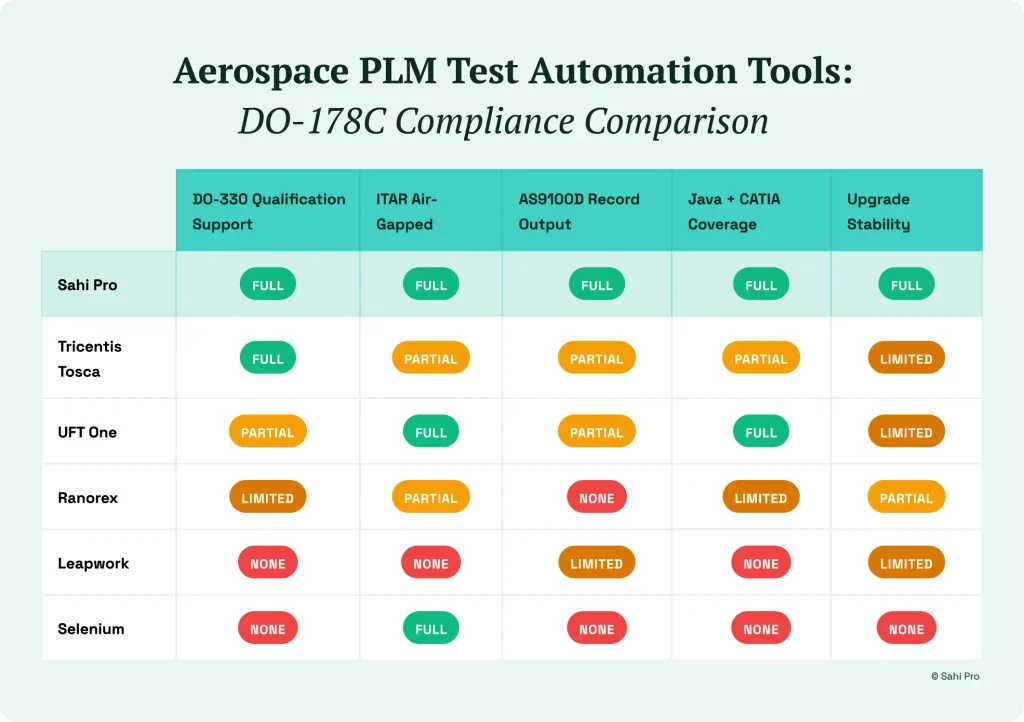
- Of the six tools here, Sahi Pro and UFT One are the strongest fits for full air-gapped deployment combined with structured compliance record output across Java thick-client PLM workflows
What DO-178C Section 12.2 Actually Requires from a Test Automation Tool
Most QA leads encounter the tool qualification requirement when it surfaces in an FAA or EASA audit rather than before tool selection. DO-178C Section 12.2 does not ask whether your automation tool works. It asks whether you can prove it works correctly for the specific verification purposes you are using it for.
The companion standard DO-330 (Software Tool Qualification Considerations) classifies tools by qualification level: TQL-1 through TQL-5, where TQL-1 applies to tools whose output becomes part of airborne software and TQL-5 applies to verification tools that could fail to detect an error. A test automation tool running regression suites against avionics PLM workflows is a verification tool. If it misses an error, that error can propagate to flight-critical systems. The qualification level assigned determines the documentation package your Designated Engineering Representative requires.
The practical programme planning implication: tool qualification is the project’s responsibility, not the vendor’s. Vendors who supply Tool Operational Requirements documents, qualification test cases, and pre-built evidence packages reduce that effort from months to weeks. That difference matters when your programme has a certification milestone on the schedule.
Two additional requirements narrow the evaluation field before any capability comparison. ITAR (22 CFR Parts 120-130) prohibits transmitting controlled technical data outside approved networks. Test execution logs and screenshots for avionics PLM workflows contain part numbers, material specifications, and design revision data that constitute controlled technical data. Any tool with cloud execution, cloud reporting, or background telemetry is out of consideration for an ITAR-controlled programme. AS9100D clause 8.5.6 requires production and service provision records, in automation terms, that means timestamped step-level execution records that map to test cases and requirements, not session-level pass/fail summaries.
The Evaluation Criteria for This List
Each tool was assessed against five criteria, applied in this order:
DO-330 qualification support: Does the vendor supply Tool Operational Requirements documentation, qualification test cases, or a pre-built evidence package? Does the tool support the documentation outputs required for TQL-5 or higher qualification?
ITAR / air-gapped deployment: Does the tool run entirely within an isolated network, license activation, execution, result storage, and report generation, with no external data routing?
AS9100D execution record output: Does the tool produce timestamped, step-level execution records that satisfy clause 8.5.6 without manual post-processing?
Java thick-client and CATIA plugin coverage: Teamcenter, Windchill, and ENOVIA all have Java-rendered layers that standard WebDriver tools cannot reach. CATIA plugin windows render entirely outside the browser DOM.
Script stability across PLM version upgrades: How much of your existing test suite survives a major PTC, Siemens, or Dassault release? Ongoing maintenance cost is the primary total cost of ownership driver, not licensing.
The 6 Best Aerospace PLM Test Automation Tools for DO-178C Programmes
1. Sahi Pro
Sahi Pro is the strongest fit for aerospace teams running PLM validation in ITAR-controlled environments. License activation, test execution, result storage, and reporting run entirely within your network. There is no phone-home behaviour and no cloud execution pathway. This satisfies ITAR data residency requirements without additional network configuration.
The execution record format produces timestamped, step-level records designed to simultaneously satisfy AS9100D clause 8.5.6, 21 CFR Part 11 Subpart C, and ISO 13485 clause 7.5.6 from a single report. For aerospace teams managing multi-standard compliance, this eliminates the post-processing work of assembling separate compliance packages for each regulatory framework.
Platform coverage spans three layers in one test script. The core product handles Teamcenter Active Workspace and other browser-based PLM interfaces through proximity-based element identification, tests locate elements by visible label and spatial relationship rather than DOM XPath, so Active Workspace upgrades that restructure the DOM do not break existing tests. The Desktop add-on covers Java Swing, AWT, and SWT applications natively, reaching Teamcenter Rich Client BOM management panels, Windchill PDM Link workflows, and Creo integration points that the browser layer does not expose. The AI Assist add-on applies OCR to canvas-rendered and WebGL regions that have no accessible DOM nodes, this is what reaches CATIA plugin windows inside Active Workspace and attribute grids in Windchill’s Java panels.
Sahi Pro provides qualification documentation support for teams pursuing DO-330 tool qualification. Confirm the current documentation package scope with the Sahi Pro team before finalising your compliance approach.
Honest limitation: The Desktop add-on and AI Assist OCR are separately licensed modules. Confirm that the full module stack covers your specific CATIA version and PLM release before evaluation is complete.
2. Tricentis Tosca
Tosca is a model-based test automation platform with genuine enterprise aerospace credentials. Its model-based approach works well for large, stable test suites where test case management at scale and centralised governance are primary requirements. On-premise deployment is supported, and Tosca has documented compliance workflows for regulated industries including aerospace.
For Teamcenter Java thick-client coverage, Tosca uses its TCD (Technical Component Definition) model approach. Java-rendered PLM component coverage exists, and Tosca’s compliance record output is configurable for AS9100D documentation requirements.
Tosca requires TBox certification for test authoring and model maintenance. Teams without certified staff cannot self-maintain their automation suites, new test development and post-upgrade maintenance require either internal certified engineers or Tricentis professional services engagement.
DO-330 support: Tosca provides compliance documentation templates for regulated industries. Verify DO-178C-specific TQL qualification documentation with Tricentis before committing to their evidence package as sufficient for your programme’s DER requirements.
Honest limitation: Tosca’s licensing and certification requirements make it the highest-cost option in this list. Year 1 total cost for a 10-person aerospace QA team, licensing, training, and tester productivity ramp, runs approximately double Sahi Pro for equivalent PLM coverage based on published case study benchmarks.
3. UFT One (OpenText)
UFT One brings 20 years of enterprise aerospace testing history and genuine Java thick-client depth through its Java Add-in. For Windchill PDM Link and Teamcenter Rich Client, UFT One’s Java object recognition provides reliable element identification on Java Swing and AWT controls in environments where the object hierarchy is stable.
On-premise deployment is fully supported and ITAR compliance is achievable with standard network isolation. UFT One’s compliance documentation capabilities, developed over two decades for regulated defence and aerospace programmes, are among the most mature in this market.
DO-330 support: UFT One has been deployed in DO-178-regulated programmes. Qualification documentation support exists. Teams should evaluate whether the available evidence package aligns with current DO-330 requirements and their programme’s DER expectations.
Honest limitation: UFT One’s Java object recognition breaks when PLM version upgrades restructure the Java object hierarchy, the same maintenance cost affecting XPath-dependent web tools, applied at the Java layer. Licensing through OpenText has increased substantially since the Micro Focus acquisition; confirm current pricing against your programme budget before evaluation.
4. Ranorex
Ranorex handles native Windows desktop automation through Windows UI Automation and Win32 APIs. For PLM tools presenting as standard WinForms or WPF applications, Ranorex provides solid coverage. On-premise deployment is straightforward and ITAR compliance is achievable in an air-gapped configuration.
The coverage limitation for aerospace PLM is canvas-rendered components. Windchill’s Java PDM Link panels render attribute grids as painted pixel regions with no Windows UI Automation handles, Ranorex returns null on these elements. For programmes where Windchill BOM and attribute grid validation is a primary requirement, this is a significant gap on the most complex test scenarios.
DO-330 support: Ranorex does not publish DO-178C-specific tool qualification documentation. Teams carry the full TOR and TQD development effort internally.
Honest limitation: Canvas-rendered PLM components are outside Ranorex’s coverage scope. Programmes with heavy Windchill or ENOVIA usage will hit this ceiling on the scenarios that matter most.
5. Leapwork
Leapwork offers visual, codeless automation with a low barrier to entry for validation engineers without programming backgrounds. For browser-based PLM document management and standard portal navigation, Leapwork’s visual approach opens automation authoring to a broader team. On-premise deployment is available in the Enterprise tier.
Leapwork has published compliance references for pharmaceutical and medical device validation contexts (FDA 21 CFR Part 11, EU Annex 11), which gives life sciences-adjacent aerospace programmes a starting point for validation documentation.
DO-330 support: Leapwork does not publish DO-178C-specific tool qualification documentation. Teams running DO-178C programmes should not assume aerospace compliance documentation exists without direct vendor confirmation.
Honest limitation: Java thick-client PLM coverage is not part of Leapwork’s core capability. For programmes where PLM workflows run primarily in Teamcenter or Windchill Java clients, Leapwork covers the browser portal layer only, limiting its applicability to document management workflows rather than core BOM and change management validation.
6. Selenium (Reference Baseline)
Selenium is the most widely deployed open-source automation framework. It can run entirely on-premise, satisfying base ITAR data residency requirements. For browser-layer PLM coverage, Active Workspace navigation, ENOVIA web portal workflows, and web-based document management, Selenium provides a functional baseline.
Selenium appears here as a reference baseline, not a recommendation for DO-178C programmes. The core compliance problem: Selenium produces no structured execution records. Output is whatever your surrounding framework generates, typically JUnit XML and console logs. Assembling AS9100D-compliant step-level execution records from Selenium output requires custom reporting tooling that the team builds, validates, and maintains independently.
DO-330 support: None. Selenium is an open-source framework. Tool qualification under DO-330 would be entirely the team’s responsibility, developing TOR documentation, qualification test cases, and a TQD for an open-source tool with no vendor accountability is a multi-month internal effort.
Honest limitation: Java thick-client, canvas-rendered components, and SAP GUI are outside Selenium’s scope. The DO-330 qualification burden for an open-source tool without vendor support is the highest of any option in this list.
Running Your Own Tool Qualification Assessment Before Selection
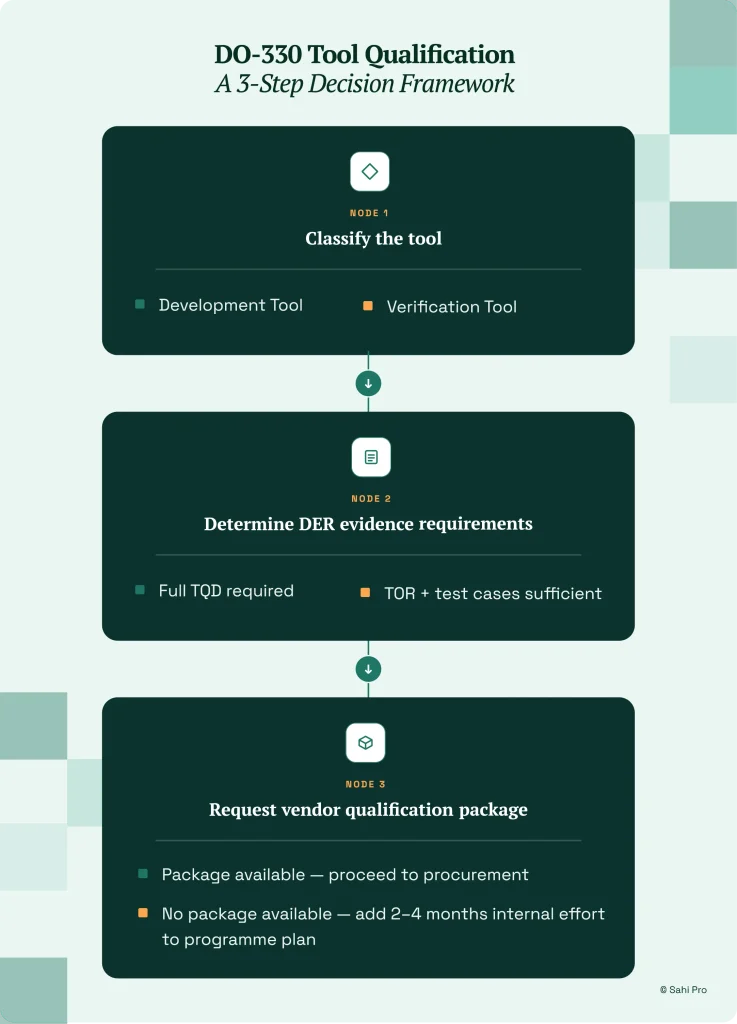
DO-330 tool qualification applies in the context of a specific project. A tool qualified on one programme does not automatically qualify on another. Before committing to a tool, apply this three-step check against your programme requirements.
Step 1: Classify the tool’s role in your verification process. Determine whether your test automation tool is a development tool (its output becomes part of airborne software) or a verification tool (used to verify software, output is not directly part of it). Most PLM workflow automation tools are verification tools. Verification tools whose failures could allow errors to escape detection qualify as TQL-5 under DO-330, the lowest level, but still requiring a formal documentation package.
Step 2: Determine what evidence your programme’s DER requires. Some DERs accept vendor-provided TOR documents with limited supplementary evidence. Others require a complete TQD package developed in your operational environment. Engage your DER before tool selection to align expectations. This conversation costs nothing; discovering a misalignment during a certification audit costs significantly more.
Step 3: Request the vendor’s qualification evidence package before licensing. Ask specifically for: the Tool Operational Requirements document, qualification test cases, and any completed TQD from prior programmes. A vendor with no qualification documentation creates a multi-month internal effort that belongs in your programme schedule before contract signature, not after.
Sources
- RTCA DO-178C: Software Considerations in Airborne Systems and Equipment Certification, Section 12.2, rtca.org
- RTCA DO-330: Software Tool Qualification Considerations, Tool Qualification Levels TQL-1 through TQL-5, rtca.org
- FAA Advisory Circular AC 20-115D: Airborne Software Development Assurance Using EUROCAE ED-12 and RTCA DO-178, faa.gov
- ITAR 22 CFR Parts 120-130: International Traffic in Arms Regulations, ecfr.gov
- AS9100D: Quality Management Systems, Requirements for Aviation, Space, and Defense Organizations, Clause 8.5.6, sae.org
- Sahi Pro: 7 Best PLM Test Automation Tools for Aerospace and Defence Compliance in 2026, sahipro.com/blog-plm-test-automation-tools-aerospace-defence-compliance-2026/