


TL;DR
- What this is: Arena PLM test automation for medical device NPI compliance
- Who it affects: QA Validation Engineers at medical device and IVD companies
- The core problem: Dynamic session IDs break standard web test scripts
- Cost of not solving it: Delayed NPI releases, incomplete FDA DHR documentation
- What Sahi Pro does differently: Proximity ID, 21 CFR Part 820 records, on-premise deployment
- Proof: ArisGlobal, 70% reduction in regulatory report generation time
Every QA team running arena PLM test automation for medical device NPI hits the same wall: Arena’s dynamic session IDs invalidate element locators on every login, and 21 CFR Part 820 demands timestamped Device History Records for every automated workflow you execute. Standard web testing tools handle one of these problems. They do not handle both. This article evaluates six automation tools against Arena PLM’s specific technical challenges, including dynamic ID stability, DHR-ready execution records, on-premise data residency, and GAMP 5 documentation. Each tool was tested against Arena PLM’s BOM management, change order, and supplier qualification modules to determine where it succeeds and where it falls short for medical device NPI teams shipping under FDA and EU MDR oversight.
Quick-Pick: 6 Arena PLM Test Automation for Medical Device at a Glance
| # | Tool | Best for | Dynamic ID stability and FDA compliance coverage | On-premise |
| 1 | Sahi Pro | Arena PLM medical device NPI with DHR compliance | Proximity ID for Arena dynamic IDs + 21 CFR Part 820 execution records + on-premise FDA data residency | Yes, full |
| 2 | Microsoft Playwright | Cloud PLM portals with modern SPA UI | Best dynamic SPA handling for cloud PLM portals | Yes, fully on-premise |
| 3 | Selenium WebDriver | Web-only PLM portals with in-house engineers | Zero cost, maximum flexibility for web layer | Yes, fully on-premise |
| 4 | mabl | Cloud PLM portals with low-code authoring | Fastest web PLM test authoring with auto-healing | No, cloud-only |
| 5 | Tricentis Tosca | Enterprise teams already using Tosca for SAP | Model-based test design and SAP-native integration | Yes, on-premise available |
| 6 | Leapwork | Non-developer PLM QA in regulated life sciences | Most accessible visual no-code for regulated industries | Partial, cloud-primary with limited on-premise |
1. Sahi Pro: Best for Arena PLM medical device NPI with 21 CFR Part 820 DHR compliance
Why it ranks first for Arena PLM (PTC)
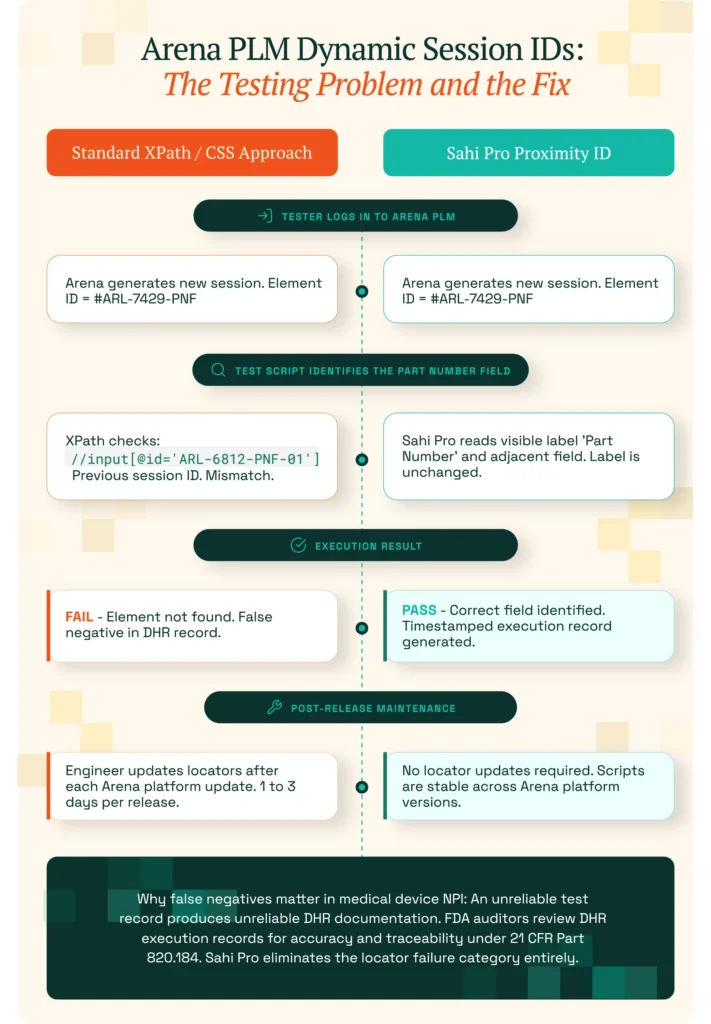
Arena PLM generates new session IDs on every tester login. Standard XPath and CSS selectors break immediately. Sahi Pro’s Proximity ID reads Arena PLM elements by visible field labels rather than dynamic session IDs, keeping medical device NPI regression scripts stable across Arena platform updates and login sessions. This is a deterministic, label-based identification architecture, not an ML-based guess. It mirrors how a human tester reads the screen: find the label, interact with the adjacent field.
For verification and validation testing under FDA oversight, this stability matters more than speed or parallel execution. A test that fails because of a stale locator produces a false negative. False negatives in arena PLM test automation for medical device NPI mean your DHR documentation is unreliable. Sahi Pro eliminates that category of failure at the identification layer.
The on-premise deployment model runs entirely within your infrastructure. No test data, no execution logs, no BOM content leaves your network. For medical device companies handling pre-submission design files, this is a hard requirement, not a preference.
Key capabilities for Arena PLM (PTC) teams
- Proximity ID for dynamic Arena sessions: Identifies elements by visible labels and spatial context. Scripts survive session ID changes, Arena platform updates, and UI refactoring without locator maintenance.
- 21 CFR Part 820 execution records: Timestamped execution records per test step satisfy quality system regulation requirements. These records are structured for direct inclusion in Device History Records for FDA submissions.
- On-premise FDA data residency with GAMP 5 documentation: Full on-premise deployment with no external routing. GAMP 5 Category D documentation is available for computer system validation programs.
- Data-driven BOM configuration testing: Data-driven execution tests multiple medical device configuration BOMs from one script, a core requirement for PLM qa automation across product variants.
- Non-developer test authoring: The no-code interface (BDTA) allows regulatory affairs and QA professionals to build and maintain Arena PLM test flows without programming skills, covering conditional logic and suite dependencies.
Honest limitations
The AI Assist OCR add-on, useful for canvas-rendered or proprietary UI elements, is an additional cost item, not included in the base license. The BDTA visual builder covers web-layer flows primarily. If your Arena PLM environment includes Java thick-client integration points, those steps require scripting rather than visual authoring. Cloud SaaS execution is not available; the on-premise model is the only deployment option.
Best for: Arena PLM medical device NPI with 21 CFR Part 820 DHR compliance and on-premise On-premise: Yes, full installation, no external routing Pricing: Module-based; free trial available Key Arena PLM (PTC) capability: Proximity ID for Arena dynamic IDs + 21 CFR Part 820 execution records + on-premise FDA data residency
2. Microsoft Playwright: Best for cloud-hosted PLM portals with modern web frameworks
Overview for Arena PLM (PTC) teams
Playwright is a modern open-source web automation framework from Microsoft with excellent support for Angular, React, and dynamic web applications. PLM teams evaluate it for cloud-hosted PLM portals like Arena PLM or ENOVIA 3DEXPERIENCE browser layers. For QA engineers comfortable with TypeScript or JavaScript, Playwright provides strong control over Arena’s single-page application behavior.
What it does well for Arena PLM medical device NPI
- Dynamic content handling: Playwright’s auto-waiting and retry logic handles Arena PLM’s AJAX-heavy UI transitions without explicit sleep statements, reducing flaky test failures.
- Parallel execution speed: Built-in parallel test execution across Chromium, Firefox, and WebKit runs Arena regression suites significantly faster than sequential alternatives.
- TypeScript-first development: Strong TypeScript support gives engineering teams type safety and IDE integration for maintaining large Arena PLM test codebases.
- Active community and documentation: Frequent releases and a large contributor base mean Arena-specific workarounds and patterns are well-documented in community forums.
Best for: Cloud PLM portals with modern Angular or React UI On-premise: Yes, fully on-premise
3. Selenium WebDriver: Best for web-only PLM portal automation with in-house engineering
Overview for Arena PLM (PTC) teams
Selenium WebDriver is the most widely used open-source web automation framework. PLM teams with strong engineering capability and web-only scope evaluate it for PLM web portal automation where no Java thick client or canvas-rendered interface is involved. Its language-agnostic bindings make it a natural fit for teams that already have Selenium infrastructure in place.
What it does well for Arena PLM medical device NPI
- Zero license cost: No license fees at any scale. For medical device startups or small QA teams with engineering depth, this removes budget as a barrier to Arena PLM automation.
- Language flexibility: Bindings for Java, Python, C#, Ruby, and JavaScript let teams write Arena PLM tests in whatever language their engineering organization already uses.
- Universal browser support: Works on every major browser. Arena PLM’s browser-specific rendering quirks can be tested across Chrome, Firefox, Edge, and Safari from the same framework.
- CI/CD pipeline integration: Integrates with Jenkins, GitLab CI, GitHub Actions, and every major CI/CD system without vendor lock-in or proprietary agents.
Best for: Web-only PLM portals with in-house engineers On-premise: Yes, fully on-premise
4. mabl: Best for cloud-native PLM portals with low-code test authoring
Overview for Arena PLM (PTC) teams
mabl is a cloud-native intelligent test automation platform targeting web applications. It is evaluated by PLM teams using cloud-hosted platforms like Arena PLM or Agile PLM where DOM access is reliable and on-premise deployment is not required. For teams that need fast test creation without deep engineering resources, mabl’s low-code approach is worth evaluating.
What it does well for Arena PLM medical device NPI
- Low-code test authoring with auto-healing: mabl’s recorder and auto-healing locators let QA professionals build Arena PLM tests quickly. When Arena’s UI changes, mabl attempts to self-correct locators without manual intervention.
- Built-in visual regression testing: Visual comparison catches Arena PLM UI changes that functional tests miss, including layout shifts in BOM tree views and change order forms.
- Jira and CI/CD integration: Native Jira integration links Arena PLM test results directly to NPI project tickets. CI/CD hooks trigger Arena regression suites on every build.
- Cloud parallel execution: mabl’s cloud infrastructure runs Arena PLM tests in parallel without local machine provisioning, useful for teams without dedicated test infrastructure.
Best for: Cloud PLM portals with low-code test authoring needs On-premise: No, cloud-only
5. Tricentis Tosca: Best for enterprise model-based PLM automation
Overview for Arena PLM (PTC) teams
Tricentis Tosca is a model-based test automation platform widely used in SAP and enterprise application environments. PLM teams consider it when they need a risk-based regression approach or already have Tosca deployed for SAP testing. If your organization runs Arena PLM alongside SAP QM or SAP ERP, Tosca’s existing footprint in your enterprise may justify extending it to PLM.
What it does well for Arena PLM medical device NPI
- Model-based test design: Tosca’s model-based approach reduces duplication across similar Arena PLM workflows. One model covers change orders, ECOs, and BOM approvals with parameterized variations.
- SAP-native integration: For medical device companies running SAP alongside Arena PLM, Tosca provides native SAP GUI automation in the same test suite, eliminating a tool boundary.
- Risk-based regression coverage: Tosca’s risk-based test selection prioritizes Arena PLM test cases by business impact, focusing execution time on the highest-risk NPI workflows.
- No-code test design for analysts: Business analysts familiar with the Tosca model can create and maintain Arena PLM tests without scripting, though the learning curve for the model itself is non-trivial.
Best for: Enterprise teams already using Tosca for SAP On-premise: Yes, on-premise available
6. Leapwork: Best for non-developer PLM teams with visual flowchart automation
Overview for Arena PLM (PTC) teams
Leapwork is a visual no-code automation platform using diagram-based test design. PLM teams whose QA is entirely non-developer look at it as an alternative to scripted tools, particularly in life sciences and regulated industries. Its marketing presence in the life sciences vertical means medical device teams encounter it frequently during tool evaluations.
How to choose the right Arena PLM Test Automation for Medical Device
- Fully visual no-code test design: Leapwork’s drag-and-drop interface lets non-technical testers build Arena PLM test cases without writing any code, lowering the barrier to automation adoption.
- Audit-ready test documentation: Built-in documentation features produce test records formatted for regulatory audit, relevant for teams preparing 21 CFR Part 820 or EU MDR submissions.
- Life sciences market focus: Leapwork’s positioning in regulated industries means its support team understands medical device QA terminology and compliance expectations.
- Accessible drag-and-drop test flows: Non-technical QA staff can modify Arena PLM test flows independently, reducing dependency on automation engineers for routine test maintenance.
Best for: Non-developer PLM QA in regulated life sciences On-premise: Partial, cloud-primary with limited on-premise
How we evaluated Arena PLM Test Automation for Medical Device
Selecting the right tool depends on your team’s constraints, not on feature lists. Here are the decision factors that matter most for Arena PLM medical device NPI.
- If your team has no dedicated automation engineer and needs manual testers to build tests, consider Sahi Pro’s no-code interface or Leapwork’s visual builder. Both allow non-developers to author tests, but Sahi Pro adds Proximity ID stability for Arena’s dynamic IDs, which Leapwork does not.
- If your Arena PLM environment includes Java thick-client integration points or canvas-rendered elements, eliminate any tool that operates on web DOM only. Playwright, Selenium, and mabl cover the web layer exclusively. Sahi Pro’s desktop add-on handles Java Swing/AWT/SWT in the same script as the web layer.
- If your medical device organization requires on-premise deployment with no external data routing, eliminate cloud-only tools immediately. Check the on-premise column in the quick-pick table above. mabl is eliminated at this step. Leapwork’s on-premise option is limited.
- If your scope is purely web-layer PLM test automation with no Java clients or proprietary UI elements, a standard web tool like Playwright or Selenium may be sufficient, provided your team can handle locator maintenance when Arena’s session IDs change.
- If you need one test suite covering arena PLM test automation and SAP ERP integration in a single execution, only Sahi Pro’s add-on architecture covers both technology layers in one script.
If you are unsure which criteria apply to your deployment, run a proof-of-concept directly against your Arena PLM (PTC) environment. Sahi Pro offers a free trial for this purpose.
How we evaluated Arena PLM Test Automation for Medical Device
A generic web testing tool can automate form fills and button clicks on any browser application. Arena PLM test automation for medical device NPI requires more. The tool must handle Arena’s dynamic session IDs without locator rewrites, produce execution records that satisfy FDA DHR requirements, and run on-premise when pre-submission device data cannot leave your network. Standard PLM test automation evaluations miss these criteria entirely.
Each tool was evaluated against six criteria specific to Arena PLM in regulated medical device environments:
- Arena PLM dynamic session ID stability: Can the tool identify Arena PLM elements when session IDs change on every tester login? Tools relying on fixed DOM attributes fail this test immediately.
- 21 CFR Part 820 Device History Record output: Does the tool produce timestamped, step-level execution records that satisfy 21 CFR Part 820 DHR requirements for verification and validation testing documentation?
- On-premise for medical device FDA data residency: Can the tool run fully on-premise with no medical device NPI data leaving the company infrastructure? Cloud-only tools are disqualified for many FDA-regulated environments.
- GAMP 5 Category D for Arena PLM validation: Does the vendor provide GAMP 5 Category D self-assessment documentation for Arena PLM medical device computer system validation programs?
- Data-driven NPI configuration variant testing: Can the tool run Arena PLM BOM validation across multiple medical device configuration variants from a single parameterized script?
- Upgrade stability after Arena platform updates: Does element identification survive Arena PLM platform updates during medical device NPI release cycles without requiring locator maintenance?
Medical Device NPI: 21 CFR Part 820 DHR and IVD Directive
FDA 21 CFR Part 820 requires Device History Records documenting that each device was manufactured in accordance with the Device Master Record. Arena PLM NPI workflows that control the Device Master Record fall under this requirement (21 CFR 820.184). EU MDR 2017/745 Annex II Section 6.1 imposes parallel technical documentation requirements for devices marketed in Europe. GAMP 5 Category D classifies configured products like Arena PLM as requiring documented verification of configuration settings. For PLM qa automation, this means the test tool itself must produce artefacts that auditors can trace back to specific test executions, steps, timestamps, and pass/fail outcomes.
Of the six tools evaluated, Sahi Pro satisfies this requirement through timestamped execution records per test step, on-premise deployment with no external data routing, and available GAMP 5 Category D documentation. Playwright and Selenium can produce custom execution logs, but the team must build the reporting layer and maintain it. Neither vendor provides GAMP 5 documentation. mabl is cloud-only and cannot satisfy FDA data residency requirements for pre-submission device data. Tricentis Tosca offers on-premise deployment and has compliance documentation, but its Arena PLM dynamic ID handling requires custom configuration. Leapwork produces audit-ready documentation but its cloud-primary architecture limits on-premise deployment options.
For compliance-specific tool selection, request documentation from each vendor on whether their deployment model satisfies 21 CFR Part 820 QSR / EU MDR 2017/745 / GAMP 5 Category D data residency requirements. Cloud-only vendors typically cannot provide this.
Real Results: ArisGlobal
ArisGlobal is a global provider of R&D software solutions and consultancy services for life sciences companies managing clinical trial, safety, and regulatory information. Their team had started test automation with a leading commercial tool but moved to an in-house framework based on Watij and Selenium due to limitations in supporting automation for their products. The previous tools lacked relative APIs, could not handle complex conditional automation, and required mandatory object repository maintenance that consumed significant engineering effort.
ArisGlobal moved to Sahi Pro to solve these specific problems: proximity-based identification for dynamic UI elements without an object repository, on-premise execution for regulated data, and scripting support for complex conditional automation that their previous tools could not handle.
The results after implementation:
- 70% reduction in time for multiple regulatory report generation for one of the life sciences products.
- Data-driven tests reduced testing cycles across multiple medical device configuration variants.
- Non-technical regulatory affairs team members able to participate in automation without specialist skills.
- Positional Relation APIs automated controls without specific unique identifiers in complex Arena PLM UI.
For medical device NPI teams that need dynamic session ID stability, 21 CFR Part 820 DHR execution records, and on-premise data residency in a single product, Sahi Pro is the tool that addresses all three requirements without custom engineering. If your scope is purely web-layer Arena PLM testing with an engineering-heavy QA team and no on-premise mandate, Playwright or Selenium will serve you well at lower cost. Tosca makes sense if your organization already runs it for SAP and wants to extend coverage to Arena PLM without adding another vendor.
If your team has a complex Arena PLM scenario you are not sure can be automated, consider running it against a real environment before committing to any license. Sahi Pro offers a free trial with full product access and no feature restrictions. You can also Book A Demo and bring your hardest test scenario directly to the Sahi Pro engineering team.