



SAP quality workflows, CAPA records, deviation reports, batch release transactions, generate the electronic records an FDA auditor reviews. The test automation tool running against them either produces compliant execution evidence natively or it creates a post-processing burden your validation team carries after every test run.
TL;DR
- SAP GUI renders controls through a proprietary SAP Scripting API, not the browser DOM, Selenium, Playwright, and Cypress cannot interact with SAP GUI transactions at all, regardless of configuration
- FDA 21 CFR Part 11.10(e) mandates “secure, computer-generated, time-stamped audit trails”, most test automation tools produce execution logs, not structured records that satisfy this requirement without custom post-processing
- GAMP 5 Category D classifies configured software products including test automation tools, requiring IQ/OQ documentation that demonstrates the tool performs as intended in your specific validated environment
- 95% of the world’s life sciences companies use SAP, and most critical quality transactions, CAPA, deviation management, batch release, still run through SAP GUI rather than Fiori in currently validated systems
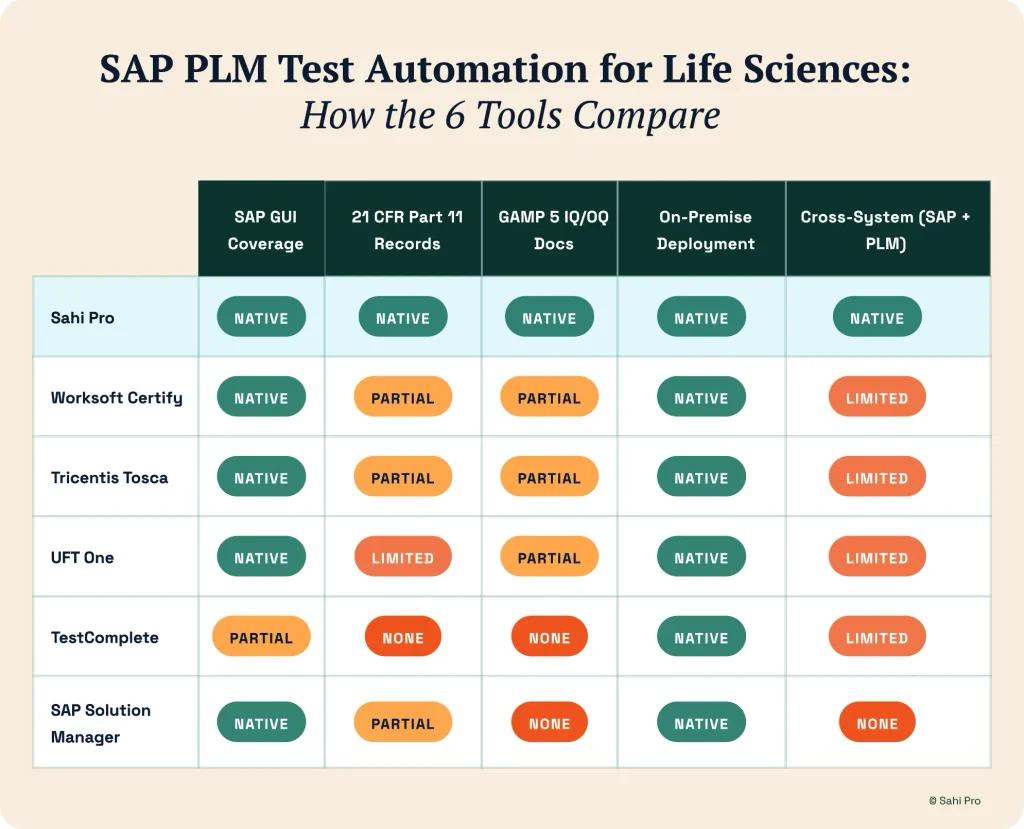
- Of the six tools here, Sahi Pro and Worksoft Certify are the only two with native SAP GUI scripting-layer coverage documented for life sciences compliance contexts
Why Standard Web Automation Tools Cannot Reach SAP GUI
The distinction between SAP GUI and SAP Fiori is the most common source of misaligned tool selection in life sciences automation projects. SAP Fiori is a modern browser-based interface, it renders HTML and JavaScript in a standard browser, and any competent web automation tool can interact with it. SAP GUI is a different application entirely.
SAP GUI renders its controls through the SAP Scripting API, a proprietary communication layer that operates outside the browser DOM. When Selenium, Playwright, or Cypress attempt to interact with a SAP GUI window, WebDriver returns null. The transaction interface is invisible to the automation tool. This is not a configuration problem, it is an architectural one. Tools without native SAP Scripting API support cannot automate SAP GUI workflows regardless of how they are configured or extended.
For life sciences organizations running CAPA management, deviation handling, batch release, and quality notifications in SAP, the GUI remains the primary transaction interface for most critical quality processes in currently validated systems. SAP S/4HANA has expanded Fiori coverage significantly, but the workflows generating electronic records subject to 21 CFR Part 11 scrutiny frequently run through SAP GUI transactions. Migrating to Fiori-only workflows to accommodate a web-based automation tool is itself a re-validation effort.
What 21 CFR Part 11 and GAMP 5 Actually Require from Test Execution Records
FDA 21 CFR Part 11.10(e) requires “secure, computer-generated, time-stamped audit trails to independently record the date and time of operator entries and actions that create, modify, or delete electronic records.” In a test automation context, execution records must be generated by the tool itself, timestamped per individual action, attributable to a specific user or automated process, and stored in a way that prevents modification after generation.
Standard test automation output does not satisfy this requirement as written. JUnit XML, HTML reports, and console logs typically timestamp at test completion rather than individual action execution. The record format is not structured for electronic records compliance. Assembling FDA-ready execution records from standard automation output requires custom reporting tooling that the team builds, validates, and maintains as a separate system in its own right.
GAMP 5 Category D classifies configured software products. A test automation tool deployed in a validated life sciences environment is a Category D system. IQ documentation must confirm correct installation in your specific environment. OQ documentation must demonstrate that the tool performs its stated functions as intended. PQ documentation covers performance under actual use conditions. Tools that supply pre-built IQ/OQ protocols, installation qualification checklists, and configuration guides significantly reduce the validation effort, the alternative is developing that documentation from scratch.
The Evaluation Criteria for This List
SAP GUI thick-client coverage: Does the tool interact with SAP GUI transactions natively through the SAP Scripting API, not through pixel-coordinate workarounds that break on any layout change?
21 CFR Part 11 execution record output: Does the tool produce timestamped, step-level execution records satisfying Part 11.10(e) natively, without custom post-processing?
GAMP 5 Category D IQ/OQ documentation: Does the vendor supply pre-built IQ/OQ protocols and a validation kit for the tool as a Category D system?
On-premise deployment for data residency: Does the tool run entirely within your validated environment with no execution data, screenshots, or test results leaving your network?
Script stability across SAP version upgrades: How much of your existing test suite survives a SAP support pack migration or S/4HANA upgrade?
The 6 Best SAP PLM Test Automation Tools for Life Sciences
1. Sahi Pro
Sahi Pro covers SAP GUI transactions natively through the SAP Scripting API, SAP Fiori interfaces through standard browser automation, and the surrounding PLM environment, Teamcenter, ENOVIA, Windchill, through its Desktop add-on and AI Assist OCR. For life sciences teams running quality workflows that span SAP GUI CAPA transactions, Fiori-based electronic batch records, and PLM validation documentation, Sahi Pro handles the full sequence in one test script without a second tool for the SAP layer.
The execution record format produces timestamped, step-level records designed to simultaneously satisfy 21 CFR Part 11 Subpart C, AS9100D clause 8.5.6, and ISO 13485 clause 7.5.6 from a single report. For organizations managing multi-standard compliance, one execution run produces records usable across regulatory frameworks rather than requiring separate compliance documentation per framework.
On-premise deployment is standard. No execution data, screenshots, or test results route externally. For life sciences environments with data residency requirements under 21 CFR Part 11 Subpart B, keeping test data within your validated infrastructure is required practice, not optional configuration.
Confirm with the Sahi Pro team whether a GAMP 5 Category D IQ/OQ documentation package is available for your specific SAP version and deployment configuration before finalising validation planning.
Honest limitation: SAP GUI coverage and AI Assist OCR are separately licensed modules. Plan for the full module stack cost when building the business case.
2. Worksoft Certify
Worksoft Certify is purpose-built for SAP automation and has the deepest SAP GUI scripting coverage in this list. It covers SAP GUI, SAP Fiori, and SAP web interfaces, and has published life sciences compliance credentials including FDA 21 CFR Part 11 support and GAMP 5 documentation. Worksoft has a long track record in pharma and biotech automation, and its compliance documentation is mature.
For organizations running exclusively SAP quality workflows, CAPA, deviation management, batch release, quality notifications, Worksoft is a strong choice. The validation kit is well-developed and widely used in regulated environments.
Honest limitation: Worksoft’s coverage stops at the SAP boundary. For teams needing to automate PLM workflows beyond SAP, Teamcenter, Windchill, or ENOVIA, Worksoft requires a second tool. Teams running both SAP and PLM validation workflows carry two maintenance cycles and two vendor relationships.
3. Tricentis Tosca
Tosca covers SAP GUI and SAP Fiori through dedicated SAP-specific automation modules and has substantial life sciences industry deployment. Its model-based approach centralises test management and works well for large regulated programmes with multiple workstreams requiring coordinated compliance documentation.
Tosca has published GAMP 5 documentation support and compliance record output for 21 CFR Part 11 contexts. It is widely used in pharma and biotech validation programmes.
Honest limitation: Tosca requires TBox certification for test authoring and maintenance. Teams without certified staff cannot self-maintain their suites. Year 1 total cost for a 10-person life sciences QA team runs approximately double Sahi Pro based on published licensing and training benchmarks.
4. UFT One (OpenText)
UFT One covers SAP GUI through its dedicated SAP add-in and has a long history in life sciences validation programmes. AS9100D and 21 CFR Part 11 compliance documentation capabilities exist and are mature. On-premise deployment is fully supported.
For organizations already invested in UFT One for other application layers, legacy desktop systems, clinical data management tools, consolidating SAP GUI coverage into the existing toolset avoids additional vendor complexity.
Honest limitation: UFT One licensing costs have increased significantly since the OpenText acquisition. For programmes evaluating from scratch, the licensing comparison with Sahi Pro and Worksoft is not favourable. SAP GUI object model maintenance after major SAP version changes also adds ongoing overhead.
5. TestComplete (SmartBear)
TestComplete covers SAP GUI through its desktop automation capabilities and supports on-premise deployment. It handles a broad range of application types, web, desktop, and SAP GUI, within one product, which reduces tool sprawl for teams validating diverse application stacks.
TestComplete has life sciences deployment references and supports structured test execution reporting. Its scripting flexibility (JavaScript, Python, VBScript) means automation engineers with existing coding skills can build suites without additional certification requirements.
Honest limitation: TestComplete’s 21 CFR Part 11 compliance record output requires configuration and potentially custom scripting to produce step-level records in the structured format FDA inspectors expect. It does not produce compliant records out of the box in the way purpose-built life sciences tools do.
6. SAP Solution Manager Test Suite (Native Option)
SAP Solution Manager’s built-in test suite (formerly Test Management, now part of Solution Manager) covers SAP transactions natively and integrates directly with SAP’s change management and transport workflows. For teams wanting native SAP integration without a third-party tool, it is the baseline option.
As the native tool, it handles SAP GUI transaction documentation directly and integrates with SAP’s own change control processes, which is relevant for 21 CFR Part 11 audit trail continuity across SAP system changes.
Honest limitation: Solution Manager’s test automation capabilities are significantly narrower than any third-party tool in this list. Cross-system test sequences, SAP GUI into PLM, SAP into laboratory systems, require significant custom development. It covers SAP well and little outside it.
What a Complete Life Sciences SAP Validation Toolkit Looks Like
The test automation tool is one component of a 21 CFR Part 11 compliant SAP validation programme. Before finalising tool selection, confirm your programme has addressed these four adjacent requirements.
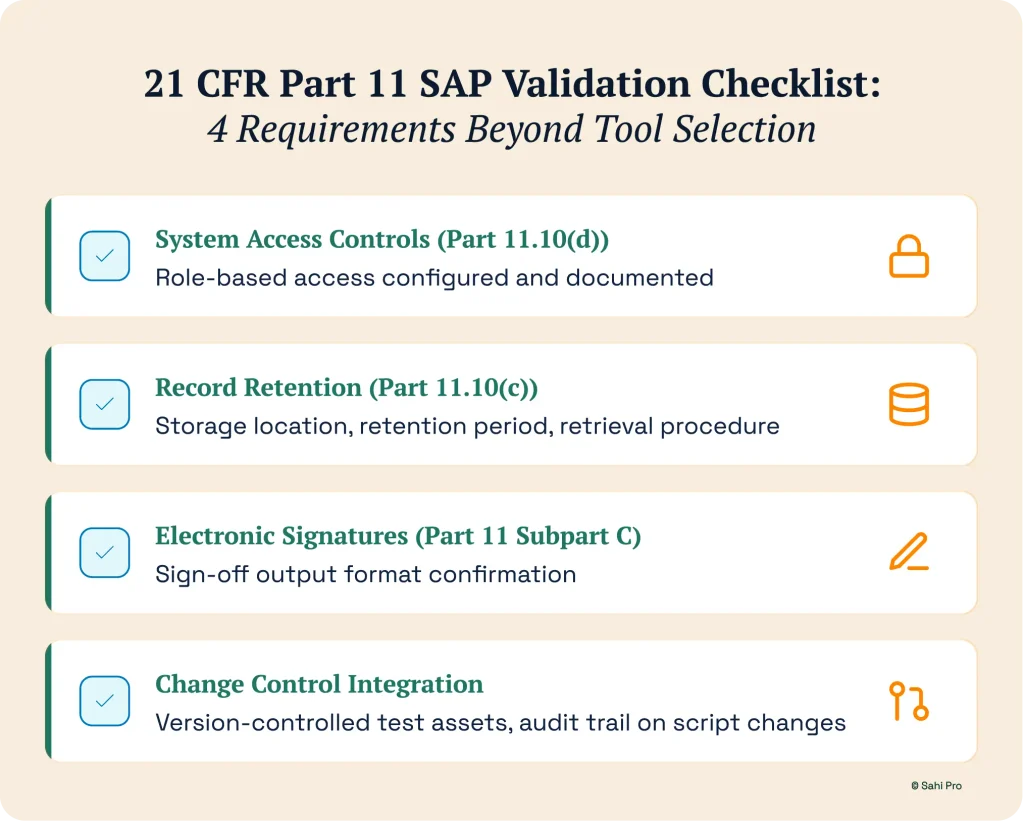
System access controls: 21 CFR Part 11.10(d) requires limiting access to authorized individuals. Your automation tool’s execution environment needs role-based access controls configured and documented in your system access policy.
Record retention: 21 CFR Part 11.10(c) requires accurate and ready retrieval of records throughout required retention periods. Confirm where test execution records are stored, for how long, and how they are retrieved during an inspection.
Computer-generated signatures: If your test execution workflow includes electronic sign-off on test results, common in IQ/OQ/PQ programmes, confirm whether your tool’s e-signature output satisfies Part 11 Subpart C requirements.
Change control integration: Every change to the test automation suite in a validated environment requires formal change control. Confirm your tool supports version-controlled test assets with audit trails on script modifications.
Sources
- FDA 21 CFR Part 11: Electronic Records; Electronic Signatures, fda.gov/regulatory-information/search-fda-guidance-documents
- FDA 21 CFR Part 11.10(e): Audit trail requirements, ecfr.gov
- ISPE GAMP 5 (Second Edition): A Risk-Based Approach to Compliant GxP Computerized Systems, Category D classification, ispe.org
- SAP S/4HANA for Life Sciences: GxP implementation overview, intuitionlabs.ai/articles/sap-s4hana-pharma-gxp-implementation-validation
- Sahi Pro: PLM Test Automation Tools for Medical Device and Life Sciences, sahipro.com/plm-test-automation-tools-medical-device-life-sciences-2026/
- ERP Research: SAP for Pharmaceutical Companies (95% market statistic), erpresearch.com