



TL;DR
- PLM test automation for electronics and semiconductor NPI
- QA engineers and DevOps leads at semiconductor companies
- Six-month NPI cycles need fast parallel PLM regression
- Manual PLM regression blocks releases, compliance data unvalidated
- Parallel execution and proximity ID across three PLM platforms
- Mahindra Comviva: 94% execution time saving, 2,300 scenarios
Running PLM QA tools for enterprise electronics environments means dealing with Arena PLM session-generated element IDs, Teamcenter Active Workspace Angular rendering, and Oracle Agile PLM DOM-heavy web interfaces, all while maintaining regression coverage across 6-month NPI release cadences. Standard web testing tools break down here because these platforms mix dynamic single-page application behavior with EDA tool integrations, multi-site execution requirements, and RoHS/REACH compliance validation workflows that span multiple technology layers. This article evaluates seven PLM test automation tools against criteria specific to electronics and semiconductor NPI, including parallel execution speed, dynamic element identification stability, on-premise deployment support, and EDA integration validation. Each tool was tested against Arena PLM, Teamcenter, and Oracle Agile PLM workflows to determine where it excels and where it falls short.
Quick-Pick: 7 Electronics PLM Test Automation Tools at a Glance
| # | Tool | Best for | NPI speed and multi-platform coverage | On-premise |
| 1 | Sahi Pro | Multi-platform electronics PLM with fast NPI parallel regression | Parallel execution for fast NPI cadence; proximity ID across all three electronics PLM platforms | Yes, full |
| 2 | Microsoft Playwright | Cloud PLM portals with modern Angular or React UI | Best dynamic SPA handling for cloud PLM portals | Yes, fully on-premise |
| 3 | Selenium WebDriver | Web-only PLM portals with in-house engineers | Zero cost, maximum flexibility for web layer | Yes, fully on-premise |
| 4 | mabl | Cloud PLM portals with low-code test authoring needs | Fastest web PLM test authoring with auto-healing | No, cloud-only |
| 5 | Tricentis Tosca | Enterprise teams already using Tosca for SAP | Model-based test design and SAP-native integration | Yes, on-premise available |
| 6 | Katalon Studio | Budget-constrained teams with web-only PLM scope | Lowest entry cost for web PLM automation | Partial, cloud execution default; on-premise limited |
| 7 | Testim | Teams prioritizing AI-driven test maintenance | AI-stabilized locators for cloud PLM portals | No, cloud-only |
1. Sahi Pro — Best for multi-platform electronics PLM with fast NPI parallel execution
Why it ranks first for Arena PLM, Teamcenter, Oracle Agile PLM
The core problem with electronics PLM regression is element identification instability. Arena PLM generates session-based IDs that change on every login. Oracle Agile PLM renders its web interface through Angular with deeply nested DOM structures. Teamcenter Active Workspace rebuilds its component tree on navigation. Standard XPath and CSS selectors fail across all three platforms because the DOM is never static long enough for positional locators to remain valid.
Sahi Pro addresses this through proximity-based identification, which reads elements by their visible labels and spatial context rather than DOM position. This is a deterministic approach, not ML-based. When a BOM tree node shifts position in Teamcenter or Arena PLM regenerates session IDs, the test script still resolves the correct element because the visible label relationship has not changed. For teams evaluating PLM QA tools for enterprise NPI workflows, this is the difference between maintaining scripts every sprint and running stable cross platform test automation across quarterly releases.
The second factor is execution speed. Electronics NPI cycles run on 6-month cadences. Running regression across Arena, Teamcenter, and Oracle Agile PLM sequentially can take days. Sahi Pro’s built-in parallel execution distributes tests across multiple machines without requiring a separate grid server, compressing multi-day regression runs into hours.
Key capabilities for Arena PLM, Teamcenter, Oracle Agile PLM teams
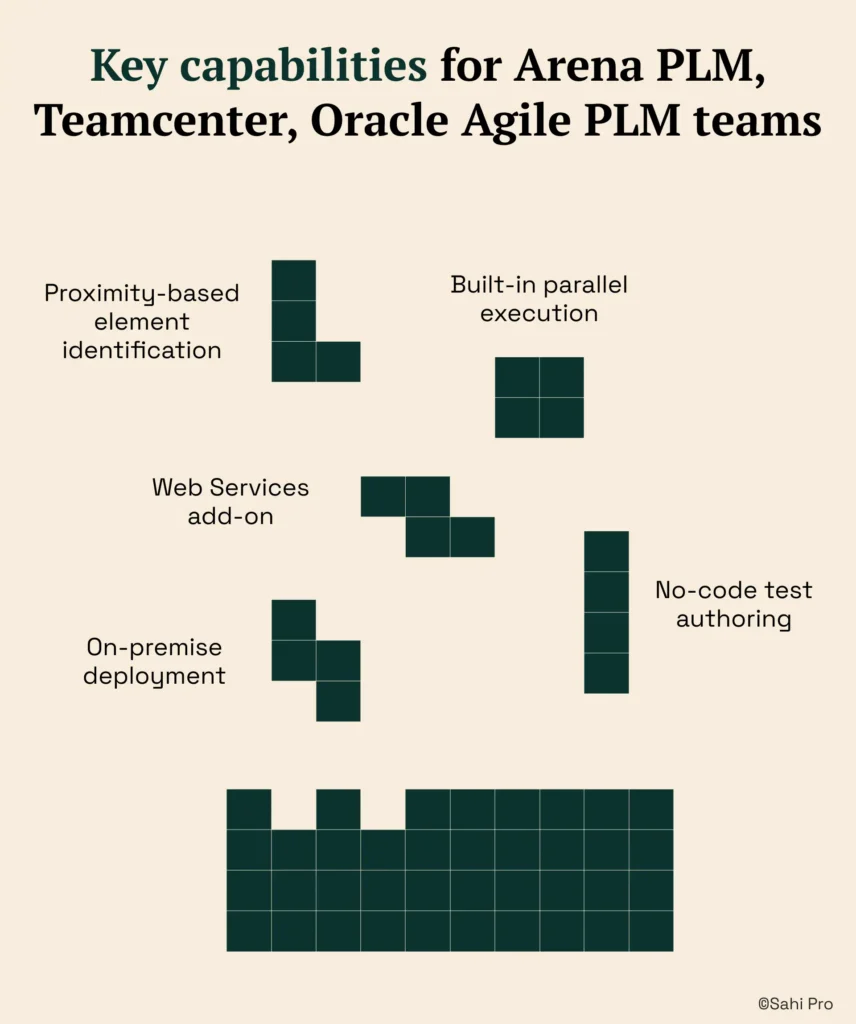
- Proximity-based element identification: Resolves dynamic session IDs in Arena PLM and Angular-rendered elements in Oracle Agile PLM by reading visible labels and structural proximity, keeping NPI regression scripts stable across platform updates.
- Built-in parallel execution: Distributes automated regression testing across multiple machines to compress NPI regression from days to hours, enabling daily or weekly regression cycles that match 6-month electronics release cadences.
- Web Services add-on: Validates EDA tool API integrations and RoHS/REACH data flows between PLM platforms and external systems like Mentor Graphics or Cadence, covering Arena, Teamcenter, and Oracle Agile PLM in one suite.
- On-premise deployment: Full installation with no external data routing. License activation, execution, and reporting remain entirely within your network, satisfying ITAR and export-controlled semiconductor environments.
- No-code test authoring: NPI quality engineers without scripting backgrounds can build and maintain PLM regression tests using the BDTA visual builder for web-layer flows.
Honest limitations
The AI Assist OCR add-on, which handles canvas-rendered and non-standard interfaces, is an additional cost module. It is not included in the base license. The BDTA visual builder covers web-layer flows effectively, but Java thick-client steps in Teamcenter Rich Client require scripting through the Desktop add-on. Teams running Teamcenter in both Active Workspace and Rich Client modes should plan for a hybrid scripted and visual approach.
Best for: Multi-platform electronics PLM with fast NPI parallel regression
On-premise: Yes, full installation, no external routing
Pricing: Module-based; free trial available
Key Arena PLM, Teamcenter, Oracle Agile PLM capability: Parallel execution for fast NPI cadence; proximity ID across all three electronics PLM platforms
2. Microsoft Playwright — Best for cloud-hosted PLM portals with modern web frameworks
Overview for Arena PLM, Teamcenter, Oracle Agile PLM teams
Playwright is an open-source web automation framework from Microsoft with strong support for Angular, React, and dynamic single-page applications. PLM teams evaluate it for cloud-hosted PLM portals like Arena PLM or ENOVIA 3DEXPERIENCE browser layers where the UI is built on modern web frameworks. Its auto-waiting mechanism and network interception capabilities make it particularly effective for SPAs that load data asynchronously.
What it does well for fast NPI cycles with multi-site Angular SPA and EDA tool integration
- Dynamic SPA handling: Built-in auto-wait and retry logic reduces flaky tests on Angular-rendered PLM portals where elements load asynchronously after API calls complete.
- TypeScript-first design: Strong TypeScript support means PLM automation engineers can build type-safe test suites with IDE autocompletion, reducing errors in complex BOM validation scripts.
- Fast parallel execution: Native parallel test execution across multiple browser contexts without external grid infrastructure, useful for running Arena PLM regression across Chrome and Edge simultaneously.
- Active development community: Frequent releases and a large contributor base mean PLM-specific issues with Angular rendering or shadow DOM handling get addressed quickly.
Best for: Cloud PLM portals with modern Angular or React UI
On-premise: Yes, fully on-premise
3. Selenium WebDriver — Best for web-only PLM portal automation with in-house engineering
Overview for Arena PLM, Teamcenter, Oracle Agile PLM teams
Selenium WebDriver is the most widely adopted open-source web automation framework. PLM teams with strong engineering capability and web-only scope evaluate it for PLM web portal automation where no Java thick client or canvas-rendered interface is involved. Its language-agnostic architecture means teams can write PLM test scripts in Java, Python, C#, or JavaScript depending on existing skill sets.
What it does well for fast NPI cycles with multi-site Angular SPA and EDA tool integration
- Zero license cost: No licensing fees of any kind, which matters for semiconductor companies running automation across multiple APAC and US engineering sites where per-seat costs multiply quickly.
- Largest community and documentation base: More PLM automation examples, Stack Overflow answers, and integration guides exist for Selenium than any other framework, reducing ramp-up time for new team members.
- Universal browser support: Works on all major browsers with standardized WebDriver protocol, ensuring PLM portal tests run identically across Chrome, Firefox, and Edge.
- CI/CD flexibility: Integrates with Jenkins, GitLab CI, Azure DevOps, and every major pipeline tool without vendor-specific plugins or agents.
Best for: Web-only PLM portals with in-house engineers
On-premise: Yes, fully on-premise
4. mabl — Best for cloud-native PLM portals with low-code test authoring
Overview for Arena PLM, Teamcenter, Oracle Agile PLM teams
mabl is a cloud-native intelligent test automation platform targeting web applications. PLM teams using cloud-hosted platforms like Arena PLM or Agile PLM evaluate it where DOM access is reliable and on-premise deployment is not required. Its auto-healing locator engine and low-code recorder make it accessible to QA engineers who need to build PLM regression suites without deep scripting expertise.
What it does well for fast NPI cycles with multi-site Angular SPA and EDA tool integration
- Low-code test authoring: Record-and-refine workflow lets QA engineers build Arena PLM test flows by interacting with the application directly, then parameterizing data inputs for BOM and ECO validation scenarios.
- Auto-healing locators: When Arena PLM or Oracle Agile PLM updates shift element positions, mabl’s ML-based locator engine attempts to resolve the new element path automatically, reducing maintenance overhead.
- Built-in visual regression: Screenshot comparison detects unintended UI changes in PLM dashboards and reporting views that functional assertions alone would miss.
- Cloud parallel execution: Runs PLM regression suites in parallel across mabl’s cloud infrastructure without requiring teams to provision or manage execution machines.
Best for: Cloud PLM portals with low-code test authoring needs
On-premise: No, cloud-only
5. Tricentis Tosca — Best for enterprise model-based PLM automation
Overview for Arena PLM, Teamcenter, Oracle Agile PLM teams
Tricentis Tosca is a model-based test automation platform widely used in SAP and enterprise application environments. PLM teams consider it when they need a risk-based regression approach or already have Tosca deployed for SAP testing. Its model-based engine lets teams define PLM UI modules once and reuse them across multiple test cases, reducing duplication in BOM approval and ECO routing workflows.
What it does well for fast NPI cycles with multi-site Angular SPA and EDA tool integration
- Model-based test design: Define PLM screen modules once and reuse across hundreds of test cases. When an Oracle Agile PLM screen changes, update the model once rather than editing every affected script.
- SAP integration: For electronics companies running SAP ERP alongside PLM, Tosca’s native SAP connector eliminates the need for a separate tool to cover ERP-to-PLM data flows.
- Risk-based regression coverage: Tosca’s risk scoring engine prioritizes test execution by business impact, useful when NPI timelines compress and full regression is not feasible.
- No-code test design for analysts: Business analysts familiar with PLM workflows can build test cases through the Tosca model interface without scripting, expanding test authoring beyond the QA engineering team.
Best for: Enterprise teams already using Tosca for SAP
On-premise: Yes, on-premise available
6. Katalon Studio — Best for small PLM teams needing low-cost automated testing
Overview for Arena PLM, Teamcenter, Oracle Agile PLM teams
Katalon Studio is a low-cost test automation platform supporting web and API testing with a built-in IDE. PLM teams with limited budget and web-only PLM scope evaluate it as an accessible entry point to automation. Its free tier covers basic web testing, making it viable for small semiconductor companies or startup hardware teams that need PLM regression coverage without upfront license investment.
What it does well for fast NPI cycles with multi-site Angular SPA and EDA tool integration
- Low entry cost: Free tier covers web automation basics. Paid tiers remain significantly cheaper than enterprise platforms, making it accessible for teams running Arena PLM regression on a constrained budget.
- Built-in test IDE: Integrated development environment reduces setup time. Teams do not need to configure a separate IDE, build system, or dependency manager to start writing PLM tests.
- Web and API testing: Covers both Arena PLM web portal interactions and REST API validation for EDA tool integrations in a single project, without requiring additional plugins.
- Accessible to junior testers: Keyword-driven and record-and-playback modes let testers with limited scripting background contribute to PLM regression suites during NPI crunch periods.
Best for: Budget-constrained teams with web-only PLM scope
On-premise: Partial, cloud execution default; on-premise limited
How to choose the right Electronics PLM Test Automation Tools
The right tool depends on your specific PLM platform mix, deployment constraints, and team composition. Here is a decision framework built for electronics and semiconductor NPI environments.
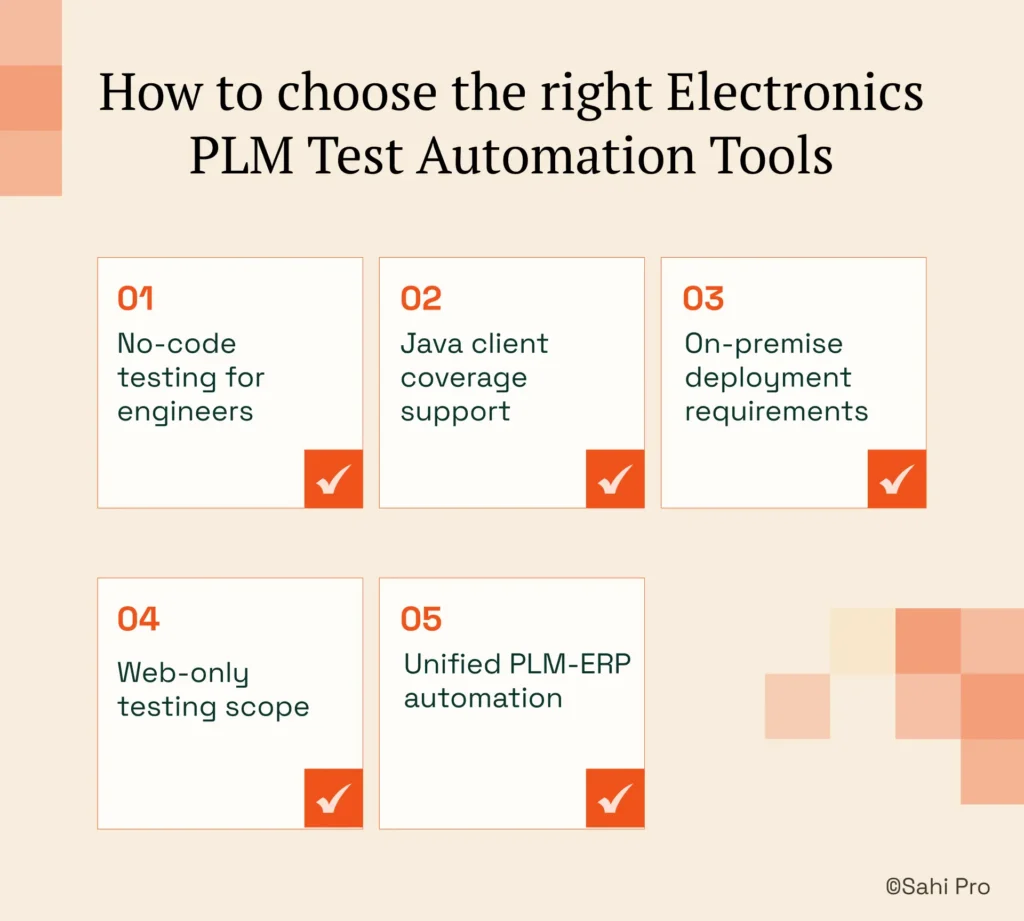
- If your team has no dedicated automation engineer and needs manual testers or NPI quality engineers to build tests, consider Sahi Pro’s BDTA visual builder or Tricentis Tosca’s model-based interface. Both allow non-engineers to author structured test flows without scripting.
- If your PLM test automation scope includes Java thick-client coverage for Teamcenter Rich Client or desktop EDA consoles, eliminate any tool that operates on web DOM only. Playwright, Selenium, mabl, and Katalon cannot interact with Java Swing or AWT interfaces natively.
- If your semiconductor environment requires on-premise deployment with no external data routing, eliminate cloud-only tools immediately. Check the on-premise column in the quick-pick table above. mabl and Testim do not offer on-premise deployment.
- If your scope is purely web-layer PLM testing with no Java clients or canvas-rendered elements, a standard web automation framework like Playwright or Selenium may be sufficient. Do not over-buy capability you will not use.
- If you need one test suite covering Arena PLM, Teamcenter, Oracle Agile PLM, and SAP ERP integration in a single execution, only Sahi Pro’s add-on architecture covers web, desktop, API, and database layers in one script. Among PLM QA tools for enterprise environments, this cross-layer capability eliminates the gaps between stitched-together tool stacks where defects hide.
If you are unsure which criteria apply to your deployment, run a proof-of-concept directly against your Arena PLM, Teamcenter, Oracle Agile PLM environment. Sahi Pro offers a free trial for this purpose.
How we evaluated Electronics PLM Test Automation Tools
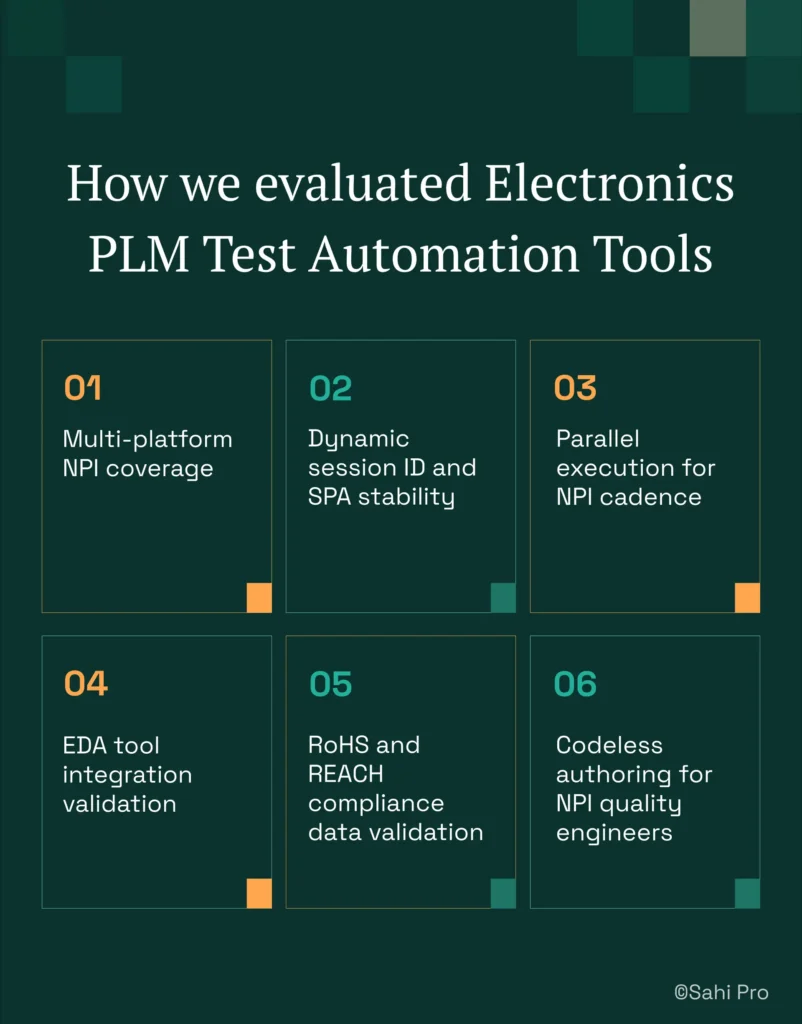
A generic web testing tool can click buttons and assert text. That is not enough for electronics PLM automation. PLM test automation for NPI requires handling dynamic session IDs, Angular-rendered BOM trees, multi-site parallel execution, and EDA tool integration validation, all within deployment constraints that semiconductor companies impose. We evaluated each tool against criteria specific to PLM QA tools for enterprise electronics and semiconductor environments.
- Multi-platform NPI coverage: Can the tool cover Arena PLM, Teamcenter, and Oracle Agile PLM in one suite for NPI regression, or does each platform require a separate tool and separate maintenance overhead?
- Dynamic session ID and SPA stability: Can the tool handle Arena PLM session-generated IDs and Oracle Agile PLM Angular rendering without brittle XPath locators that break on every platform update? This criterion is critical for arena PLM test automation specifically, where session tokens rotate on each login.
- Parallel execution for NPI cadence: Can the tool run multi-site parallel regression fast enough to support 6-month NPI release cycles? Sequential execution across three PLM platforms is a non-starter for weekly regression.
- EDA tool integration validation: Can the tool validate PLM integrations with EDA tools like Mentor Graphics or Cadence through API-level assertions, not just UI checks?
- RoHS and REACH compliance data validation: Can the tool automate RoHS and REACH data entry and validation workflows in PLM for regulatory reporting? Manual entry of compliance data is both slow and error-prone.
- Codeless authoring for NPI quality engineers: Can NPI quality engineers without scripting backgrounds build and maintain PLM regression tests, or is the tool limited to software engineers only?
Running Electronics PLM Regression in Jenkins and GitLab CI
Electronics teams that run PLM regression daily rather than before each release detect integration defects 3 to 5 times faster, reducing NPI delay costs (Sahi Pro customer deployment data, 2024). Integrating automated regression testing into Jenkins or GitLab CI pipelines requires the test automation tool to support on-premise execution agents, CLI-triggered test runs, and structured result output in JUnit XML or similar formats that pipeline dashboards can parse. For semiconductor companies subject to ITAR or EAR export control regulations, the execution infrastructure must remain entirely within the corporate network, with no test data or results routed through external servers.
Of the seven tools evaluated, Sahi Pro, Playwright, and Selenium support fully on-premise Jenkins and GitLab CI integration with no cloud dependencies. Sahi Pro provides a CLI runner and Ant/Maven integration that triggers distributed parallel execution from a Jenkins job, with HTML and XML reports written to local storage. Tricentis Tosca supports on-premise deployment but requires its own orchestration layer (Tosca DEX) for CI integration, adding infrastructure complexity. Katalon offers partial on-premise support but defaults to cloud execution for parallel runs. mabl and Testim are cloud-only and cannot satisfy ITAR data residency requirements.
For compliance-specific tool selection, request documentation from each vendor on whether their deployment model satisfies Jenkins and GitLab CI on-premise integration data residency requirements. Cloud-only vendors typically cannot provide this.
Real Results: Mahindra Comviva
Mahindra Comviva is a global mobility solutions provider that needed to automate regression across HTML, JSP, JavaScript, and Flex-based web applications while reducing time to market without compromising test quality. Their manual testing process could not scale to match release velocity, and they required a browser-agnostic tool with fast execution and minimal learning curve for manual testers transitioning to automation.
They moved to Sahi Pro to gain parallel execution across multiple machines and stable element identification across their diverse web technology stack. The proximity-based identification handled both standard HTML interfaces and Flex application components without requiring separate tools or locator strategies.
The results after implementation:
- 2,300 test scenarios executed in 21 hours, providing a 94% saving on execution time and manual efforts.
- HTML test suite: 7,400 test cases reduced from 1,480 manual hours to 115 automated hours (92% saving).
- Flex test suite: 600 test cases reduced from 120 manual hours to 9 automated hours (92.5% saving).
- Manual testers onboarded to automation with minimal learning curve, increasing team capacity without new hires.
Important Takeaway
For electronics and semiconductor teams running NPI regression across Arena PLM, Teamcenter, and Oracle Agile PLM, Sahi Pro is the strongest fit when you need parallel execution, stable element identification across dynamic SPAs, and on-premise deployment in a single suite. If your scope is limited to a single cloud-hosted PLM portal with a modern Angular or React UI, Playwright or Selenium will serve you well at zero license cost. Tosca makes sense if your team already uses it for SAP and wants to extend coverage to PLM without introducing a new tool.
The practical way to validate any of these tools is to run them against your own environment. Sahi Pro offers a free trial with full product access and no feature restrictions. If you want to see how it handles your hardest PLM test scenario, Book A Demo and bring the workflow that has been breaking your current scripts.